
Aerated Bokashi-Windrow Hybrid for Vegetable Waste
The aerated Bokashi-windrow hybrid combines anaerobic pre-fermentation with controlled aerobic windrow composting to convert vegetable farm waste into stable, nutrient-rich compost faster and with fewer odors. This article explains why farms choose the hybrid, how to design and operate it, monitoring protocols, troubleshooting, and practical reuse strategies for vegetable production systems.
What is an aerated Bokashi-windrow hybrid for vegetable waste?

An aerated Bokashi-windrow hybrid for vegetable waste is a two-stage composting system that begins with Bokashi-style anaerobic fermentation of fresh vegetable residues and finishes with aerated windrow decomposition to produce mature compost. The first stage uses a concentrated inoculant of effective microorganisms (EM) and limited oxygen to rapidly ferment high-moisture vegetable waste. The second stage places the pre-fermented mass into an aerated windrow where controlled oxygen, temperature, and turning complete decomposition, stabilize organic matter, and reduce phytotoxic compounds.
Why use a hybrid method on vegetable farms instead of simple windrows?
Vegetable farms produce high volumes of wet, easily compacted residues that can anaerobically sour, generate leachate, and attract vectors if piled untreated. The hybrid method reduces these problems by:
- Lowering odors and vector attraction during early decomposition through Bokashi fermentation.
- Decreasing nitrogen loss as ammonia by converting soluble nitrogen into microbial biomass during the anaerobic stage.
- Speeding pathogen reduction and stabilization in the aerated windrow stage through improved oxygen supply and optimized thermophilic conditions.
- Improving carbon-to-nitrogen (C:N) balance and structure for easier handling and faster curing.
How does the Bokashi (anaerobic) stage work for vegetable waste?
The Bokashi stage works by creating an oxygen-limited environment in which a microbial inoculant ferments fresh vegetable residues. Apply an EM or Bokashi bran evenly over chopped vegetable waste in sealed containers or covered bays, compact the material to displace air, and allow fermentation for 7 to 21 days. During this period, lactic acid-producing bacteria and other facultative anaerobes preserve labile carbon and reduce odor-causing anaerobes. For vegetable waste, the Bokashi step decreases free-draining leachate volume and partially stabilizes soluble nitrogen.
What materials and ratios work best for the Bokashi stage?
The Bokashi stage works best with:
- Chopped vegetable residues (pieces 2-5 cm) for even inoculant contact.
- A Bokashi inoculant applied at .5 to 2% dry weight or a bran carrier at .5 to 5% by fresh weight, depending on product concentration.
- Layering of residues and inoculant in 10-20 cm lifts to ensure uniform fermentation.
- Sealing with a tarp or lid to limit oxygen and maintain moisture at 50-65%.
What monitoring matters during anaerobic fermentation?
The Bokashi stage matters for smell, temperature, and moisture. Check every 3-4 days and intervene if you detect strong hydrogen sulfide or black, slimy pockets. Maintain moderate temperatures (ambient to 40 C) to avoid overheating that kills beneficial fermenters. Adjust moisture by aerating slightly or adding dry bulking material between layers if the mass becomes excessively wet.
How is the aerated windrow stage designed after Bokashi pre-fermentation?
The aerated windrow stage is designed to supply steady oxygen and control temperature while the pre-fermented material decomposes. Transfer fermented material into windrows sized to fit aeration systems: typical base widths 1.2 to 2.5 m, heights .8 to 1.2 m, and lengths limited by site layout. Use forced aeration (perforated piping with blowers) or passive aeration channels to maintain aerobic conditions. Blend Bokashi-fermented residues with dry bulking materials such as wood chips, straw, or shredded cardboard at 20-50% by volume to reach a workable C:N ratio (ideally 20:1 to 30:1) and 50-60% moisture.
What aeration methods suit vegetable farm windrows?
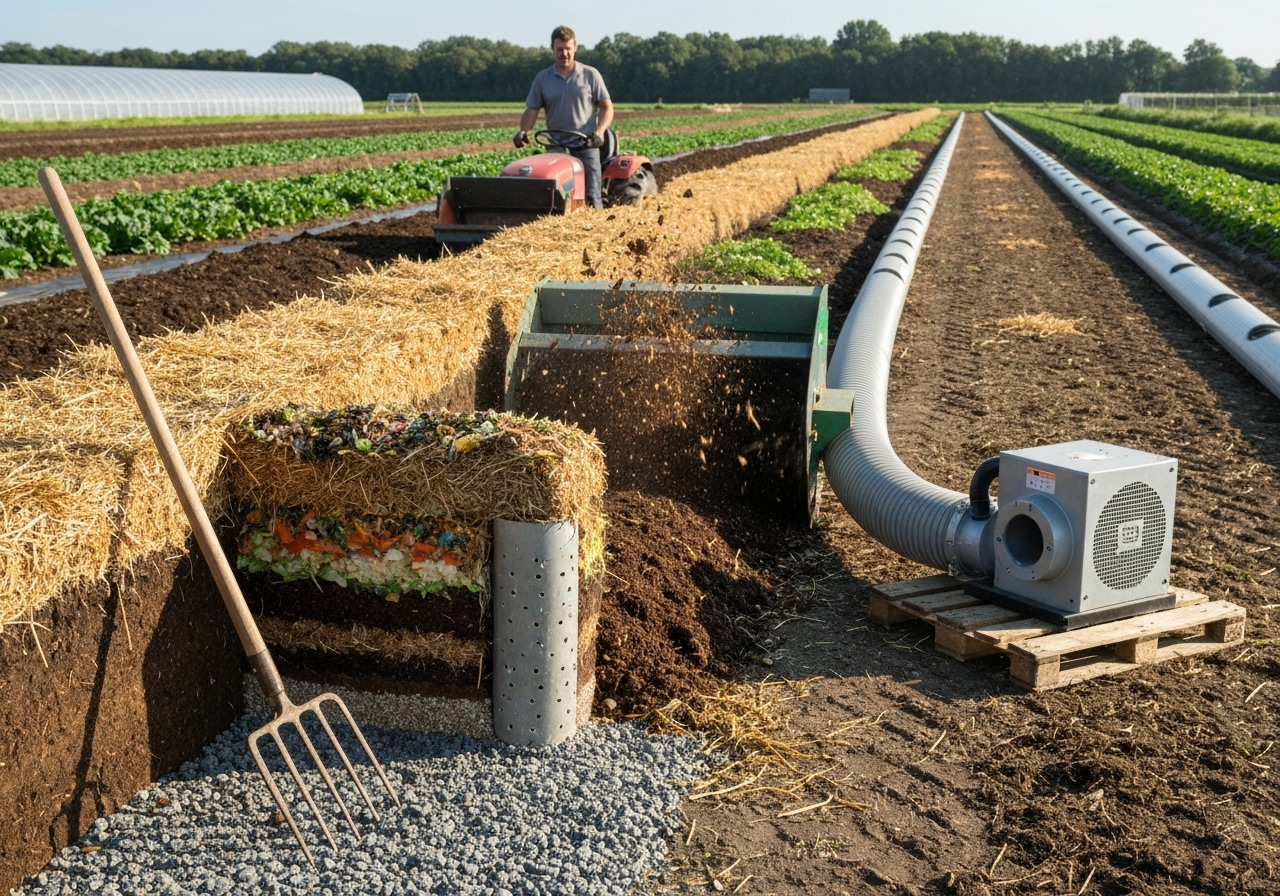
Choose aeration based on scale and budget:
- Forced aeration with blowers and perforated piping for high-control, low-turning systems on medium to large farms.
- Passive aeration with wick channels and coarse bulking material for low-cost, lower-control systems on small farms.
- Intermittent turning combined with surface aeration for farms with limited equipment.
What temperature and turning regime promotes safe maturation?
The aerated windrow stage promotes microbial succession and pathogen reduction. Maintain thermophilic temperatures of 55 to 65 C for at least 3 consecutive days for pathogen control, then allow a gradual cool-down. Monitor temperatures daily using a long-probe thermometer. Turn or adjust aeration when core temperatures exceed 65 C for prolonged periods or fall below 40 C and decomposition slows. Typical turning or aeration adjustments occur every 3 to 10 days during active decomposition and less frequently during curing.
How to manage C:N, moisture, and particle size for vegetable waste in the hybrid system?
Manage C:N, moisture, and particle size by measuring or estimating inputs and adjusting bulking materials. Vegetable waste often has low C:N (10:1 to 20:1) and high moisture (70-90%). Mix with high-carbon bulking agents (wood chips, straw, dry leaves) at 20-60% by volume to achieve 25:1 to 30:1 C:N and 50-60% moisture. Reduce particle size by chopping to 2-5 cm to speed surface-area-driven decomposition but retain some coarse fraction (1-3 cm) to preserve porosity. Use a simple field test for moisture: material that holds together when squeezed but does not drip is in the target range.
What operational steps form a standard workflow for a vegetable farm?
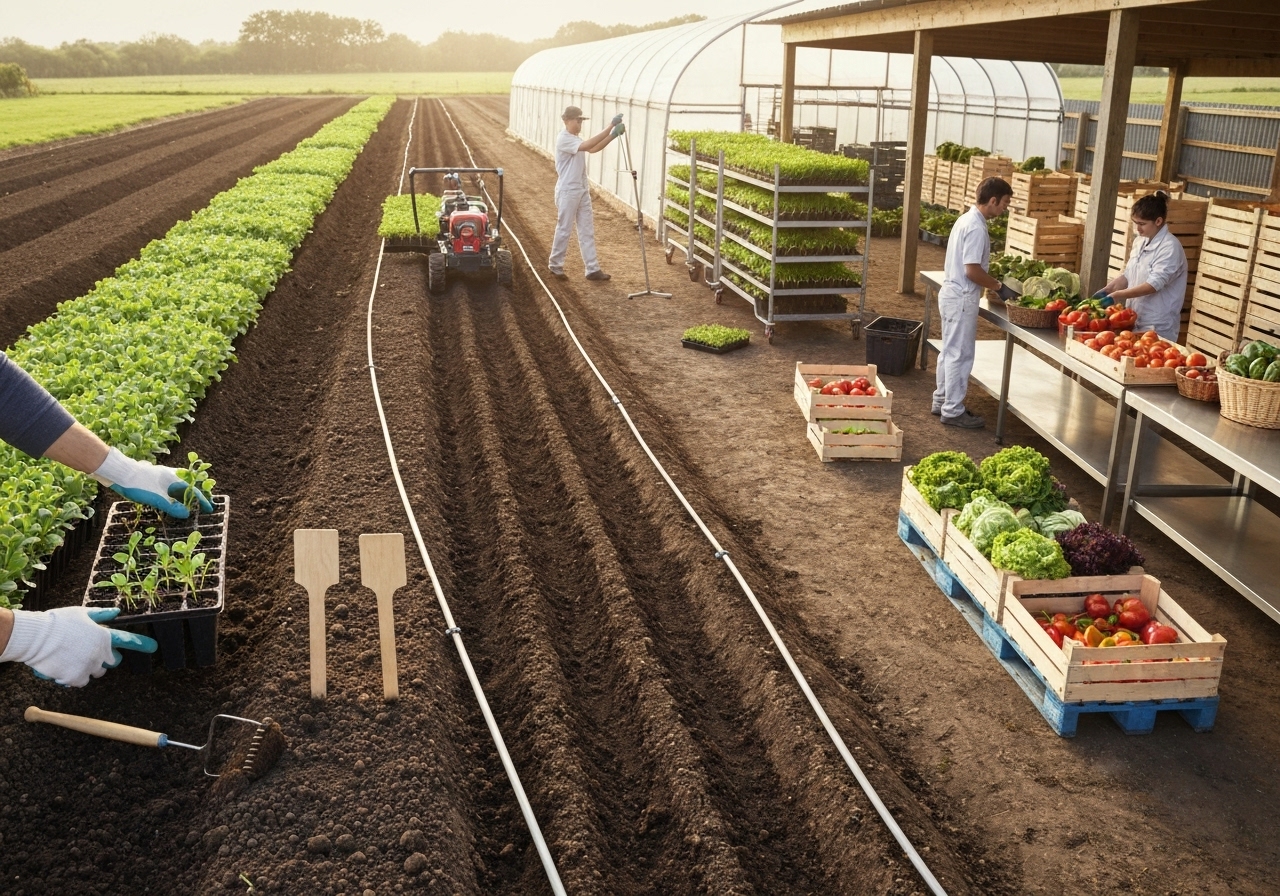
The standard workflow for a farm using the aerated Bokashi-windrow hybrid includes receiving and prepping waste, Bokashi fermentation, blending with bulking agents, aerated windrow placement and monitoring, curing and screening, and field application. Implement daily logs that capture input weights or volumes, inoculant doses, moisture adjustments, temperature readings, turning/aeration events, and final quality checks. Use the log to optimize inoculant rates and bulking ratios over time.
Step-by-step workflow
- Collect and chop vegetable residues; remove contaminants.
- Layer residues and Bokashi inoculant in sealed fermentation bays for 7-21 days.
- Mix fermented material with bulking agents and adjust moisture to 50-60%.
- Place blend into aerated windrows with perforated piping or construct passive channels.
- Monitor temperature and oxygen; adjust aeration and turn as needed.
- Allow 6-12 weeks for active decomposition and 4-12 weeks for curing depending on conditions.
- Screen or age compost; test for maturity and pathogens before field use.
How to test compost maturity and safety for vegetable production?
Test compost maturity and safety using a combination of simple field checks and laboratory analyses. Perform the cress or radish seed germination test to detect phytotoxicity: plant seeds in a 20% compost extract and compare germination and root growth with controls. Measure stability by checking for earthy smell, crumbly texture, and temperatures near ambient. Obtain laboratory tests for electrical conductivity (EC), nitrate and ammonium levels, pathogen indicators (E. coli, Salmonella), and heavy metals if your feedstock includes suspect materials. Follow local regulations for pathogen thresholds when applying compost to vegetable beds.
What are common problems and how to troubleshoot them?
Common problems and solutions include:
- Odor during Bokashi: Check seals and inoculant coverage; add dry bulking material and reduce moisture.
- Excessive leachate: Increase dry bulking ratio or extend Bokashi fermentation time to bind soluble compounds.
- Slow decomposition in windrows: Improve aeration, increase surface area by turning, or adjust C:N with more high-carbon material.
- Temperature spikes above 65 C: Increase aeration or reduce windrow size to prevent heat damage to beneficial microbes.
- Incomplete pathogen kill: Ensure sustained thermophilic temperatures and consider longer curing or additional pasteurization steps.
How to integrate the hybrid compost into vegetable farm nutrient management?
Integrate the hybrid compost into nutrient management by aligning application rates with crop nutrient removal, soil tests, and carbon-building goals. Test compost nutrient content and calculate nitrogen availability: assume 10-30% of total nitrogen is mineralized in the first season depending on maturity. Apply compost as a pre-plant incorporation to improve soil organic matter, structure, and water-holding capacity. Use compost tea or liquid extracts from mature compost for foliar or transplant starter applications, following best-practice extraction methods to avoid pathogen spread.
What application rates make sense for vegetables?
Apply mature compost at 5-20 t/ha (dry weight) depending on soil organic matter targets and crop requirements. Use lower rates (2-5 t/ha) as a supplemental amendment in high-input systems and higher rates (10-20 t/ha) to rebuild degraded soils. Combine compost with targeted mineral or organic fertilizers to match crop nutrient demands without over-applying phosphorus or salt from high-EC composts.
How does this hybrid support regenerative farm goals and revenue streams?
The hybrid system supports regenerative goals by increasing on-farm nutrient recycling, building soil carbon, reducing off-farm waste disposal costs, and creating a value-added product. Mature compost raises soil organic matter and can enhance yields and water retention. Documented soil carbon gains from compost applications contribute to carbon accounting and may qualify for soil carbon credit programs when validated by proper measurement protocols. For small farms seeking diverse revenue, selling screened compost or using it to reduce purchased fertilizers can improve margins.
Link the composting strategy to broader regenerative systems such as micro-irrigation integration for improved water use efficiency that optimizes irrigation scheduling and soil carbon initiatives to monetize soil improvements through emerging carbon markets.
What equipment and infrastructure does a farm need?
Equip the farm with basic tools for an effective hybrid system: a chopping or shredding device, sealed fermentation bays or drums, breathable tarps, bulking material storage, perforated aeration piping and blower(s) or passive channel materials, long-probe thermometers, moisture meters, and screening equipment for finished compost. Scale equipment choices to volumes and budget; small farms can use low-tech bins and hand-turning, while medium operations benefit from forced aeration and mechanized turning.
How to measure performance and economics of the hybrid system?
Measure performance through metrics such as mass reduction, processing time, nutrient preservation, pathogen indicators, and compost quality (C:N, stability, EC). Track costs for labor, inoculant, bulking materials, equipment amortization, and energy for aeration. Compare against avoided costs of waste hauling and potential revenue from compost sales or improved yields. Run simple payback calculations using baseline waste disposal costs and expected savings or income from compost use.
What practical tips reduce risk and increase success?
Reduce risk and increase success by implementing these practical tips:
- Start with a pilot: process a small, representative batch to refine inoculant rates and bulking mixes before scaling.
- Keep records: log inputs, temperatures, and actions to tune the system for local conditions.
- Source consistent bulking materials: irregular carbon sources produce variable results.
- Train staff on odor control and pathogen-hygiene practices to protect produce safety.
- Test finished compost regularly to maintain quality for vegetable use or sale.
What are alternatives and complementary practices to the hybrid approach?
Consider alternatives and complements such as on-farm anaerobic digesters for biogas production, vermicomposting for high-value, fine-stable compost, and distributed small-batch hot composting for rapid pathogen kill. Combine composting with other regenerative practices like cover cropping, agroforestry, and microclimate management to maximize soil health benefits across the farm. See approaches for integrating compost outputs with irrigation and micro-farm networks to close nutrient loops and scale impact.
How to start implementing an aerated Bokashi-windrow hybrid on your vegetable farm?
Start implementation by assessing your annual vegetable waste volume and moisture profile. Create a pilot plan that includes a 2-4 week Bokashi fermentation test and a 2-3 month windrow trial. Source an EM product and a reliable bulking material supplier. Set up monitoring protocols and safety procedures for handling and testing. Scale incrementally and use field trials to measure crop responses and soil improvements.
Where to find further technical guidance?
Find further guidance from agricultural extension services, composting technical manuals, and peer farms. Engage local university extension programs for lab testing and pathogen advice. Explore regenerative farm networks for case studies and technical assistance on integrating compost with microclimate and irrigation systems.
This practical design blends rapid initial stabilization through Bokashi fermentation with the robustness of aerated windrow decomposition, giving vegetable farms a scalable, lower-odor, and nutrient-conserving path to recycle residues into productive soil amendments.


