
AI-guided pollinator corridors for regenerative farms
What are AI-guided pollinator corridors for regenerative farms?
AI-guided pollinator corridors are planned strips of habitat on regenerative farms that use artificial intelligence to map, design, monitor, and adaptively manage nectar, pollen, and nesting resources for wild pollinators.
AI-guided pollinator corridors combine ecological design, remote sensing, on‑farm sensors, and machine learning to create continuous, species-appropriate pathways that connect remnant habitat patches across working lands.
Why do regenerative farms need pollinator corridors?
Regenerative farms need pollinator corridors because they increase pollinator abundance, stabilize pollination services, and support biodiversity that underpins soil health, pest control, and crop yields.
Regenerative farms prioritise soil, water, and biodiversity; corridors extend those benefits by restoring pollination networks, reducing pollination deficits and buffering climate-driven phenology shifts.
How does AI guide corridor design and placement?
AI guides corridor design and placement by integrating multi-source data to predict pollinator movement, identify high-value connectivity nodes, and optimise planting mixes and schedules for local species.
AI-driven workflows typically follow three steps:
- Assess: Use satellite imagery, drone maps, and field sensors to map land use, floral resources, nesting sites, and microclimates.
- Model: Run species-distribution and movement models to find likely routes, pinch points, and resource gaps.
- Optimise: Use optimisation algorithms and scenario analysis to select corridor routes, widths, and plant palettes that maximise pollinator visits per dollar.
What sensors and data sources feed the AI?

What sensors and data sources feed the AI are remote imagery, microclimate stations, acoustic detectors, camera traps, citizen observations, soil and floral sampling, and farm management records.
Key data inputs include:
- Multispectral drone or satellite imagery for floral cover and phenology.
- LiDAR for structural habitat complexity and hedgerow height.
- Microclimate sensors for temperature, humidity, and wind that influence flight activity.
- Acoustic and image recognition devices for species detection and abundance trends.
- eDNA and pollen metabarcoding for diet and floral-use information; see soil microbiome mapping for examples of on-farm molecular monitoring workflows that adapt to small-scale operations.
Which AI models are used?
Which AI models are used include species distribution models, convolutional neural networks for imagery, acoustic classifiers, time-series models for phenology, and reinforcement learning for placement optimization.
Model types and roles:
- MaxEnt or Random Forest for habitat suitability.
- CNNs for camera and drone image classification of insects and floral cover.
- Acoustic deep learning models to detect bee buzz frequencies and bird activity.
- LSTM and other time-series models to forecast bloom windows and pollinator emergence.
- Genetic algorithms or mixed-integer programming for cost-constrained corridor layout.
What are best-practice corridor designs (width, planting palette, structure)?
Best-practice corridor designs use layered vegetation (groundcover, herbaceous flowers, shrubs, and trees), variable widths 3–30 m depending on context, and nesting structures to support multiple pollinator guilds.
Design principles:
- Layer resources: Include early-, mid- and late-season bloomers across 3 vertical strata.
- Provide nesting: Bare ground patches, woody stems, tussock grasses, and beetle galleries.
- Ensure continuity: Create temporal bloom overlap to avoid resource gaps.
- Landscape context: Broaden corridors near large fields and narrow through hedgerows; increase width near nesting hotspots.
- Edge management: Maintain 2–5 m buffer zones from pesticide application areas.
How to choose plants and flowering schedules?

How to choose plants and flowering schedules means selecting native species with staggered bloom periods that match local pollinator phenology and provide nectar, pollen, and nesting materials.
Follow this plant selection workflow:
- Survey local native flora and existing remnant patches.
- Rank species by bloom period, nectar/pollen value, and structural role (groundcover, shrub, tree).
- Create a 6–12 month bloom calendar ensuring at least 70% floral resource continuity.
- Prioritise 10–20 species on small farms; scale mixes on larger properties.
- Test mixes in 10–50 m pilot strips before scaling.
How to integrate corridors into farm operations and machinery?
Integrate corridors by aligning them with field margins, headlands, riparian buffers, and rotational grazing lanes so machinery access and farm operations remain efficient.
Integration tactics:
- Place corridors on less productive margins (headlands, odd-shaped corners) to maximise opportunity cost benefits.
- Align corridors with access roads to reduce machinery detours and create permanent protection zones.
- Incorporate corridors into grazing rotations to provide forage and trampling control using practices described in smart pasture management.
- Create foldable or removable protection around young plantings to permit equipment during establishment.
What are monitoring and adaptive management workflows?
Monitoring and adaptive management workflows use automated detection, periodic ground surveys, and AI-driven alerts to trigger management actions such as reseeding, invasive removal, or pesticide buffer enforcement.
Practical workflow:
- Install low-cost cameras and acoustic sensors at 3–5 sites within the corridor.
- Run automated daily classification to track visitation rates and species lists.
- Set thresholds (e.g., 20% decline in visits over 30 days) that trigger alerts and field inspections.
- Use seasonal AI forecasts to adjust flowering mixes and transplant schedules.
- Log management actions and outcomes to improve model predictions over time.
How to measure corridor success and pollinator health?
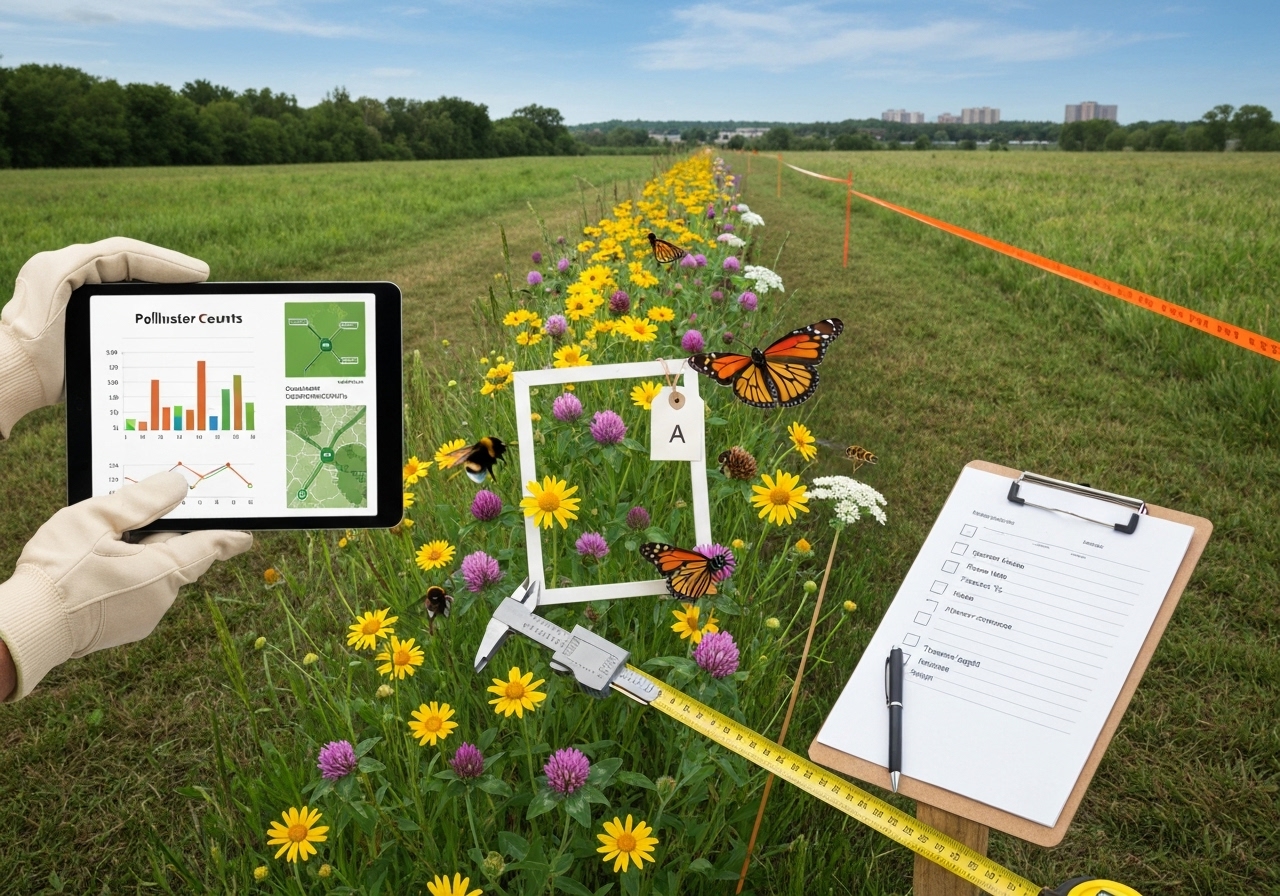
How to measure corridor success and pollinator health requires species richness, visitation frequency, nesting density, pollination service measures (fruit set), and genetic diversity metrics from pollen or eDNA samples.
Success indicators and methods:
- Visitation monitoring: Timed transect counts and automated camera logs.
- Species richness: Periodic netting or image-acoustic tallies validated by experts.
- Nesting density: Visual nest counts, trap-nests for cavity nesters, and soil nest surveys for ground-nesters.
- Pollination service: Paired exclusion experiments (bagging/unbagging) to estimate fruit set contribution.
- Genetic and diet analysis: Pollen metabarcoding to confirm floral use and habitat links.
What are costs, funding, and ROI for farmers?
Costs, funding, and ROI for farmers vary by scale: initial establishment ranges from $200 to $5,000 per hectare depending on seed mix, labour, and infrastructure; long-term returns arise from yield improvements, reduced input use, and available conservation funding.
Cost and funding considerations:
- Estimate establishment costs: $200–$1,200/ha for seed mixes and site prep on small projects; planting shrubs/trees raises costs to $2,000–$5,000/ha.
- Expect maintenance costs: $50–$200/ha annually for weed control and reseeding during first 3 years.
- Recover benefits: Improved pollination can increase crop yields by 5–30% depending on crop dependence.
- Funding sources: Government conservation grants, agri-environment schemes, carbon or biodiversity credits, and cost-share programs.
- Calculate ROI: Use a 3–7 year horizon; include non-marketable benefits (pest suppression, soil health) in decision models.
What limitations, risks, and mitigation strategies exist?
Limitations, risks, and mitigation strategies include data gaps, pesticide drift, invasive plants, farmer labour constraints, and potential increases in pest habitat; mitigate by buffer zones, targeted plant lists, and stakeholder coordination.
Common risks and mitigations:
- Pesticide drift: Create 10–20 m pesticide-free buffers and enforce spray windows.
- Invasive plants: Use vetted native-only seed sources and monitor the first 3 years closely.
- Data bias: Combine automated sensing with occasional expert surveys to validate AI outputs.
- Social resistance: Run farmer workshops, participatory mapping, and demonstration strips to build buy-in.
- Non-target pests: Incorporate predators and floral diversity to support natural enemies and avoid monocultures.
How do corridors interact with advanced alternatives like robotic pollinators?
Corridors interact with robotic pollinators by complementing technological interventions: corridors support wild populations, while robotic pollinators temporarily fill service gaps during extreme events.
Integration points:
- Use corridors to maintain background biodiversity and reduce dependency on robotics.
- Deploy robotic pollinators during short-term deficits or in controlled environments; continue habitat restoration for resilience.
- Combine data from robotic monitoring and corridor sensors for richer ecological models; see research direction in robotic pollinators.
How to start an AI-guided corridor project on a small-scale regenerative farm?
How to start an AI-guided corridor project on a small-scale regenerative farm is to map priorities, run a 1–2 ha pilot, use low-cost sensors, and iterate using a clearly defined monitoring plan.
12-step starter checklist:
- Map: Use a free satellite viewer or drone to map field edges, remnant habitat, and crop blocks.
- Prioritise: Identify 1–3 high-impact margins or headlands representing 1–2% of farm area.
- Choose species: Select 10 native plants with staggered bloom; order seed from certified suppliers.
- Design corridor: Choose width (3–10 m) and length based on farm layout and machine access.
- Install sensors: Place 1 camera and 1 microclimate sensor per 200–500 m of corridor; use solar power as needed.
- Deploy AI tools: Start with off-the-shelf image recognition platforms or partner with a local university for model development.
- Pilot: Establish a 50–200 m pilot strip in spring or autumn depending on species.
- Monitor: Run weekly checks in year 1 and automated analyses monthly.
- Adjust: Reseed or replace failing species; add nesting blocks in year 2.
- Scale: Expand to additional margins based on measured benefits.
- Document: Keep a management log and upload sightings to regional citizen science portals to increase dataset value.
- Share: Host farm tours and workshops to build local momentum and access cost-share programs; see community benefits described in farming and country life for community engagement ideas.
What is the long-term vision for AI-guided pollinator corridors?
The long-term vision for AI-guided pollinator corridors is resilient farmscapes where distributed AI coordinates habitat, management, and market incentives to maintain pollination services under climate change.
Vision elements:
- Regional connectivity: Networks of corridors across farms create functional metapopulations for pollinators.
- Data commons: Shared datasets improve models and reduce deployment costs for smallholders.
- Market signals: Biodiversity and pollination credits reward stewardship alongside yield gains.
- Integrated tools: AI connects soil health, pasture management, and pollinator planning—for example integrating soil microbial insights with habitat design to create synergistic benefits.
Conclusion: What is the practical takeaway for farmers?
The practical takeaway for farmers is to start small, measure impact, and use AI as a decision-support tool rather than a black box; combine low-cost monitoring with native plantings to secure pollination services and farm resilience.
Begin with 1–2 pilot corridors, monitor simple metrics (visits per minute, species lists, fruit set), and iterate annually to build benefits and reduce risk. AI-guided pollinator corridors are a pragmatic investment in long-term productivity and ecological health for regenerative farms.
Further reading and resources
Explore related concepts for implementation and farm systems integration:
- Smart pasture management methods for integrating corridors into grazing systems.
- Technical papers on species distribution modelling and landscape connectivity (lookup regional conservation journals for local guidance).
- Practical seed-mix suppliers and native plant nurseries; consult local extension services for provenance-appropriate species.


