
Designing On-Farm Microbial Consortia to Enrich Soil
Designing on-farm microbial consortia gives small farms a practical path to richer soil biology, improved nutrient cycling, reduced input costs, and greater crop resilience. This guide explains what microbial consortia are, why they matter for soil fertility, and how to design, culture, test, apply, and monitor low-cost consortia at farm scale while integrating regenerative practices.
What are on-farm microbial consortia and why design them?
Microbial consortia are communities of bacteria, fungi, and other microbes that work together to support soil fertility and crop health.
Microbial consortia improve nutrient availability, enhance soil structure, suppress pathogens, and increase plant stress tolerance (according to a 202 review in Frontiers in Microbiology). Designing consortia on-farm lets farmers tailor microbial blends to soil type, crops, and climate while reducing dependence on off-farm chemical inputs.
How do microbial consortia improve soil fertility?
Microbial consortia enhance fertility through multiple complementary mechanisms.
- Fix atmospheric nitrogen using diazotrophs, increasing plant-available N (evidence in Nature Reviews Microbiology reviews).
- Mobilize phosphorus through phosphate-solubilizing bacteria and mycorrhizal fungi, improving P uptake.
- Mineralize organic matter via saprophytic microbes, releasing N, P, and S.
- Produce plant growth promoting compounds such as auxins, cytokinins, and ACC deaminase.
- Aggregate soil by producing extracellular polysaccharides, improving porosity and water retention.
- Suppress pathogens through competition, antibiosis, and induced systemic resistance.
What baseline soil tests are needed before designing consortia?
Baseline soil tests define constraints and targets for designing microbial consortia.
Collect these baseline data: 1) standard soil chemistry (pH, P, K, Ca, Mg, organic matter), 2) soil texture and bulk density, 3) soil respiration or microbial biomass estimates, and 4) simple pathogen presence if disease is a concern. Use a lab or on-farm tests like electrical conductivity probes and compost tea aeration metrics. The USDA Natural Resources Conservation Service provides guidance on basic soil testing protocols.
Which microbial functional groups should small farms include?
Include functional groups that address local limiting factors in soil fertility.
Common functional groups and roles:
- Nitrogen fixers (rhizobia for legumes; free-living diazotrophs such as Azotobacter).
- Phosphate solubilizers (Pseudomonas, Bacillus, Penicillium species).
- Mycorrhizal fungi (arbuscular mycorrhizal fungi for most crops; ectomycorrhizae for trees).
- Decomposers (Trichoderma, Bacillus, cellulolytic fungi) to speed organic matter turnover.
- Biocontrol agents (Bacillus subtilis, Trichoderma harzianum) to reduce disease pressure.
- Plant growth-promoting rhizobacteria (PGPR) producing hormones and stress-relief enzymes.
How do you source microbes for on-farm consortia?
Source microbes from reliable suppliers, on-farm isolates, and ecological transplants based on safety and local relevance.
Use three sourcing strategies: 1) purchase characterized isolates or mixed inoculants from certified suppliers and research institutions, 2) isolate beneficial microbes from thriving local soils or compost using simple culturing, and 3) use ecological transplants like compost, mature vermicompost, or rhizosphere extracts that contain complex communities. Cite research from university extension services when using commercial inoculants to compare efficacy.
Can farmers culture microbes on-farm and what equipment is required?
Yes, farmers can culture many beneficial microbes on-farm using low-cost equipment and safe protocols.
Required materials and steps:
- Materials: clean containers, air filters, a small incubator or warm sheltered area, nutrient media recipes, sterile water, and simple measuring tools.
- Methods: prepare a low-cost growth medium (for bacteria: sugar+yeast extract+minimal salts; for fungi: grain-based spawn for AMF-friendly saprophytes), inoculate with source material, maintain aeration and temperature, and dilute to desired application rates.
- Safety: practice hygiene, avoid culturing unknown pathogens, and seek extension support for isolation of unknown cultures.
What simple starter recipes work for on-farm microbial cocktails?

Use starter recipes that create diverse, active communities suited to application method and crop needs.
Three practical starter recipes:
- Compost tea: brew 1:10 to 1:20 compost-to-water with aeration for 12 to 24 hours at 18-25 C, using molasses (.5-1 g per liter) for bacterial-dominant tea; use kelp or fish hydrolysate for fungal-promoting teas. Monitor odor and oxygenation to avoid anaerobic conditions (per extension guidance).
- Liquid mixed inoculant: combine dilute suspensions of nitrogen fixing bacteria, phosphate solubilizers, and PGPR to 10^6-10^8 CFU/ml prior to seed or soil application. Mix immediately before use and keep cool.
- Carrier-based granular: blend peat, biochar, or vermiculite with concentrated inoculum and dry to 10-20% moisture for seed coating or banded soil placement.
How should microbial consortia be applied on small farms?
Apply consortia using seed coatings, soil drenches, transplant dips, or banded granules depending on crop and life stage.
Application methods and guidance:
- Seed coatings: apply carrier-based inoculum to seed using adhesive binders (e.g., methyl cellulose), aiming for 10^4-10^6 CFU per seed. Seed coatings fit low-seed-rate crops and save on inoculant volume.
- Soil drenches and compost tea: apply 100-500 liters per hectare for field crops, focusing on root zones during early growth stages. Use calm morning hours and irrigate lightly after application when needed.
- Transplant dips: dip roots in microbial suspension (10^6 CFU/ml) for 5-30 minutes before planting to ensure rhizosphere colonization.
- Banded granules: place granular carriers near the seed row for longer persistence where repeated liquid application is difficult.
How do you integrate microbial consortia with regenerative practices?
Integrate microbial consortia with cover cropping, reduced tillage, organic amendments, and agroforestry to amplify benefits.
Integration steps:
- Cover crops: plant legumes to partner with nitrogen-fixing microbes and grasses to build fungal networks.
- Reduced tillage: minimize disturbance to preserve hyphal networks and microbial structure.
- Organic matter inputs: apply compost, composted manure, and biochar as carriers and substrates for consortia activity.
- Polyculture and agroforestry: create root diversity to support microbial biodiversity; see strategies in regenerative agroforestry approaches.
How do you monitor microbial consortia success on-farm?
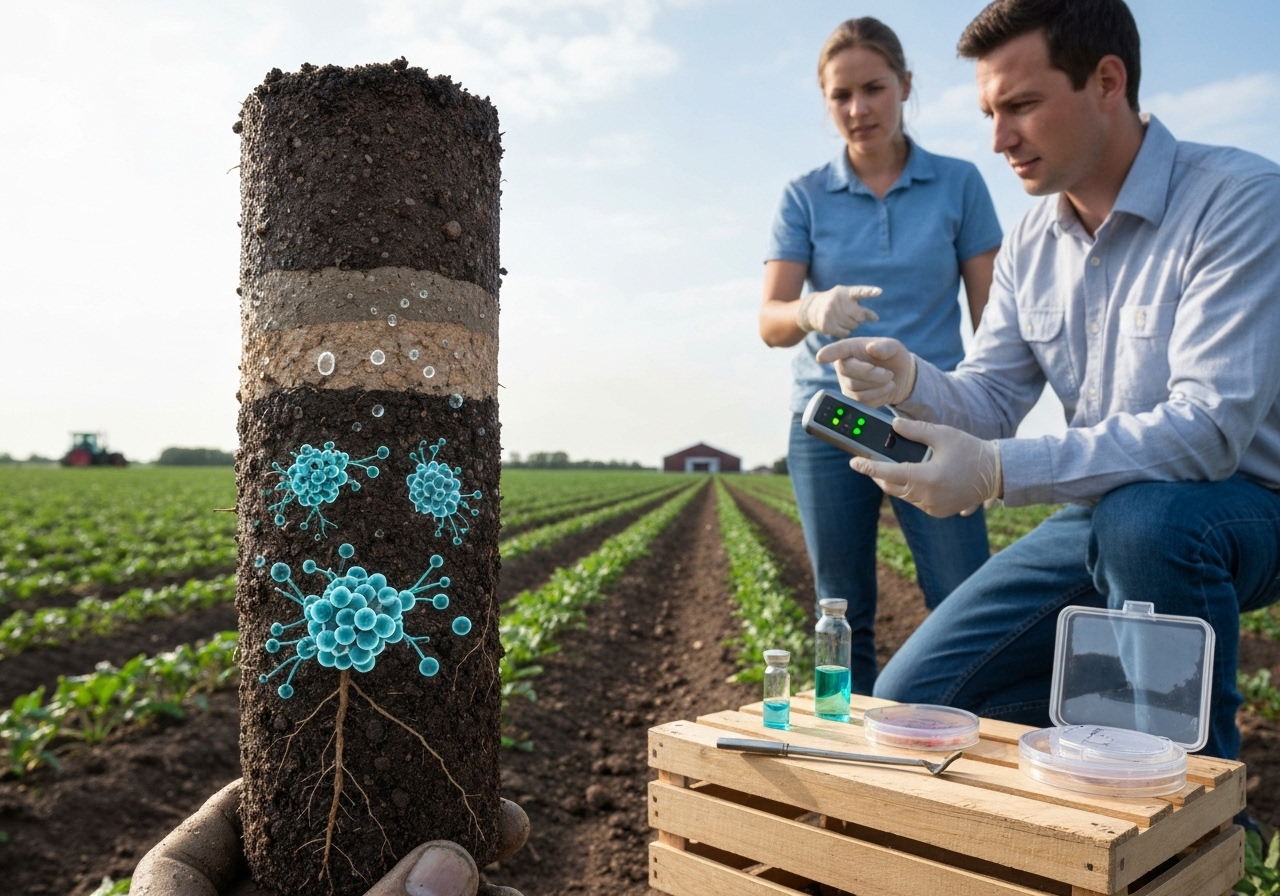
Monitor consortia success using soil chemical, biological, and plant performance indicators.
Key monitoring metrics:
- Soil chemistry: pH, available P and K, and nitrate/ammonium trends using periodic lab tests.
- Soil biology: soil respiration rate, microbial biomass carbon (fumigation-extraction where available), and simple enzyme assays (phosphatase, dehydrogenase).
- Plant metrics: emergence rate, vigor scores, leaf color indices, and yield per unit area.
- Targeted microbiome assays: 16S and ITS sequencing can track community shifts when funded; partner with university labs or services for periodic snapshots.
Combine low-cost sensors and labor-light protocols. Use insights from sensor-guided monitoring to integrate real-time data when possible.
What are common pitfalls and how to troubleshoot consortia on small farms?
Common pitfalls include poor colonization, contamination, and mismatch between microbe function and field constraints.
Troubleshooting steps:
- Poor colonization: improve carrier quality, increase inoculum density, apply during cooler periods, and avoid applying after heavy chemical sprays.
- Contamination: discard cultures showing foul odors or slimy films; adopt sterilization and aseptic handling for liquid cultures.
- Mismatched function: revisit baseline soil tests and replace or augment the consortium with microbes targeting limiting nutrients or stresses.
Are there regulatory or safety considerations?
Yes, follow local regulations on introducing microbial products and avoid culturing potential pathogens on-farm.
Safety and compliance guidance:
- Check national and regional agricultural agencies for rules on biofertilizers and microbial releases.
- Prefer locally sourced or well-characterized strains with documented safety records.
- Use personal protective equipment during culturing and application, and label stored inoculants clearly.
How do you design experiments to test consortia effectiveness?

Design randomized, replicated trials with clear controls to measure effect size and economic value.
Experimental design steps:
- Set up randomized plots with n=3 or more replicates per treatment across representative field zones.
- Include controls: untreated, single-strain inoculant, and full consortium to separate interactions.
- Measure soil and plant metrics at baseline, mid-season, and at harvest to capture trajectories.
- Analyze results with simple statistics (ANOVA) or nonparametric tests if sample sizes are small. Document management history for repeatability.
What are low-cost quality control checks for on-farm cultures?
Use simple visual, olfactory, and plate-based checks to assess culture health and purity.
Quality control methods:
- Visual: check for turbidity and consistent color changes in liquid cultures.
- Olfactory: healthy bacterial cultures smell fresh or yeasty; foul odors indicate anaerobic spoilage or contamination.
- Simple plating: streak a small sample on general agar to observe colony types and estimate contamination.
- CFU estimates: perform serial dilutions and plate counts if resources permit to quantify viable cells.
How much do on-farm consortia programs cost and what is the ROI?
Costs vary by scale, equipment, and monitoring depth; ROI stems from reduced fertilizer inputs, higher yields, and improved resilience.
Cost factors and ROI considerations:
- Initial costs: low-cost incubators, carriers, and starter cultures range from a few hundred to a few thousand dollars depending on scale.
- Recurring costs: carrier materials, molasses, and minimal lab supplies.
- Benefits: decreased fertilizer purchases, higher nutrient use efficiency, improved yields, and potential premium for regenerative products. Studies on soil microbial interventions report variable yield responses from 5 to 30 percent depending on conditions.
- Leverage carbon markets: increased soil carbon from improved biology may create opportunities in programs described in soil carbon credit initiatives.
What case studies and field reports show success with microbial consortia?
Case studies show improved yield, nutrient use efficiency, and salinity mitigation with targeted consortia.
Examples and references:
- Field trials with multi-strain PGPR consortia reported yield gains in vegetables and cereals when paired with organic amendments (university extension publications).
- Saline field rehabilitation trials using microbial seed coatings improved germination and early growth in arid climates (research reported in Applied Soil Ecology and operationalized in projects described in microbial seed coatings for saline fields).
- On-farm records combining consortia with cover crops and reduced tillage demonstrate lasting increases in soil respiration and aggregate stability over 3 to 5 years.
Can microbial consortia help urban and rooftop farms?
Yes, microbial consortia support soil and substrate fertility in urban farms and rooftop systems when tailored to container media.
Urban-specific tips:
- Use lighter carriers such as biochar and coco coir blends for rooftop weight limits.
- Combine inoculants with tailored fertigation schedules to avoid salt buildup in closed systems; see compatible strategies in regenerative micro-irrigation for rooftops.
- Prioritize mycorrhizal fungi for tree crops in containers and PGPR for leafy greens to maximize nutrient use efficiency.
How do you evolve consortia season to season?
Evolve consortia iteratively by tracking performance, swapping strains, and enriching successful local strains.
Iteration steps:
- Document performance year-to-year and identify consistent winners.
- Enrich locally successful strains by selective culturing from the rhizosphere of top-performing plants.
- Rotate functional emphasis seasonally: emphasize P-solubilizers during early root growth and decomposers post-harvest for residue breakdown.
What future tools improve on-farm consortia design?
Emerging tools such as low-cost sequencing, AI microbiome mapping, and sensor networks support precision community design.
Tools to watch:
- Portable sequencing and partner lab services for periodic community profiling; see advances in AI soil microbiome mapping.
- Soil sensors that combine moisture, temperature, and redox to time applications for microbial survival.
- Decision-support platforms that recommend consortia based on soil tests, crop, and climate.
What practical first steps should a small farmer take this season?
Begin with simple, low-risk actions: test soil, add quality compost, trial a compost tea or commercially trusted inoculant, and monitor results.
Action plan for the season:
- Test soil chemistry and respiration to set targets.
- Apply mature compost at 5-20 tonnes per hectare to provide a microbial carrier and substrate.
- Run a small pilot: compare control, compost tea, and a simple microbial consortium on replicated beds.
- Record plant emergence, vigor, and yield; iterate based on data.
Useful resources and reading
Consult extension publications, university protocols on inoculant handling, and the FAO and USDA guidance on biofertilizers. Read synthesis articles in Frontiers in Microbiology and Applied Soil Ecology for evidence-based protocols and safety considerations.
Designing on-farm microbial consortia is a practical, adaptive strategy for small farms to rebuild soil fertility. By combining sound baseline testing, careful sourcing, simple culturing, targeted application, and integration with regenerative practices, farmers can create resilient soils that support steady yields and lower input costs.


