
Best gravity-fed microdrip systems for small potato farms
Best gravity-fed microdrip systems for small potato farms: This guide explains gravity-fed microdrip design, component selection, pressure and flow calculations, emitter types, installation, maintenance, fertigation options, cost estimates, and crop-specific scheduling for potatoes.
What are gravity-fed microdrip systems and why choose them for small potato farms?
What are gravity-fed microdrip systems? Gravity-fed microdrip systems deliver water by gravity from an elevated reservoir to low-flow emitters along rows.
Why choose them for potatoes? Gravity-fed systems cost less, require no pumps, reduce fuel and electricity needs, and provide gentle, localized soil moisture suited to potato tuber development.
Why potatoes benefit: Potatoes need consistent soil moisture during tuber bulking. Microdrip minimizes surface wetting and limits disease pressure compared with overhead irrigation.
Which small farms are best suited? Farms under 5 hectares with reliable water sources and gentle slopes benefit most.
What are the main components of a gravity-fed microdrip system?
What are the main components? A gravity-fed microdrip system includes an elevated water tank, inlet filter, mainline, pressure regulator or orifice, lateral lines, emitters, fittings, and end caps.
Which tank options work? Use plastic IBC tanks, polyethylene cisterns, or small concrete reservoirs elevated on stands or terraces to provide head.
Which filters are required? Use screen filters (120-200 mesh) and disc filters to protect emitters from sand and biofilm growth.
Which emitters are used? Use low-flow inline drippers, pressure-compensating drippers, or spaghetti tubing with 1-4 L/h emitters depending on required flow.
How much head and pressure does a gravity-fed microdrip system need?
How much head is required? Desired pressure depends on emitter type. Many microdrippers need 10-30 kPa. 1 meter of water head gives about 9.81 kPa.
How to calculate head: Multiply reservoir height in meters by 9.81 to get kPa. For bar, divide kPa by 100.
What reservoir heights are typical? Raise tanks 2-4 meters for 20-40 kPa (.2-.4 bar). Use higher elevation for longer lateral runs.
When to use pressure regulators: Use a simple orifice plate or low-cost regulator when head exceeds emitter optimal range to avoid emitter blowouts.
Which emitter types work best for gravity-fed potato irrigation?
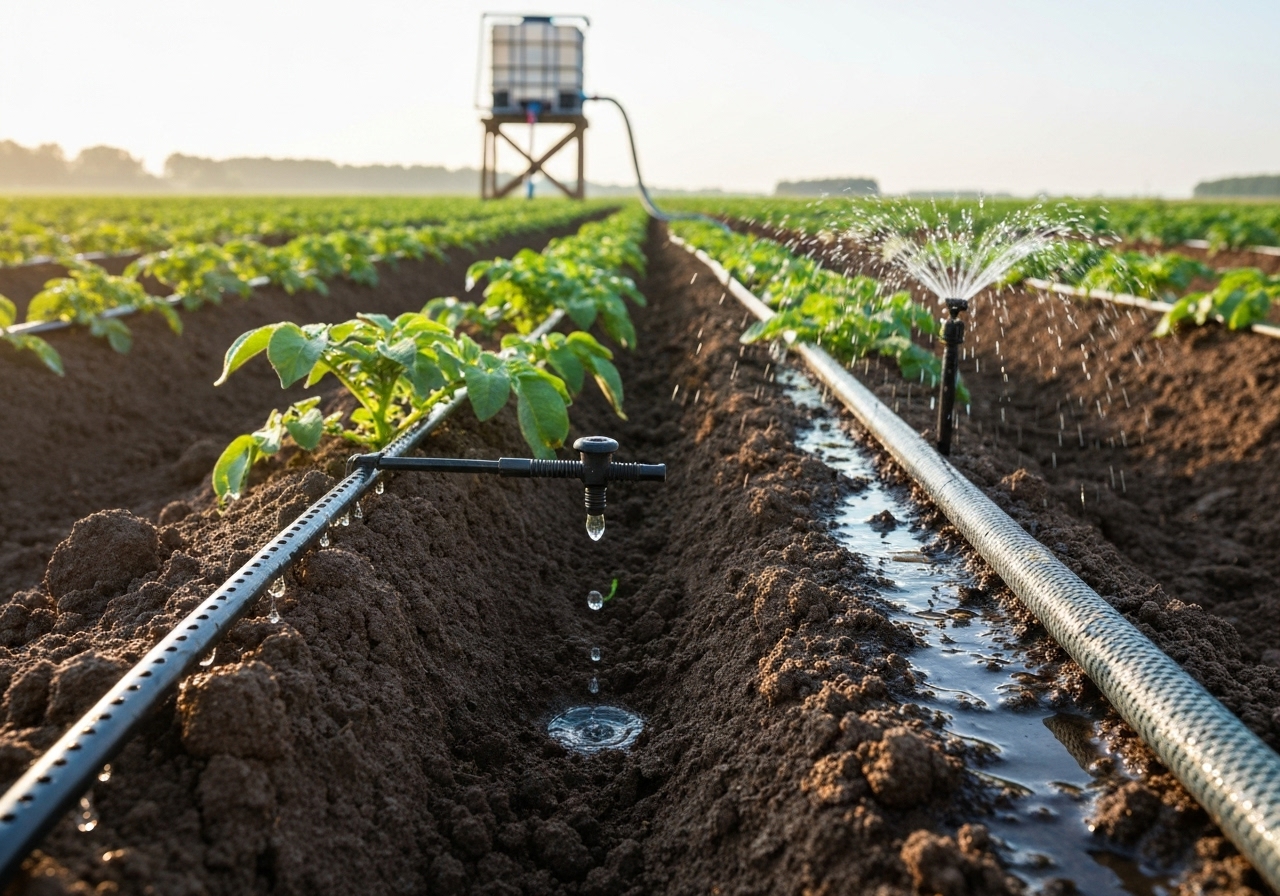
Which emitter types suit gravity systems? Use emitters with low operating pressure like .02-.4 bar. Choose one of these options:
- Inline pressure-compensating drippers at 1-4 L/h per emitter for even flow across slopes.
- Non-compensating inline drippers at 2-8 L/h for very uniform fields and short laterals.
- Spaghetti tubing with point emitters at .5-2 L/h for flexible localized wetting.
- Drip tape with integrated emitters when shallow subsurface wetting is acceptable.
Which emitter to prefer for potatoes? Choose pressure-compensating drippers or spaghetti tubing with small emitters for row spacing and tuber depth control.
How to size lateral lines, flow, and run lengths for a small potato plot?
How to size laterals? Size laterals by target crop application rate, emitter flow, and row length. Calculate total emitters per lateral and desired application depth.
Which steps to follow:
- Define crop water use. Potatoes often need 4-7 mm per day during peak growth (source: FAO and regional irrigation guides).
- Choose emitter flow. Use 2 L/h emitters for moderate flow and uniformity.
- Calculate irrigation duration: Required volume per plant divided by emitter flow gives hours per cycle.
- Limit lateral length to maintain uniformity: 50-100 meters for low-pressure gravity systems depending on pipe diameter and head.
How to estimate peak flow: Multiply emitter flow by number of emitters operating simultaneously on the system.
What filtration and anti-siphon measures are necessary?
What filtration is necessary? Install a primary sediment filter (mesh 120-200) and a secondary disc filter for fine particles and biofilm control.
Why anti-siphon devices are important? Use vacuum breakers or air vents to prevent backflow when using fertiliser tanks or non-potable sources.
How to maintain filters? Backflush or clean filters weekly during irrigation season. Replace filter elements per manufacturer guidance or when flow decreases.
How to layout emitters and schedule irrigation for potatoes?
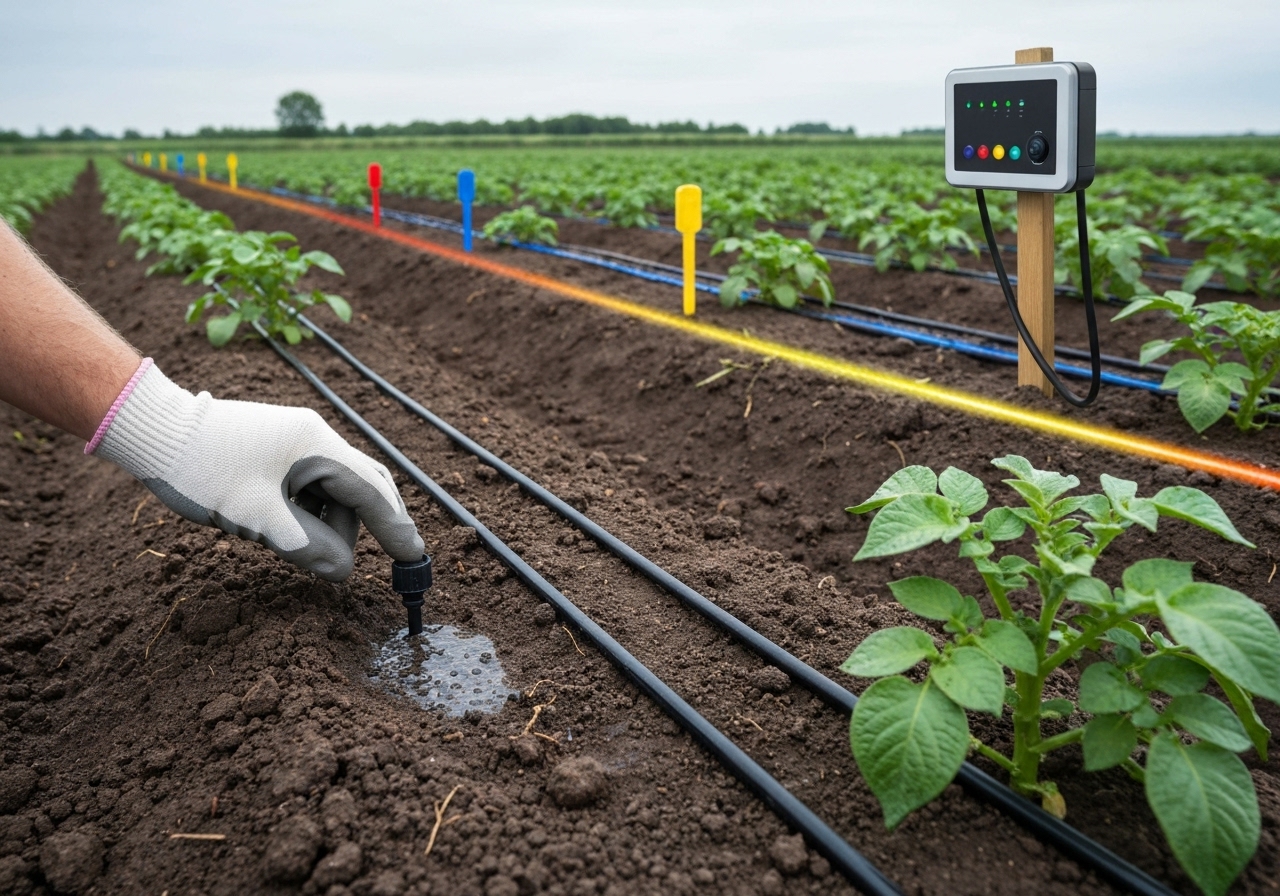
How to layout emitters? Place emitters 10-30 cm from each plant row and 20-30 cm between emitters along rows to concentrate moisture in the root zone.
How to schedule irrigation? Increase frequency and reduce duration during tuber initiation and bulking. Target soil moisture of 60-80 percent of field capacity in the root zone.
Which scheduling tools help? Use tensiometers or low-cost soil moisture probes to trigger irrigation. Consider simple calendars based on degree-days and rainfall.
How to integrate fertigation and microbial inoculants safely?
How to apply fertilizer through gravity-fed systems? Use venturi injectors or proportioners designed for low pressure. Maintain secondary tanks above injectors to prevent contamination.
Which fertilizers work best? Use soluble fertilizers and adjust concentrations to avoid emitter clogging.
How to add microbial consortia? Add microbial seed coatings or soil inoculants through fertigation only after compatibility testing and using inline filters to protect emitters.
What agronomic caution applies? Follow guidance from on-farm microbial consortia research for soil health compatibility, similar to practices in Designing On-Farm Microbial Consortia to Enrich Soil.
What are the common installation steps?
What are the installation steps? Follow this sequence for reliable setup:
- Install and level the tank stand and secure the reservoir.
- Fit a screened inlet and shutoff valve to the tank outlet.
- Install primary filter, pressure regulation or orifice, and mainline.
- Lay lateral lines along rows and attach emitters or spaghetti tubing at desired spacing.
- Flush laterals to purge debris, then cap ends and test for uniformity.
- Record run times and mark emitter positions for maintenance.
Which testing is required? Conduct a single lateral uniformity test by measuring output at emitters across the run and adjust emitter spacing or head accordingly.
How to maintain gravity-fed microdrip systems to prevent clogging and failures?
How to maintain systems? Perform weekly filter checks and monthly lateral flushing during the season.
Which chemical maintenance helps? Use mild acid or chlorine treatments periodically to remove mineral scale and biofilm, following safety and environmental rules.
How to winterize? Drain and store removable components in freezing climates. Seal lines or bury deeper where frost is a risk.
What are typical costs and payback for small potato farm gravity systems?
What are typical upfront costs? Expect tank and stand: $200-1,200; filtration and fittings: $100-600; lateral tubing and emitters: $300-2,000 depending on area and emitter density.
What are operating costs? Operating costs are minimal without pumps: mainly maintenance filters, replacement emitters, and occasional chemicals.
How to estimate payback? Compare to tanker or overhead irrigation. Savings on fuel and labor often payback within 1-3 seasons for small, intensive potato enterprises.
Which design variations improve performance in sloped or uneven terrain?
What to change on slopes? Use multiple smaller reservoirs at contour benches to provide consistent head across zones.
How to handle pressure variation? Install simple pressure-compensating emitters or inline orifices at lateral inlets to equalize flow.
Which layout works on steep land? Emphasize shorter laterals and multiple manifolds to limit hydraulic variability.
Which environmental and crop-health benefits follow from microdrip use on potatoes?
Which environmental benefits apply? Microdrip reduces runoff, lowers evaporation losses, and saves water relative to furrow or sprinkler systems (FAO irrigation data).
Which crop-health benefits apply? Microdrip reduces leaf wetness, thereby lowering risk of late blight and other foliar diseases common to potatoes.
What tests and performance checks should be done after installation?
What tests to perform? Measure emitter flow uniformity, check pressure at the reservoir outlet, and quantify application depth per cycle.
How to measure emitter uniformity? Capture output from representative emitters for a fixed time and compute coefficient of variation. Aim for CV under 20 percent for reliable systems.
Which suppliers, kits, and DIY options are recommended for small farms?
Which supplier types to consider? Choose from drip irrigation manufacturers, local agricultural suppliers, or DIY kits using PVC and polyethylene tubing for low-cost installs.
How to evaluate kits? Review included filter quality, emitter types, guarantee terms, and spare parts availability.
Which DIY parts offer the best value? Use quality inline emitters, UV-resistant lateral tubing, and standard 1-inch mainline pipe to balance cost and durability.
How to adapt system design across different potato planting densities and varieties?
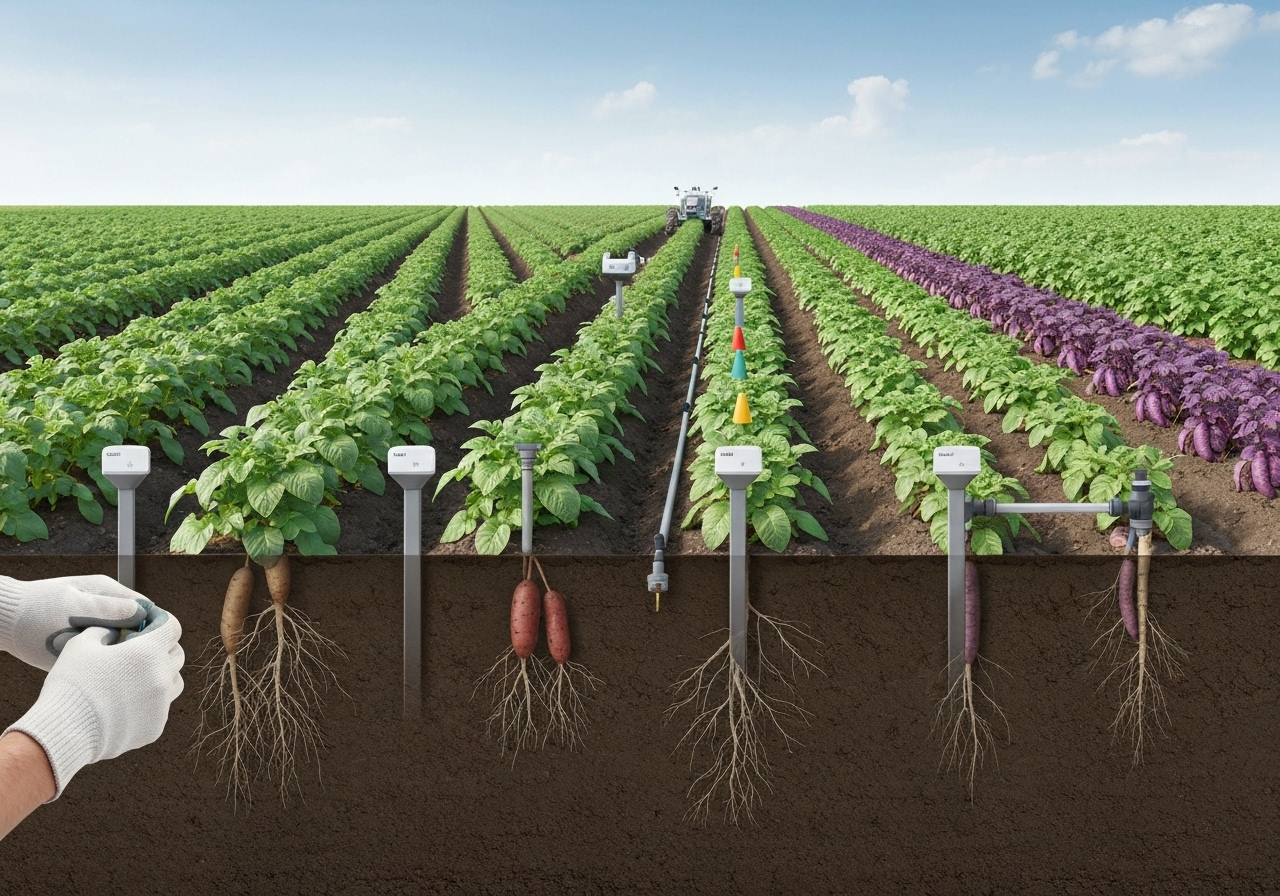
How to change emitter spacing? Use closer emitter spacing (10-20 cm) for high-density planting and farther spacing (25-40 cm) for lower density.
Which emitter flow changes are needed? Increase emitter flow or cycle time for large-tuber varieties that demand higher water volumes during bulking.
Which monitoring and automation options are viable with gravity-fed systems?
Which monitoring is simple and effective? Use soil moisture sensors, simple float valves for reservoir refill, and low-cost data loggers to record cycles.
How to automate without pumps? Use solenoid valves powered by solar controllers to run zones on a timer using gravity head.
How to integrate gravity-fed microdrip with regenerative and rotation practices?
How to pair irrigation with rotation? Pair irrigated potato beds with adaptive low-input rotation plans to prevent disease buildup and manage nutrients.
Which regeneration practices complement microdrip? Use targeted fertigation combined with soil microbial strategies to boost soil health, as discussed in Designing On-Farm Microbial Consortia to Enrich Soil.
Where to learn about micro-irrigation principles? Explore applied techniques in Regenerative Micro-Irrigation for Urban Smallholder Farms and related case studies.
Which troubleshooting checklist helps fix common gravity-fed problems?
Which quick checks to run? Verify reservoir height, clean filters, inspect for kinks, flush laterals, and test emitter outputs.
How to address low pressure? Raise reservoir, shorten lateral runs, or install a smaller-diameter orifice to concentrate head at emitters.
How to fix uneven output? Replace degraded emitters, check for airlocks with air vents, and rebalance manifold flow.
What are recommended best practices summary for small potato farms?
What best practices to follow? Use proper filtration, maintain a 2-4 meter tank head, choose low-pressure pressure-compensating emitters, limit lateral runs, and monitor soil moisture frequently.
How to plan system scaling? Start with a test block, refine emitter spacing and schedules, then expand manifolds as production demands increase.
Which resources and learning paths help? Train farm staff on flushing, filter cleaning, and simple pressure checks. Use supplier technical sheets and irrigation manuals for emitter-specific guidance (FAO; USDA NRCS).
Where to find further reading and related practical guides?
Where to find more on rotation and irrigation integration? See Adaptive Low-Input Crop Rotation Plans for Small Farms for rotation guidance that pairs with irrigation strategies.
Where to read on microclimate mapping and water planning? Consult microclimate mapping and farm calendar resources for planting and irrigation timing in different zones.
What final advice for implementing gravity-fed microdrip on small potato farms?
What final advice applies? Begin with a compact test system, monitor performance closely, and prioritize filtration and maintenance to keep emitters functioning throughout the season.
Which community practices help? Share field reports with nearby growers and adapt designs to local water quality and soil types for best outcomes.


