
Agroforestry Microclimates: Boosting Urban Farm Yields
Agroforestry Microclimates: Boosting Urban Farm Yields
Agroforestry microclimates combine trees, shrubs, crops, and designed landscape elements to create favorable localized climates that increase productivity, conserve resources, and improve biodiversity on urban farms.
What are agroforestry microclimates?
Agroforestry microclimates are intentionally created local climate conditions produced by the arrangement of woody vegetation, structures, water features, and soil management to modify wind, temperature, humidity, radiation, and soil moisture around crops.
Why do agroforestry microclimates matter for urban farming?
Agroforestry microclimates matter because they reduce heat stress, buffer wind, retain moisture, improve pest and disease resilience, and increase pollination and biodiversity — all of which raise yields and crop quality on small urban plots.
How do agroforestry elements change microclimates?
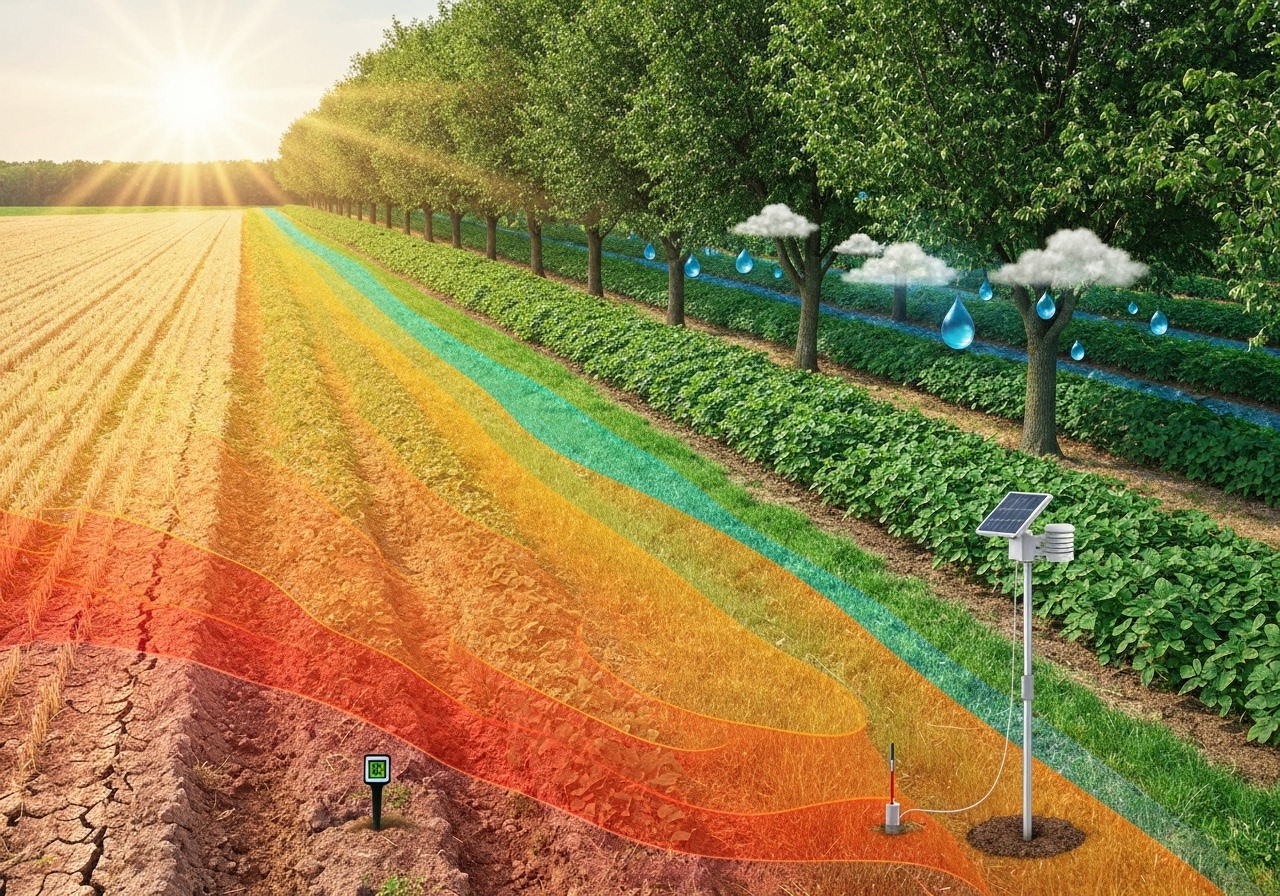
Agroforestry elements change microclimates by altering the energy and water balance at plant scale through shade, evapotranspiration, wind reduction, and belowground effects from roots and soil organic matter.
Shade and radiation management
Shade trees reduce direct solar radiation and midday leaf temperatures, lowering water demand for sensitive crops and preventing sunscald on fruits and stems.
- Use light-filtering canopies for vegetables that tolerate partial shade (e.g., leafy greens, brassicas, some herbs).
- Place tall trees to the west or northwest in temperate cities to limit late-afternoon heat while allowing morning sun.
Windbreaks and turbulent flow
Windbreaks reduce damaging gusts, decrease evapotranspiration, and lower soil erosion, which preserves moisture and improves microclimate stability around crop rows.
- Design windbreaks with 50–80% porosity using mixed-species hedgerows to reduce wind speed effectively and avoid creating turbulent eddies.
- Place windbreaks at 3–5 times their height upwind of vulnerable beds for best protection distances.
Evapotranspiration and humidity
Trees and shrubs release water vapor through transpiration, raising local relative humidity and cooling adjacent beds; this can be beneficial in hot, dry urban sites but may increase fungal risk if poorly ventilated.
Belowground effects and soil buffering
Perennial roots stabilize soil structure, increase porosity, and cycle nutrients from deep layers, which moderates soil temperature swings and supports steady moisture availability for annual crops.
What design principles should urban agroforestry follow?
Design urban agroforestry using site-specific analysis, layered planting, multifunctionality, and adaptive maintenance to create resilient microclimates that support yield and ecosystem services.
1. Conduct a site assessment

Conduct a site assessment to record solar patterns, prevailing winds, slope, drainage, soil type, existing vegetation, and micro-topography before placing trees and beds.
2. Layer vegetation for multiple functions
Layer vegetation in vertical tiers — canopy trees, midstory shrubs, understory perennials, and groundcover — to maximize surface area for microclimate modulation and biodiversity.
- Canopy trees: produce shade, wind reduction, and biomass.
- Shrubs: act as wind buffers, habitat, and living mulch sources.
- Perennials and groundcovers: protect soil, reduce evaporation, and attract beneficial insects.
3. Prioritize multifunctional species
Prioritize species that provide shade, nitrogen fixation, biomass for mulching, wildlife habitat, edible yields, or medicinal value to increase returns on limited urban space.
4. Plan for water capture and distribution

Plan water capture using swales, rain gardens, permeable paving, and berms to route stormwater into root zones and hold water where crops can access it during dry periods.
Which tree, shrub, and crop combinations work best?
Best combinations match light and root habits, pairing deep-rooted trees with shallow-rooted annuals and choosing shade-tolerant crops under dense canopies or light-demanding crops in canopy gaps.
Example functional guilds for urban plots
- Fruit-tree guild: dwarf apple or pear (canopy), nitrogen-fixing shrub (e.g., Elaeagnus), berry understory (raspberry), and shade-tolerant groundcover (thyme or clover).
- Fast-rotation vegetable guild: poplar or willow (short-term windbreak, biomass), herbaceous nutrient accumulators (comfrey), annual beds in the protected mid-row.
- Pollinator-rich guild: native flowering trees (e.g., Amelanchier), nectar shrubs (buddleia or ceanothus), and a diverse herbaceous layer to provide continuous bloom.
How do agroforestry microclimates improve soil and root-zone conditions?
Agroforestry microclimates improve soil health by increasing organic matter, supporting diverse root networks, and fostering beneficial microbial communities that stabilize nutrients and water retention.
Manage soil biology intentionally
Manage soil biology intentionally using compost, mulches, cover crops, and periodic soil testing coupled with targeted interventions like soil microbiome mapping to identify microbial deficits and build a resilient soil food web.
- Apply 2–5 cm of compost or well-aged leaf mulch annually to boost organic carbon and microbial habitat.
- Introduce mycorrhizal inoculants where soils are degraded to improve root access to water and phosphorus.
What management practices make microclimates effective over time?
Effective microclimates require adaptive pruning, nutrient cycling, integrated pest management, and monitoring to maintain balance between shade, airflow, and moisture.
Pruning and canopy management
Prune to control light levels, open lower canopy layers to airflow, and produce usable biomass for mulch and compost.
Integrated water strategies
Combine targeted irrigation in crop rows, mulch to limit evaporation, and passive water capture to reduce dependence on municipal water and increase drought resilience.
Use of monitoring and sensors
Use low-cost sensors to track soil moisture, temperature, and light to fine-tune canopy density and irrigation schedules. Sensors improve resource efficiency and prevent overwatering under shaded zones.
How does pollination perform in agroforestry microclimates?
Pollination improves when agroforestry increases floral diversity, nesting habitat, and microclimate stability that supports pollinator activity across variable urban conditions.
Enhance pollinator habitat and movement
Enhance pollinator habitat with continuous bloom sequences, nesting substrates (bare ground and hollow stems), hedgerows, and safe pesticide practices to sustain bees, butterflies, and beneficial insects.
Consider complementary technologies for augmentation where native pollinators are limited, including trialing robotic pollinators in specialized situations while prioritizing habitat restoration first.
What are measurable benefits and expected yield gains?
Measured benefits typically include higher marketable yields, reduced irrigation needs, and more stable production across seasons; specific gains vary with site, species, and management intensity.
Reported performance indicators
- Yield stability: reduced crop failure during heatwaves or late frosts due to buffered temperatures.
- Water savings: 10–40% lower irrigation demand in moderated microclimates versus exposed beds in some studies and case reports.
- Soil improvements: .2–1% organic matter increases over 3–5 years with deliberate mulch and perennial integration.
How to implement an agroforestry microclimate on a typical urban lot?
Implement an agroforestry microclimate on an urban lot by planning in phases, starting with windbreaks and soil-building, then adding canopy layers and diversified understory crops.
Phase 1: Assess and stabilize
Assess the lot for exposures and drainage. Stabilize vulnerable soil with covers and begin composting to generate mulch.
Phase 2: Install structural elements
Plant quick-establishing windbreak shrubs and fast-growing biomass trees to shape immediate microclimate benefits and produce mulch materials within 1–3 years.
Phase 3: Introduce layered plantings
Introduce fruit trees, nitrogen-fixers, and perennial herbs in the second and third years, and switch some annual beds to perennial polycultures where appropriate.
Phase 4: Monitor and adapt
Monitor light, moisture, and crop performance for two seasons and adapt pruning, spacing, and harvest rotations to reach target microclimate outcomes.
What risks and trade-offs should urban growers consider?
Risks include increased humidity and disease under dense canopies, root competition with annuals, invasive tree or shrub species, and potential conflicts with neighbors or utilities when planting tall trees.
Risk mitigation checklist
- Select non-invasive, site-appropriate species and avoid trees with aggressive roots near foundations.
- Limit canopy density near moisture-sensitive crops and prune to maintain airflow.
- Coordinate with municipal guidelines for street trees and overhead utilities.
How does agroforestry integrate with sustainable urban farming systems?
Agroforestry integrates with sustainable urban farming systems by combining perennials, renewable biomass flows, and ecological functions that align with regenerative and low-input approaches to food production.
For broader context on sustainable strategies that complement agroforestry, refer to discussions of sustainable urban farming practices and regenerative management techniques that reduce chemical inputs and emphasize ecological resilience.
What monitoring and evaluation metrics should be tracked?
Track microclimate metrics and farm performance using soil moisture, soil temperature, air temperature at crop canopy height, wind speed, pest incidence, pollinator visitation rates, and yield per square meter.
Suggested monitoring plan
- Install one soil moisture sensor at root depth in shaded and exposed beds.
- Record canopy temperatures during peak heat events for 2–3 years.
- Log pollinator visit counts and crop set on a weekly basis during flowering.
- Compare yields annually and relate changes to microclimate interventions.
Where can urban farmers find further resources and innovations?
Urban farmers can explore research on microclimate design, connect with local extension services for species recommendations, and trial technologies such as low-cost sensors and automated irrigation to optimize microclimate benefits.
Related innovations and practical reads
- Explore soil diagnostics and mapping for targeted soil biology interventions with resources like soil microbiome mapping.
- Adapt smart grazing and sensor strategies to community-scale green spaces where livestock or mobile biomass sources are used; lessons from smart pasture management can be adapted to urban biomass cycling.
What are practical next steps for urban farmers wanting to start?
Start by sketching sun and wind maps, selecting 3–5 multifunctional species suitable for your climate, and running a simple soil test. Pilot a single guild on one bed and monitor changes for two seasons before scaling.
Quick starter checklist
- Map sun and prevailing wind directions for your lot.
- Test soil pH, texture, and organic matter; consider a microbiome scan if resources allow.
- Choose non-invasive, multifunctional trees and shrubs with appropriate mature sizes.
- Install temporary shade cloths and mulches to simulate canopy effects and test crop responses.
- Monitor, document, and adapt based on observed moisture, pest, and yield metrics.
Conclusion: Can agroforestry microclimates significantly boost urban farm yields?
Yes — when designed and managed with site-specific goals, agroforestry microclimates increase resilience, reduce inputs, and frequently improve yield quantity and quality on urban farms; success requires staged implementation, monitoring, and adaptive management.
Agroforestry microclimates represent a high-return pathway for urban farmers seeking to expand productivity while delivering ecosystem services such as carbon storage, biodiversity habitat, and improved water use efficiency.
Further reading and links
For related ideas on innovation, pollination, and sustainable practices consult: robotic pollinators, soil microbiome mapping, and sustainable urban farming practices to deepen technical understanding and apply complementary methods on your site.
Design your microclimate intentionally, monitor consistently, and scale incrementally to transform small urban lots into productive, climate-resilient agroforestry farms.


