
AI-Guided Rotational Grazing Cuts Feed Costs and Emissions
What is AI-guided rotational grazing?
AI-guided rotational grazing is a pasture-management system that uses sensors, satellite and drone imagery, animal tracking, virtual fencing and machine learning to decide when and where livestock should graze. It combines traditional rotational grazing principles with data-driven decision making to maximize forage utilization, reduce supplemental feed, and lower greenhouse gas emissions.
Why choose AI-guided rotational grazing?
Choose AI-guided rotational grazing because it optimizes feed input, improves pasture productivity, and creates measurable reductions in on-farm emissions while maintaining or improving animal performance. Farmers who adopt this approach report better forage rest periods, more uniform grazing, and fewer emergency feed purchases.
How does AI-guided rotational grazing work?
AI-guided rotational grazing works by integrating four data layers into an optimization loop:
- Real-time pasture condition (biomass, greenness, moisture) from multispectral imagery and ground sensors.
- Animal location and behavior from GPS collars and activity sensors.
- Weather forecasts and soil moisture models to predict regrowth rates.
- Farm economics and constraints (feed costs, labor availability, herd nutritional requirements).
The AI models process those inputs, score paddocks for grazing readiness, and propose move schedules. Farmers receive recommended move windows via mobile apps or automated virtual fence systems that open and close grazing boundaries with electronic cues.
What are the main components of the technology stack?

The technology stack includes hardware, connectivity, and software:
- Hardware: GPS collars, soil moisture probes, NDVI-capable drones or satellite feeds, solar-powered IoT sensors, and virtual-fence actuators.
- Connectivity: LoRaWAN, cellular, or satellite links to move data from sensors to cloud servers in remote areas.
- Software: Cloud AI platforms with machine-learning models that forecast forage growth, optimize moves, and estimate emissions and feed-savings.
Deploy standard APIs where possible and select devices with long battery life and low maintenance to fit pasture settings.
What immediate benefits can farmers expect?
Farmers can expect several direct, measurable benefits:
- Lower feed costs: AI-guided systems reduce overgrazing and undergrazing, keeping sward quality high and lowering the need for purchased feed. Producers report up to 20-30% reductions in supplementary feed in many climates.
- Reduced emissions: Better forage management lowers enteric methane intensity per kg product and increases soil carbon sequestration through more consistent plant recovery patterns.
- Better animal health: Optimized moves reduce parasite loads and improve nutritional intake balance across the herd.
- Labor efficiency: Automated move alerts and virtual fencing reduce physical labor for fence moves and monitoring.
How does AI-guided grazing cut feed costs?
AI-guided grazing cuts feed costs by ensuring livestock graze at peak forage quality and by extending the productive life of pastures. The system:
- Schedules grazing windows to harvest forage at a nutritional peak, improving feed conversion.
- Predicts regrowth so paddocks are rested long enough to recover, maintaining pasture carrying capacity.
- Flags low-biomass paddocks early so targeted supplementation minimizes large emergency feed purchases.
These operational changes reduce reliance on purchased concentrates and hay during the growing season, flattening feed expenditure spikes.
How does it reduce farm greenhouse gas emissions?
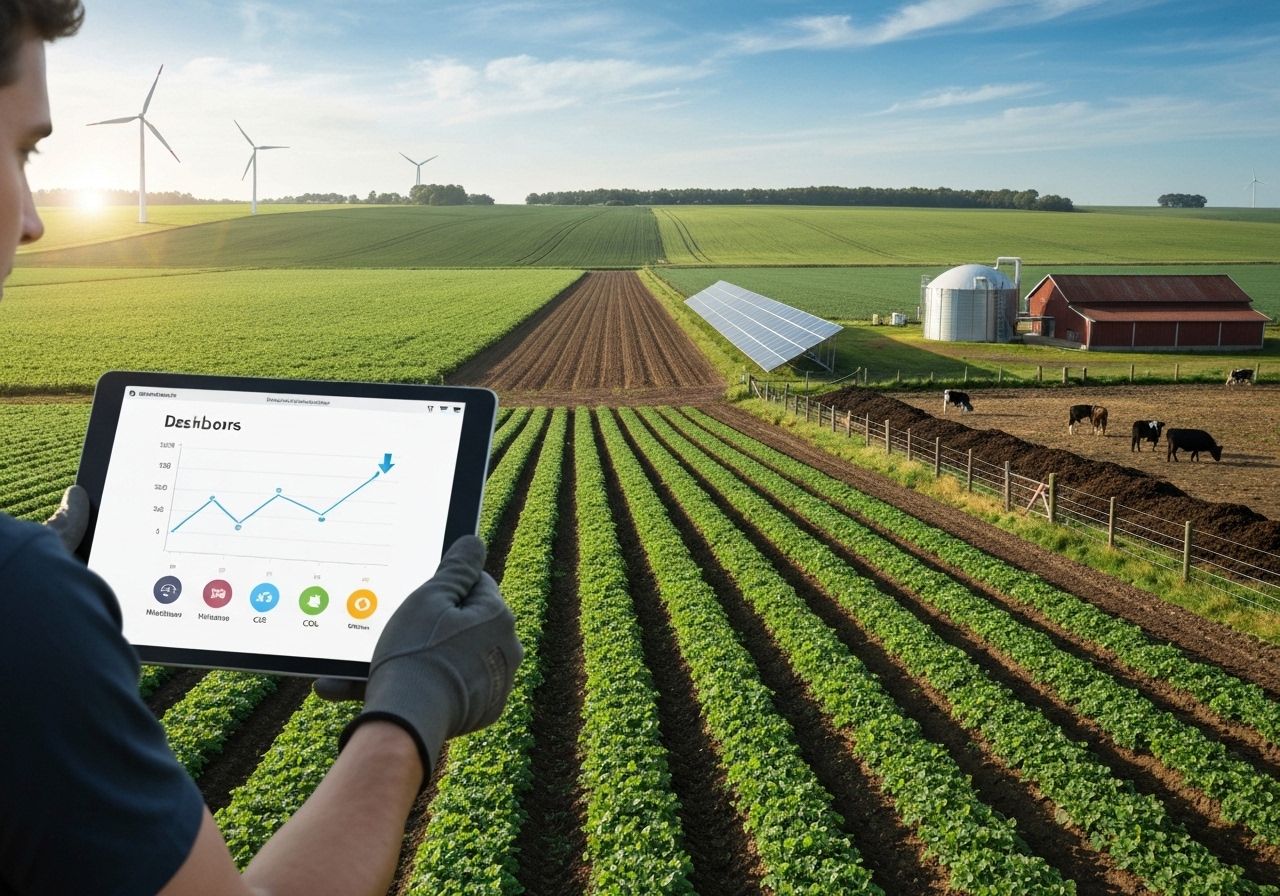
AI-guided grazing reduces greenhouse gas emissions through three pathways:
- Lowered methane intensity: Improved diet quality from fresh pasture reduces methane per unit of weight or milk produced.
- Soil carbon: Proper rest and avoidance of persistent overgrazing improve root growth and carbon inputs to the soil.
- Reduced external inputs: Less purchased feed and fertilizer lower embodied emissions in supply chains.
Quantifying emissions reductions depends on herd type, climate, soil, and baseline management. Use farm-level life-cycle assessments to measure local impact.
What are realistic performance metrics and targets?
Realistic metrics and targets for an AI-guided rotational grazing program include:
- Feed cost reduction: target 10-30% lower purchased feed in the first full grazing season.
- Forage utilization: increase usable forage harvest by 10-25% through better timing and distribution.
- Labor hours: reduce time spent on paddock moves and monitoring by 30-60% with automation.
- Emissions: aim for measurable reductions in methane intensity and modest soil carbon gains within 3-5 years, verified by repeated soil sampling.
Which farms benefit most from AI-guided rotational grazing?
Farms that benefit most are those with:
- Moderate to high stocking density where efficient forage use matters economically.
- Variable pasture types across fields that are hard to monitor manually.
- Access constraints for labor or fence infrastructure.
- Markets or incentives for lower emissions or regenerative certification.
However, scaled solutions exist for smallholders and large operations; hardware and service models make the approach adaptable.
How to implement AI-guided rotational grazing on your farm?
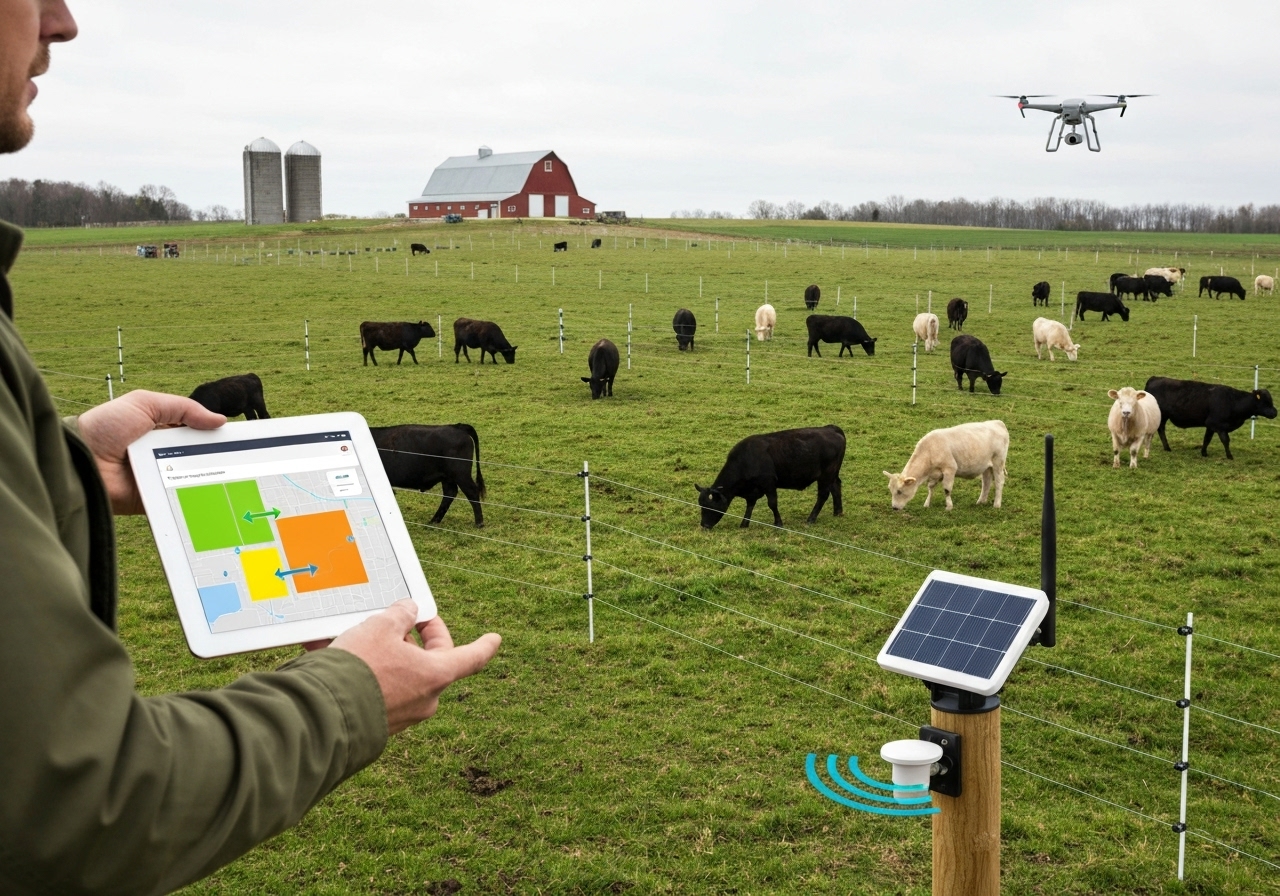
Follow these practical steps:
- Assess objectives: set targets for feed cost reduction, emissions, animal performance, and cash flow.
- Baselining: measure current feed purchases, pasture yield, animal gains, and simple soil carbon indicators.
- Choose tech partners: select sensor vendors, virtual-fence providers, and an AI platform with pasture-specific models.
- Start small: pilot one paddock or a subset of the herd for one grazing cycle to validate recommendations.
- Train staff and set workflows: define who moves animals, monitors dashboards, and handles exceptions.
- Scale and measure: expand across the farm, continually measure feed use and emissions, and adjust models with farm-specific data.
What monitoring and data collection are required?
Collect these minimum datasets to run effective AI models:
- Weekly or biweekly biomass indices (NDVI/EVI) for each paddock.
- Soil moisture and simple compaction or infiltration measures in representative spots.
- Animal locations and activity levels from GPS collars.
- Weather station data and short-term forecasts.
- Records of supplemental feed usage, animal weights or milk yield, and labor hours.
Feed the collected data into the platform and let the model learn site-specific response curves for regrowth and animal intake.
How does this approach interact with soil health and microbiome management?
AI-guided rotational grazing supports soil health by enabling consistent rest periods that favor root turnover and carbon inputs. When combined with targeted practices like multi-species swards, reduced chemical inputs, and periodic soil testing, grazing can accelerate beneficial shifts in the soil microbiome.
Integrate this work with soil-mapping efforts. For guidance on analyzing soil microbial patterns on small operations, see soil microbiome mapping for small-scale climate farms. That link explains how local microbiome data can improve grazing timing and cover crop selection.
How should pasture managers combine AI with other smart tools?
Combine AI-guided grazing with remote sensing, automated weather stations, and occasional drone scouting. Smart pasture monitoring systems increase the accuracy of AI predictions and create redundancy when one data source is missing. For a holistic view of integrating sensors and drones into pasture plans, review smart pasture management: drones, soil sensors, grazing.
What are the main challenges and limitations?
Challenges include:
- Initial cost: upfront hardware, connectivity and subscription fees can be a barrier for some farms.
- Data gaps: connectivity and sensor maintenance in remote pastures require planning.
- Model transferability: AI models need farm-specific calibration and won’t be perfect out of the box.
- Behavioral change: managers must trust and act on AI recommendations for benefits to materialize.
Address these by phasing investments, choosing robust low-maintenance sensors, and designing pilot programs with clear KPIs.
Which economic models support adoption?
Economic adoption models include:
- Subscription services: software-as-a-service where farmers pay monthly for analysis and recommendations.
- Hardware financing: leasing GPS collars and sensors to reduce capital barriers.
- Aggregator models: cooperatives or service providers manage data for several small farms, spreading costs.
- Incentive programs: link participation to regenerative or low-emission certification premiums or carbon payments.
Calculate payback by comparing reduced purchased feed and labor savings against annual service and hardware costs.
What policy incentives or market mechanisms help scale this approach?
Policy and market mechanisms that accelerate adoption include:
- Carbon and ecosystem service payments for measurable soil carbon gains and biodiversity outcomes.
- Grants for agricultural technology adoption and rural connectivity improvements.
- Market premiums for low-emission or regenerative animal products that reward verified on-farm reductions.
Design monitoring frameworks that satisfy both regulators and private buyers; interoperable data formats and transparent metrics build trust.
Are there case study examples or field trials?
Yes. Several pilot projects and commercial farms have demonstrated tangible benefits from combining rotational grazing with decision-support systems. Results commonly show improved forage utilization, seasonal feed savings, and measurable animal performance improvements in the first 1–2 seasons. Use pilot results as a guide—adaptation to local soil, climate and herd type is critical.
How to measure success on your farm?
Measure success with these indicators:
- Feed costs per unit product (e.g., $/kg liveweight gain or $/kg milk) before and after implementation.
- Forage utilization percentage and paddock biomass trends across the season.
- Labor hours for grazing management and fence moves.
- Simple soil carbon trend sampling and pasture species composition shifts every 1–3 years.
- Animal health and production metrics (mortality, weight gain, milk yield).
Use consistent measurement protocols and document all changes to isolate the effect of the AI-guided system.
Can small-scale and hobby farmers use this technology?
Yes. Scaled-down packages and cooperative models make AI-guided rotational grazing viable for small-scale or hobby farms. Lightweight GPS devices, smartphone-based paddock maps, and community-shared analytics allow small farms to benefit without major capital outlays. For inspiration on low-cost sustainable practices, see eco-friendly and sustainable farming.
What are best practices for long-term success?
Best practices include:
- Start with clear targets and simple KPIs.
- Run a controlled pilot and learn before scaling.
- Maintain sensors and validate AI recommendations with periodic ground truthing.
- Document changes and adapt grazing plans seasonally.
- Partner with trusted advisors, agronomists, or local extension services for context-specific adjustments.
What future developments will shape AI-guided grazing?
Future advances likely include improved low-cost sensors, federated learning that protects farm data while improving model accuracy, integrated carbon accounting tools, and tighter automation with robotics and virtual fences. As models become more localized, recommendations will become more precise and cost-effective.
How to get started this season?
Get started by:
- Set one measurable objective (e.g., reduce purchased hay by 15% this grazing season).
- Select a single paddock and equip it with a biomass index (drone, satellite, or clip-and-weigh baseline).
- Trial GPS collars on a subset of animals to learn movement patterns and validate stocking rate assumptions.
- Choose a cloud platform with pasture models and begin receiving move recommendations.
- Review outputs weekly and adjust moves; track feed purchases and animal performance.
Conclusion: Will AI-guided rotational grazing transform farms?
AI-guided rotational grazing can transform pasture-based livestock systems by tightening the feedback loop between pasture condition, animal behavior, and managerial decisions. When implemented thoughtfully, it lowers feed costs, reduces emissions intensity, and supports healthier soils and animals. The technology is practical for a wide range of operations and pairs well with broader sustainable farming strategies.
Further reading and next steps
Read about integrating sensors and drones into pasture programs at smart pasture management: drones, soil sensors, grazing, and explore how soil microbiome insights can guide grazing and cover crop choices at soil microbiome mapping for small-scale climate farms. For practical sustainable farming tips that align with grazing optimization see eco-friendly and sustainable farming.
If you want a one-page checklist to start implementing AI-guided rotational grazing on your farm, request a printable pilot plan from vendors or local extension networks and begin with a single paddock this season.


