
Blockchain for Soil Carbon Credits on Family Farms
Blockchain for Soil Carbon Credits on Family Farms
Blockchain for soil carbon credits provides a transparent, tamper-resistant ledger to record greenhouse gas removals from family farms.
What is soil carbon crediting and why does it matter for family farms?
Soil carbon crediting issues tradable credits for quantified increases in soil organic carbon (SOC) created by on-farm practices.
Family farms gain additional revenue, improve soil health, increase resilience to drought, and demonstrate climate stewardship through carbon crediting.
Carbon credits create a market value for regenerative practices such as cover cropping, reduced tillage, and optimized grazing.
How does blockchain change carbon credit markets?
Blockchain changes carbon credit markets by recording every transaction and measurement in an immutable, auditable ledger.
Blockchain reduces middlemen, lowers verification costs, and increases buyer confidence in credit provenance.
Smart contracts automate credit issuance, retirement, and payment flows when pre-set verification conditions are met.
What are the core components of a blockchain system for soil carbon credits?
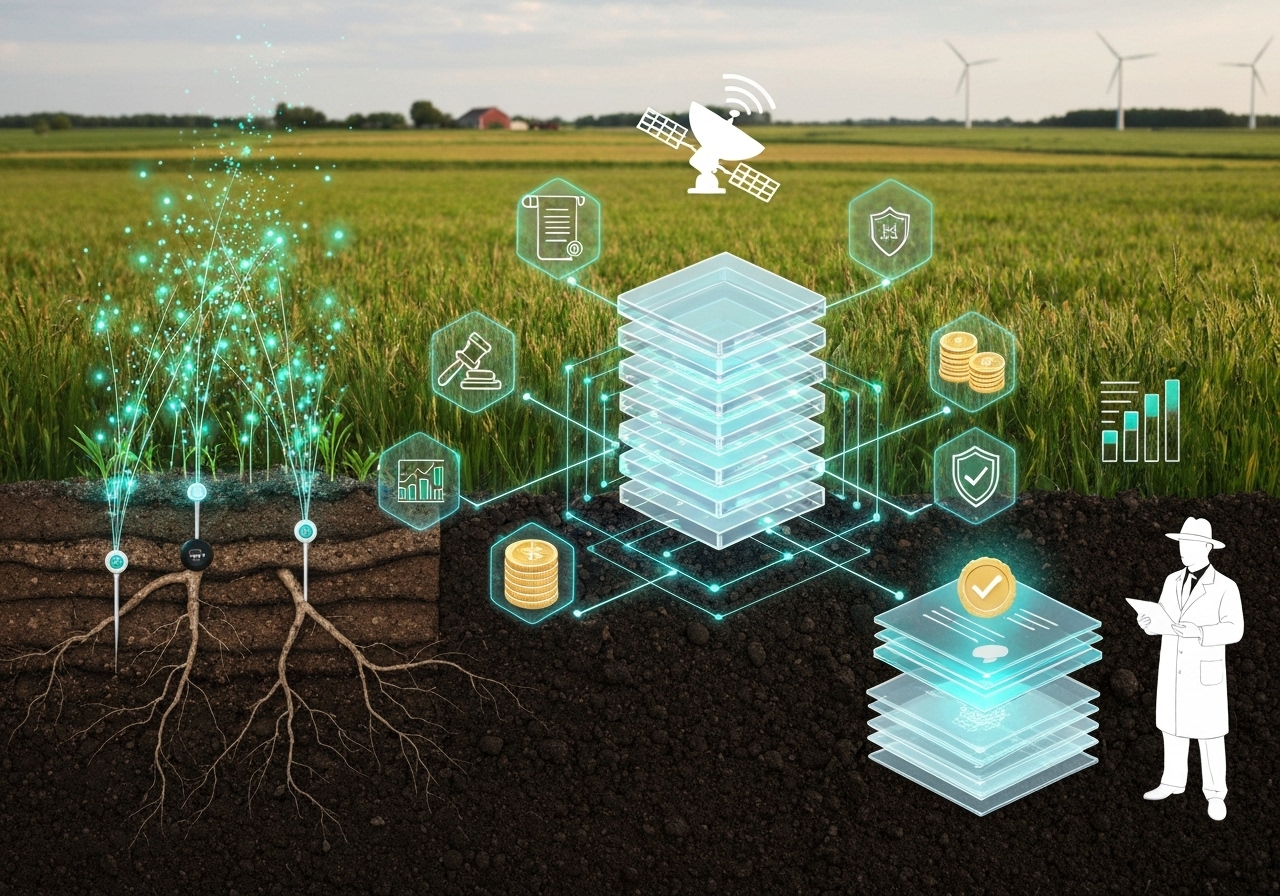
The core components include on-chain registries, oracles for off-chain data, smart contracts, tokenization, and a verification workflow.
- On-chain registries store project metadata, credit issuance, and ownership history.
- Oracles bridge measurement data (soil tests, remote sensing, IoT sensor outputs) to the blockchain.
- Smart contracts define issuance rules, payment triggers, and retirement processes.
- Tokenization converts quantified carbon units into transfer-ready digital tokens.
How are soil carbon changes measured and validated?
Soil carbon changes are measured through a mix of direct soil sampling, proximal sensors, remote sensing, and modeling.
Direct sampling provides ground-truth SOC values; modeling extrapolates to field scale between samples.
Sensors and satellite data give high-frequency context: moisture, biomass, and land-use signals feed verification models.
Validation combines third-party audits and data reconciliation to confirm claimed carbon sequestration.
How does blockchain integrate measurement data?
Blockchain integrates measurement data via secure oracles that push verified, timestamped records on-chain.
Oracles accept digital lab reports, sensor feeds, and satellite-derived indices after cryptographic signing by trusted parties.
Each measurement entry links to metadata: GPS coordinates, sampling depth, lab method, and analyst credentials.
Can small family farms realistically use blockchain for carbon credits?
Yes, it is realistic when platforms lower onboarding friction and bundle cost-effective measurement services.
Aggregators and cooperatives allow small farms to pool projects, share sampling costs, and access simplified token platforms.
Mobile apps and farm-level dashboards reduce recordkeeping time and automate data submission for verification.
What are the benefits of tokenized soil carbon credits for family farms?
Tokenized soil carbon credits provide faster settlements, fractional sales, and transparent ownership history.
- Faster payments: Smart contracts release funds upon verification events.
- Fractionalization: Small credit parcels sell to diverse buyers, improving liquidity.
- Traceability: Buyers can verify origin, measurement method, and retirement status on-chain.
How does blockchain improve trust and reduce fraud?
Blockchain improves trust by creating an auditable trail of all data and transactions that cannot be altered retroactively.
Immutable timestamps and cryptographic signatures make it harder to double-count credits or manipulate records.
Combining blockchain with geospatial checks and independent auditors reduces opportunities for fraudulent claims.
What are the main technical choices for a blockchain-based carbon registry?

Main technical choices include permissioned vs permissionless ledgers, consensus mechanism, and oracle architecture.
Permissioned ledgers (private chains) offer greater transaction speed and identity control for regulated registries.
Permissionless chains increase openness but carry higher energy and transaction-cost considerations unless using energy-efficient protocols.
Choose an oracle design that supports multiparty signatures and verification workflows from labs and auditors.
What data governance and ownership rules should farms expect?
Farms should expect data governance that grants them control over raw farm data while permitting verified summaries on-chain.
Contracts should specify who can read sensor streams, who can attach lab reports, and how aggregated results are published.
Farms must negotiate consent clauses for data sharing, revenue splits, and the duration of data retention.
How do smart contracts handle issuance, sale, and retirement of credits?
Smart contracts automate issuance when verification triggers are met, transfer ownership upon sale, and mark credits as retired once used.
Issuance rules reference validated data hashes and auditor approvals; sales execute upon buyer payment confirmation; retirement burns the token and records the purpose.
What are common business models for family farms in blockchain carbon markets?
Common models include independent sellers, aggregator-membership models, and partnership with service providers.
- Independent seller: Farm manages measurements and lists credits on a marketplace.
- Aggregator: Cooperative or service provider bundles many small farms into a qualifying project.
- Service partnership: Third-party handles measurement, verification, and marketing for a revenue share.
How much revenue can family farms expect from soil carbon credits?
Revenue varies widely; it depends on sequestration rate, credit price, and project boundaries.
Typical SOC increases range from .1 to 1.5 metric tons CO2e per hectare-year depending on practice intensity and baseline soil conditions.
Credit prices range from single-digit USD per ton to over USD 50/ton in voluntary markets; conservative planning uses $10–$30/ton.
Example: A 50-hectare farm sequestering .5 tCO2e/ha-year at $20/ton yields $500/year before costs.
What are the costs and risks to consider?
Costs include soil sampling, sensor deployment, platform fees, auditor payments, and potential changes to farm operations.
Risks include temporary carbon gains that later reverse, measurement uncertainty, and fluctuating credit prices.
Additional legal and reputational risks arise if contracts are ambiguous about ownership or permanence.
How does permanence and liability work in tokenized credits?
Permanence requires contractual safeguards and monitoring to ensure carbon remains sequestered for an agreed period.
Buckets such as buffer pools, insurance, or contractual buybacks manage reversal risk.
Smart contracts can automate contributions to buffer pools or call for remedial action if reversals are detected.
How do aggregated projects and cooperatives help family farms?
Aggregated projects reduce per-farm verification costs, smooth variability in sequestration rates, and create bankable project sizes.
Cooperatives negotiate better lab rates, coordinate sampling, and maintain a shared registry to simplify accounting.
Aggregation increases attractiveness to institutional buyers looking for scale and diversified supply.
What farm practices increase soil carbon most cost-effectively?
Cost-effective practices include cover cropping, reduced or no-till, perennialization, rotational grazing, and organic amendments.
- Cover crops sequester carbon and protect soil, with modest input costs.
- No-till reduces SOC oxidation and supports aggregation.
- Perennial crops and silvopasture sequester more carbon long-term.
Combine practices for synergistic gains and stronger verification signals.
How do remote sensing and on-farm sensors complement soil sampling?
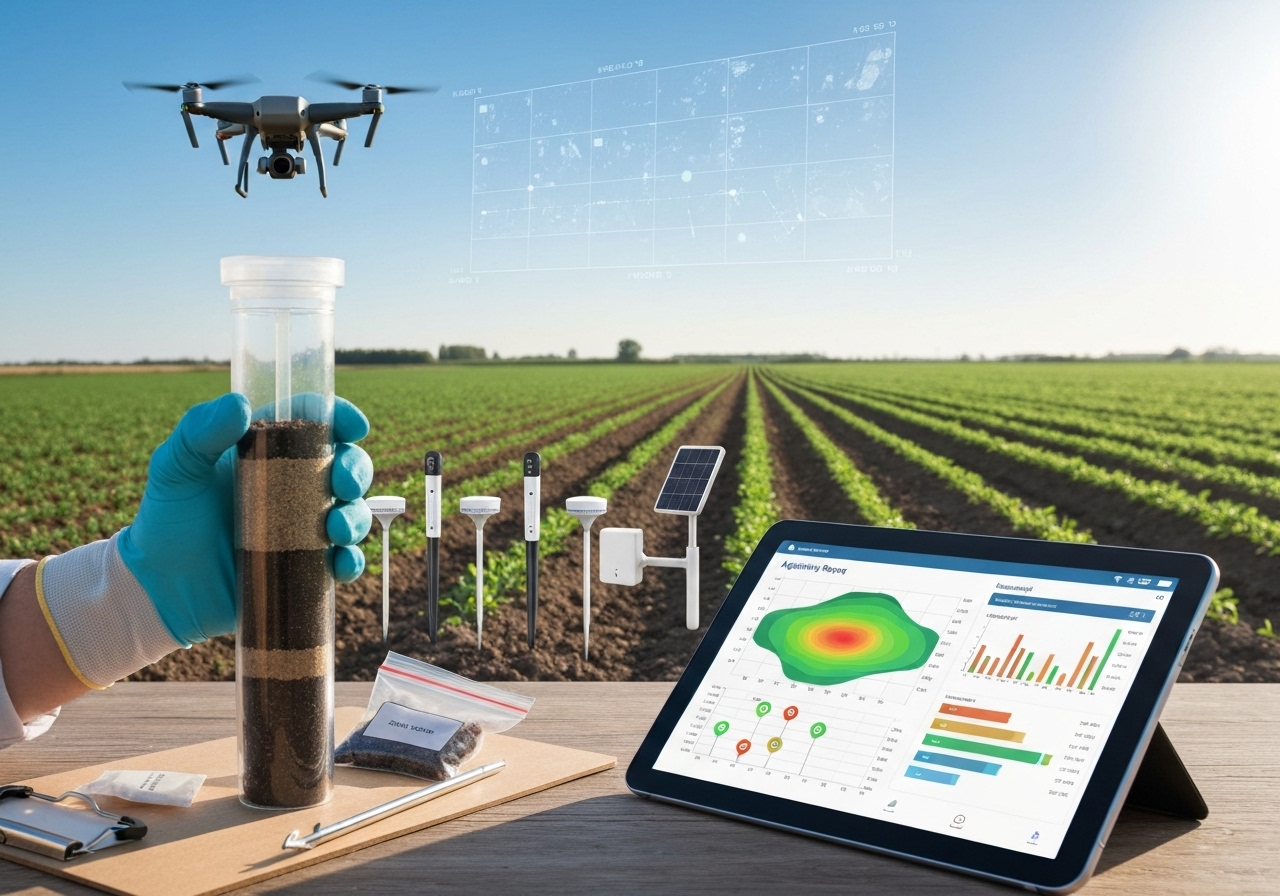
Remote sensing and sensors provide high-frequency, spatially continuous indicators linked to biomass, soil moisture, and land cover.
These data reduce the number of soil samples needed and flag anomalies for targeted sampling.
Integrate sensor data with soil microbiome mapping and pasture management for more robust claims; see practical workflows in smart pasture management case studies and soil microbiome mapping.
Which standards and registries should farms consider?
Consider voluntary frameworks that specify measurement, reporting, and verification (MRV) protocols for soil carbon.
Look for registries that support nested projects, clear permanence rules, and transparent auditing processes.
Prioritize registries that allow on-chain linking or provide API access for automated verification flows.
What legal and contract clauses should farmers watch?
Farmers should watch clauses about data ownership, revenue splits, liability for reversals, and duration of commitments.
Ensure termination rights, dispute resolution, and clear definitions of measurement protocols and acceptable uncertainty.
Seek legal counsel when entering multi-year or tokenized agreements to avoid unintended transfers of land or data rights.
How can buyers verify credits on a blockchain-enabled marketplace?
Buyers verify credits by inspecting on-chain metadata, linked measurement reports, GPS coordinates, and auditor signatures.
Smart contracts provide the full credit lifecycle: issuance, transfers, and retirement, allowing buyers to trace provenance.
Look for marketplaces that display both on-chain evidence and human-readable audit summaries.
How will blockchain platforms handle privacy and sensitive farm data?
Platforms handle privacy by storing hashes of sensitive reports on-chain while keeping raw data off-chain under farm-controlled access.
Permissioned access, role-based keys, and zero-knowledge proofs can reveal verification outcomes without exposing raw inputs.
Read platform privacy policies and consent forms to confirm how long data will be retained and who can access it.
What incentives can accelerate adoption among family farms?
Incentives include subsidized sampling, aggregator cost-sharing, upfront payments, and training on regenerative practices.
Grants and public programs can de-risk initial participation and build local demonstration projects.
Local extension services and farmer networks increase trust and speed adoption.
How do blockchain carbon projects align with broader farm sustainability goals?
Blockchain carbon projects align by financially rewarding practices that improve soil health, biodiversity, and water retention.
Use carbon revenue to fund long-term investments such as precision irrigation, pollinator habitat, or controlled grazing; see related innovations like robotic pollinators as part of diversified sustainability planning.
What steps should a family farm take to join a blockchain carbon program?
Steps: assess baseline SOC, consult a verifier, choose a platform, agree on data governance, implement practices, and enroll in MRV.
- Perform a baseline soil assessment using accredited labs and agreed sampling protocols.
- Choose a registry or aggregator with blockchain integration and clear issuance rules.
- Sign data-sharing agreements and install any required sensors or mapping tools.
- Implement chosen regenerative practices and record operational inputs.
- Submit verification data and trigger issuance via the chosen platform.
What future trends will shape blockchain for soil carbon on family farms?
Future trends include automated IoT-based verification, improved soil microbiome–carbon models, standardized token formats, and tighter integration with ecosystem service markets.
Interoperability across platforms will allow credits to move between voluntary and compliance markets using cross-chain bridges and standardized metadata.
Expect increased regulation and auditability as governments consider carbon accounting for national inventories.
What are practical recommendations for family farmers considering enrollment?
Recommendations: start small, join an aggregator, prioritize measurable practices, and retain data rights.
- Start with a pilot field to learn sampling cadence and economics.
- Join a cooperative to share verification costs and access better market access.
- Keep raw data under your control; publish only necessary validated summaries on-chain.
- Budget conservatively for multi-year commitments and monitor for reversals.
Where can farmers learn more and find trustworthy partners?
Farmers can learn through extension services, pilot programs, and platforms that publish transparent MRV methods.
Look for partners with established laboratory networks, clear data governance policies, and experience aggregating smallholder projects.
Explore applied articles and guides about sustainable practices and innovations in crop and pasture management to build context; see resources on eco-friendly farming methods and opportunities in crop farming innovations.
Conclusion: Is blockchain a good fit for your family farm?
It depends on farm size, willingness to adopt monitoring, and access to aggregators or service providers.
Blockchain can add value by enhancing transparency, lowering transaction friction, and enabling new buyer relationships for family farms that commit to measurable soil-carbon practices.
Start with small pilots, protect data rights, and choose partners that align technical capability with farmer needs.


