
Carbon-Smart Millet: Low-Input Grain Farming for Drylands
What is Carbon-Smart Millet?
What is Carbon-Smart Millet? Carbon-smart millet is an approach to growing traditional millet crops using practices that reduce greenhouse gas emissions, enhance soil carbon sequestration, and maintain productivity under dryland conditions. Carbon-smart millet combines low-input management, resilient millet varieties, and landscape-level practices to produce nutritious grain while improving soil health and climate resilience.
Why focus on millet for drylands?
Why focus on millet for drylands? Millet crops are naturally adapted to low and erratic rainfall, poor soils, and high temperatures common in drylands. Millet requires less irrigation and synthetic fertilizer than major cereals, offering a pathway to reduce on-farm emissions and input costs. Millet families include pearl millet, finger millet, foxtail millet, proso millet, and others, each suited to specific rainfall patterns and soil types.
Key advantages of millet in drylands
- Low water requirement: Millet matures with less rainfall than maize or rice.
- Low input demand: Millet performs under minimal fertilizer and limited pest control.
- Diverse uses: Millet provides grain, stover for livestock feed, and straw for soil cover.
- Nutrition: Millet is rich in minerals and resilient against food system shocks.
How does millet become carbon-smart?
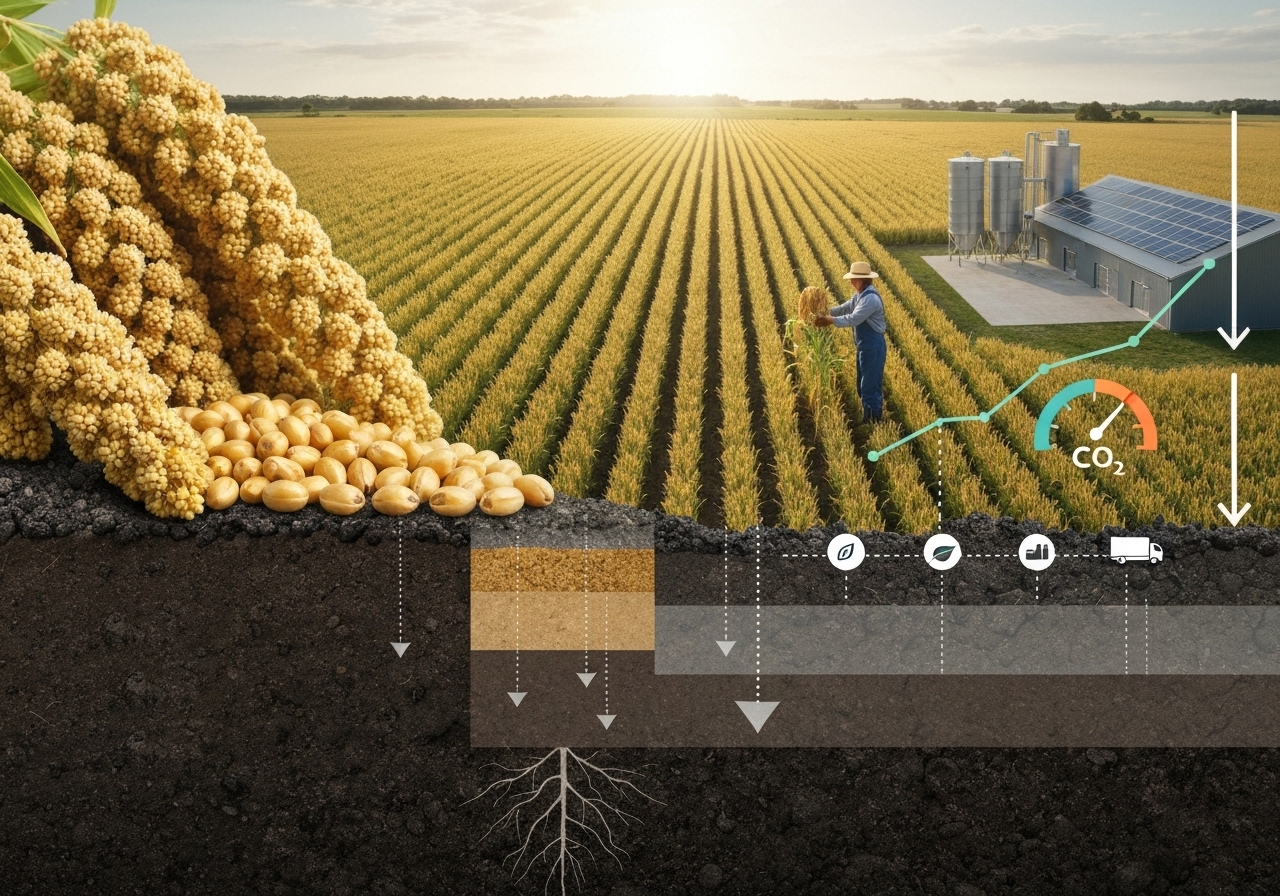
How does millet become carbon-smart? Millet becomes carbon-smart when farmers adopt practices that reduce emissions per unit produced and increase net carbon stored in soils and biomass. These practices are low-cost, scalable, and appropriate for smallholder dryland systems.
Core carbon-smart practices for millet
- Conservation tillage or zero-till to reduce soil disturbance and preserve soil carbon.
- Residue retention and mulching to add organic matter and protect soil moisture.
- Intercropping and rotational cropping with legumes to fix nitrogen and improve biomass inputs.
- Targeted micro-dosing of fertilizers to avoid over-application and improve nutrient-use efficiency.
- Rainwater harvesting and micro-catchments (zai pits, contour bunds) to maximize water availability.
- Use of adapted, early-maturing or drought-tolerant millet varieties to reduce crop failure risk.
- Agroforestry and shady windbreaks to increase above-ground carbon and stabilize microclimate.
Which agronomic steps produce the biggest climate benefits?
Which agronomic steps produce the biggest climate benefits? Prioritize soil and water measures that increase biomass and reduce external inputs. The highest-impact steps in many drylands are residue retention, minimal tillage, and water-conserving planting techniques.
Practical low-input techniques
- Zai pits and planting basins: Concentrate scarce rainfall around the seed to improve establishment without irrigation.
- Micro-dosing: Apply small measured fertilizer doses with seed or at emergence to increase nutrient efficiency.
- Mulch with crop residues: Place stover on the soil surface to reduce evaporation, suppress weeds, and add carbon.
- Intercropping with legumes: Grow cowpea, mung bean or groundnut alongside millet to supply nitrogen and extra biomass.
- Strip cropping and contour planting: Reduce runoff and erosion while increasing infiltration.
How to select millet varieties for low-input drylands?
How to select millet varieties for low-input drylands? Choose varieties that match local rainfall, soil texture, and farmer preferences for grain quality. Prioritize drought-tolerant, early-maturing, and disease-resistant lines where possible.
Variety selection checklist
- Crop duration: Prefer short-duration varieties where rainfall is brief.
- Root system: Favor genotypes with deep or robust roots for moisture access.
- Biomass production: Value varieties that produce additional stover for soil cover.
- Local adaptation: Use farmer-tested landraces or improved varieties proven in similar agroecologies.
What soil actions increase sequestration and yield?
What soil actions increase sequestration and yield? Build soil organic matter through continuous carbon inputs, protect existing carbon pools, and stimulate microbial activity that stabilizes organic matter. Simple, low-cost soil actions deliver both sequestration and yield benefits.
Soil-building practices
- Retain crop residues to feed soil biota and create a continuous organic matter input.
- Apply compost or farmyard manure where available to add stable organic carbon.
- Practice cover cropping or relay cropping with legumes to maintain living roots and add nitrogen.
- Reduce tillage frequency to reduce carbon loss via oxidation.
- Use rock phosphate or slow-release phosphorus sources to support biological activity instead of high-rate soluble fertilizers.
What soil actions increase sequestration and yield? Monitor soil health with simple indicators (aggregate stability, infiltration, surface cover) and advanced tools where possible. For targeted interventions, farmers can use laboratory or in-field tests; for deeper analysis, soil microbiome mapping provides data-driven insights into microbial communities that drive carbon cycling and nutrient availability.
How do water-saving methods integrate with millet systems?
How do water-saving methods integrate with millet systems? Integrate water-harvesting, mulching, and planting date optimization to align crop needs with rainfall. These measures reduce the need for irrigation and increase water-use efficiency.
Rainwater and soil moisture strategies
- Contour bunds and stone lines to slow runoff and increase infiltration.
- Mulching to reduce evaporation losses during the critical grain-filling period.
- Planting in micro-catchments (zai pits) to raise planting success in marginal rainfall years.
- Adjust sowing dates to match the onset of the reliable rainy window for the location.
What pest and disease management fits low-input millet?
What pest and disease management fits low-input millet? Use integrated pest management (IPM) tailored to low-input systems: monitor pests, deploy resistant varieties, encourage biological control, and apply interventions only when thresholds are reached.
IPM components for millet
- Regular field scouting and participatory monitoring with farmers to detect pests early.
- Conservation of natural enemies by maintaining habitat and avoiding broad-spectrum pesticides.
- Use of botanical repellents or targeted biopesticides when damage risks are high.
- Sanitation: remove infested residues before planting to reduce inoculum.
How to measure carbon benefits and verify results?

How to measure carbon benefits and verify results? Establish a baseline for soil organic carbon (SOC), then measure changes over multi-year intervals. Combine simple field indicators with periodic soil sampling to a standard depth (often –30 cm) and laboratory SOC analysis. Where resources allow, pair SOC measurements with modeling tools to estimate sequestration trajectories.
Monitoring tips for smallholders
- Start with a reference plot to track changes under the new practice versus current farmer practice.
- Use consistent sampling locations, timing, and methods each year to reduce variability.
- Combine farmer-recorded data on inputs and yields with SOC measurements for robust accounting.
- Leverage local extension services or regional labs to lower testing costs.
What are the economics of carbon-smart millet?
What are the economics of carbon-smart millet? Economics vary by region, but low-input, carbon-smart millet systems typically reduce cash expenses (fertilizer, irrigation, and fuel) while stabilizing yields and providing diverse farm products like stover and legumes. Initial labor investments for practices such as zai pits or contour bunding may rise, but benefits accrue through higher establishment rates, lower crop failure risk, and improved soil fertility over time.
Simple cost-benefit considerations
- Costs: labor for soil and water works, seed for intercropping, initial training.
- Benefits: reduced fertilizer and irrigation costs, greater yield stability, added fodder and straw value, potential access to climate finance or carbon credits.
- Time horizon: many soil and carbon benefits accumulate over 3–10 years; plan investments accordingly.
How can carbon-smart millet reach markets and scale?
How can carbon-smart millet reach markets and scale? Integrate production improvements with value chain development: build local processing for millet flour and snacks, aggregate farmer groups for consistent supply, and promote millet in school feeding and health programs to expand demand.
Scaling actions
- Develop farmer cooperatives for seed multiplication, bulk marketing, and shared equipment.
- Invest in small-scale mills and value-added processing to raise consumer demand and farmer returns.
- Pursue public procurement and nutrition programs that prefer climate-resilient staples.
- Document and share success stories and yield data to attract investment and policy support.
How can carbon-smart millet reach markets and scale? Link scaling efforts to innovation platforms and training that promote adoption of practices highlighted in opportunities and innovations in crop farming, enabling farmers to adopt new techniques with reduced risk.
What policy and finance mechanisms support carbon-smart millet?
What policy and finance mechanisms support carbon-smart millet? Policy tools can accelerate adoption through targeted subsidies (for water-harvesting, seed systems, or compost), public extension services, and inclusion of millet in climate-smart agriculture programs. Carbon finance, payments for ecosystem services, and blended finance can help cover upfront costs for soil and landscape works.
Designing supportive programs
- Provide cost-share or vouchers for tools and materials (rakes, planting basins, mulching materials).
- Offer technical assistance and demonstration plots to show returns on investment.
- Include millet and other drought-resilient crops in national climate strategies and procurement policies.
- Create accessible measurement, reporting and verification (MRV) frameworks for SOC to link farmers to carbon markets.
How does carbon-smart millet connect to broader sustainable farming?
How does carbon-smart millet connect to broader sustainable farming? Carbon-smart millet aligns with principles of eco-friendly and sustainable farming by reducing dependence on fossil-fuel-based inputs, improving biodiversity, and enhancing livelihoods. Millet systems can integrate with livestock management, pasture improvement, and landscape restoration for synergistic climate benefits.
Which innovations can strengthen carbon-smart millet?
Which innovations can strengthen carbon-smart millet? Combine traditional knowledge with modern tools: remote sensing for rainfall mapping, improved seed nurseries, biostimulants to boost establishment, and digital advisory services for planting windows. Innovations tailored to small farms reduce risk and increase adoption speed.
Examples of useful innovations
- Decision-support tools that time planting to forecasted rains.
- Small-scale mechanization for seedbed preparation and harvesting to lower labor bottlenecks.
- Microbial inoculants that enhance nutrient uptake and soil aggregation.
- Data-driven soil testing and mapping to target interventions (linking to advanced soil microbiome approaches).
What are practical steps to start a carbon-smart millet plot?
What are practical steps to start a carbon-smart millet plot? Follow a simple implementation sequence adapted to local conditions and farmer capacity.
Step-by-step starter plan

- Assess: Map fields, soils, and water flow; identify low-productivity areas and erosion hotspots.
- Plan: Select millet varieties, decide on intercropping, and design micro-catchments or bunds.
- Prepare: Retain residues, build zai pits/contour bunds where needed, and ensure seed availability.
- Plant: Use optimal sowing dates, micro-dose nutrients, and plant legumes as intercrops.
- Manage: Monitor pests, conserve residues, and maintain soil cover through the season.
- Record: Track inputs, labor, and yields for economic assessment and carbon accounting.
What common pitfalls should farmers avoid?
What common pitfalls should farmers avoid? Avoid over-relying on a single practice and underinvesting in local knowledge sharing. Beware of removing all residues for sale, which undermines soil building. Also avoid one-size-fits-all prescriptions; tailor interventions to soil type, rainfall patterns, and household capacity.
How to integrate millet with livestock and pasture?
How to integrate millet with livestock and pasture? Integrate stover management and grazing calendars so that livestock benefit without removing protective mulch at critical times. Use mixed cropping corridors and set-aside strips to provide fodder and biodiversity refuges. For integrated grazing and pasture tools, consult approaches that combine sensors and grazing planning to optimize land use and animal welfare, like those outlined in smart pasture management resources.
How to integrate millet with livestock and pasture? For technical integration of pasture systems and crop-livestock synergies, see approaches in smart pasture management that complement millet-based landscapes.
What next steps should extension agents and NGOs take?
What next steps should extension agents and NGOs take? Promote farmer-led trials, provide seed and tools, document outcomes, and facilitate market linkages. Equip extension teams with demonstration plots and simple MRV templates so farmers can quantify benefits and access incentives.
Conclusion: Can millet be a climate solution for drylands?
Can millet be a climate solution for drylands? Yes. When managed with low-input, carbon-conscious practices, millet offers a scalable route to resilient food production that sequesters soil carbon, reduces emissions, and supports rural livelihoods. Combining traditional knowledge with targeted innovations, measurement, and supportive policy can elevate millet from a local staple to a core element of climate-smart dryland agriculture.
Further reading and resources
Further reading and resources: For technical depth on soil biology, monitoring, and scalable innovations, explore materials on soil microbiome mapping and sustainable farming platforms that provide practical frameworks for adoption and scaling.
Further reading and resources: Related resources include detailed analyses of soil biology at soil microbiome mapping for small-scale climate farms and broader innovation pathways in crop farming at opportunities and innovations in crop farming.


