
Microbial Consortia Maps: Field-Scale Soil Health Guide
Microbial Consortia Maps: Field-Scale Soil Health Guide
Microbial consortia maps show the spatial distribution of key microbial communities and functions across a field to guide soil health decisions. This guide explains why mapping microbes at field scale matters, how to build and interpret consortia maps, and how to convert maps into farm actions that improve resilience, yield, and sustainability.
What are microbial consortia maps?
Microbial consortia maps are spatial layers that identify clusters of microorganisms and their functional roles across agricultural fields. These maps combine lab-derived microbial data (taxa, genes, functional markers) with geolocation to produce actionable zones, hotspots, and deficit areas for biological functions like nitrogen cycling, disease suppression, carbon stabilization, and decomposition.
Why should a farmer map microbial consortia at field scale?
Mapping microbial consortia reveals within-field variability that chemical tests alone miss and enables targeted, biology-driven interventions. Farmers use consortia maps to: reduce input waste, target cover crops and inoculants, monitor regenerative practices, detect pathogen hotspots, and prioritize zones for soil building.
How do you design a field-scale microbial mapping program?

Designing a program begins with an objective and sampling plan that matches field heterogeneity and management goals.
Step 1: Define objectives and scale
Start by asking what decisions the map will support (e.g., targeted amendments, cover-crop selection, disease surveillance). Choose map resolution: 10–50 m grids suit precision interventions; 100 m or coarser may suffice for strategic planning.
Step 2: Create a sampling framework
Use stratified-random or grid sampling to capture soil type, topography, crop history, and known management zones. Collect 15–30 cores per hectare for high-resolution maps or 3–6 cores per hectare for lower-resolution surveys. Composite cores per sample point to –15 cm for topsoil analyses; add 15–30 cm for rooting-depth concerns.
Step 3: Handle soils and metadata
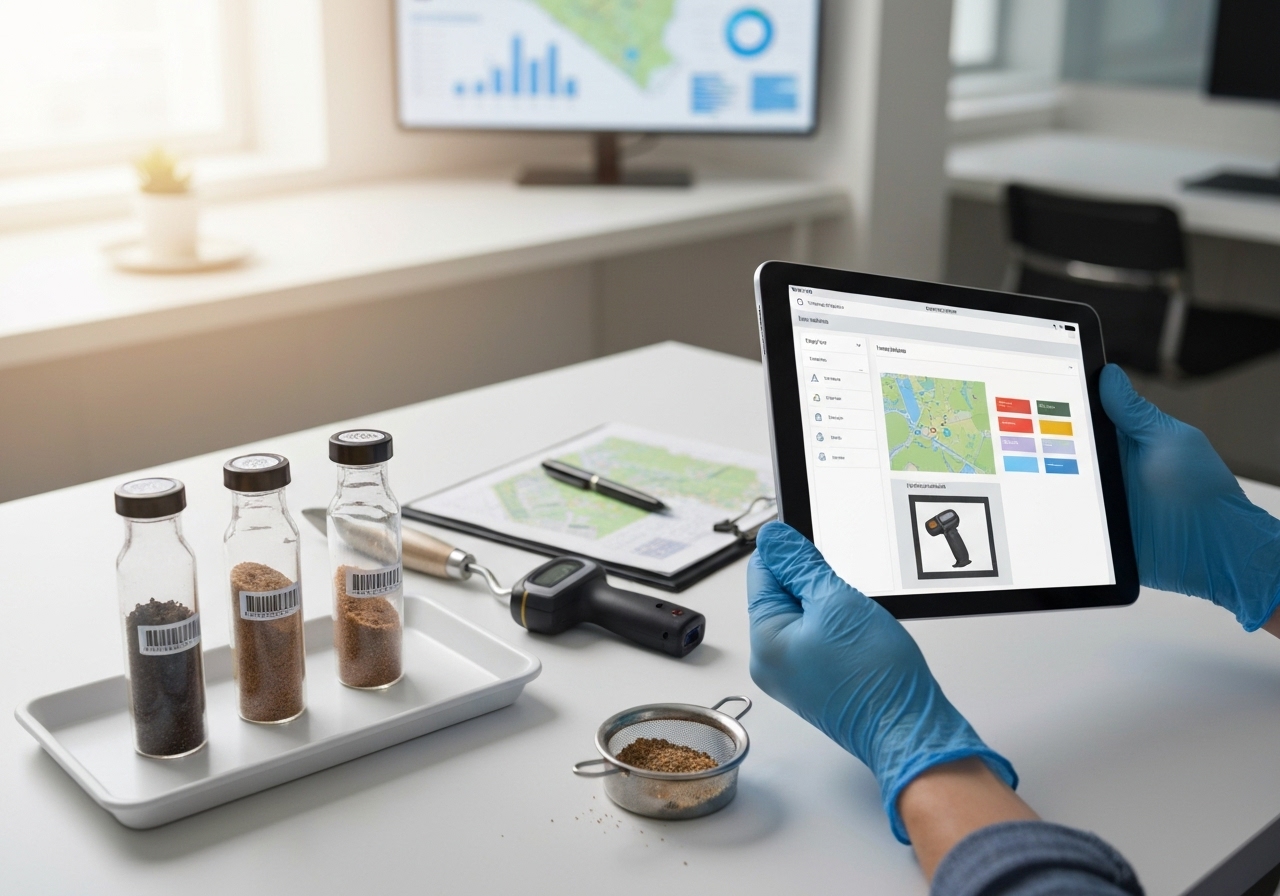
Place samples in sterile bags, keep cool, and ship quickly to a molecular lab. Record GPS coordinates, sampling depth, recent management, crop stage, moisture, and visible soil features. Good metadata increases map value and repeatability.
Step 4: Choose laboratory assays
Select assays that match objectives: 16S rRNA gene sequencing for bacteria, ITS for fungi, shotgun metagenomics for gene-centric functions, qPCR for specific pathogens or functional genes, and enzyme assays for activity proxies. Pair molecular data with soil chemistry (pH, organic matter, nitrate, phosphorus) for interpretation.
Step 5: Process data and build maps
Convert sequence reads into taxa and function tables; normalize counts and filter low-abundance features. Use ordination and clustering to define consortia groups. Apply spatial interpolation (kriging, inverse distance weighting) and machine-learning models (random forest, gradient boosting) to predict consortia distributions across the field.
What metrics define a consortia map?

Consortia maps use a combination of diversity, functional, and indicator metrics to show biological condition.
- Alpha diversity: species richness and Shannon diversity per sample—higher values often correlate with stability.
- Beta diversity: compositional differences between zones—used to identify distinct consortia clusters.
- Functional gene indices: abundance of nitrification, denitrification, nitrogen fixation, phosphorus solubilization, cellulose decomposition genes.
- Indicator taxa: presence/absence of beneficial or pathogenic taxa mapped as hotspots (e.g., mycorrhizal guilds vs. soil-borne pathogens).
- Network metrics: co-occurrence modules and keystone taxa that indicate community stability or susceptibility to disturbance.
How do consortia maps inform specific farm actions?
Consortia maps guide precise interventions by matching biological deficits with targeted treatments.
Variable-rate biological amendments
Apply inoculants, compost teas, or biofertilizers where maps show low functional gene abundance or depleted beneficial taxa rather than broadcasting field-wide.
Targeted cover-crop mixes
Choose cover-crop species that support missing functions; for example, legume-rich mixes in zones with low nitrogen-fixation gene signals, or deep-rooted brassicas where decomposition and pathogen suppression are priorities.
Localized soil chemistry fixes
Apply lime or sulfur in zones where pH limits beneficial microbes, based on co-mapped chemical and microbial layers. Target phosphorus or organic amendments to hotspots that limit microbial activity.
Disease surveillance and containment
Use pathogen hotspots from consortia maps to focus sanitation, crop rotation, or biological controls, reducing the need for preventive blanket fungicide use.
Adaptive grazing and pasture decisions
Integrate microbial maps with pasture management to optimize forage resilience; combine mapping with remote sensing and soil sensors for practical pasture plans. See practical sensor and grazing strategies in smart pasture practices using drones and soil sensors.
How do you integrate microbial maps with other farm datasets?
Combine microbial maps with yield maps, soil texture, topography, remote sensing, and management history to generate multi-layer prescriptions and validate map-driven decisions.
- Overlay yield and microbial deficits to identify biology-driven yield constraints.
- Correlate topographic wetness indices with anaerobic-function genes to spot drainage-related microbial patterns.
- Fuse drone multispectral data with consortia zones to monitor recovery after interventions.
Can small farms practically implement microbial consortia mapping?
Yes. Small farms can implement consortia mapping by scaling sampling intensity to budget and focusing on priority fields or experimental plots. Community labs, cooperative testing, and phased sampling reduce costs.
For small-scale climate farms specifically, use streamlined protocols and lower-cost assays to get meaningful guidance; see methodologies tailored to small operations in soil microbiome mapping for small farms.
What tools and vendors support mapping workflows?
Tools span field sampling kits, sequencing providers, bioinformatics platforms, and spatial analytics tools.
- Field: GPS units, sterile sleeves, composite corers, coolers for transport.
- Lab: companies offering 16S/ITS or shotgun sequencing and qPCR services.
- Bioinformatics: open-source pipelines (QIIME2, mothur) and cloud services for sequence processing.
- Spatial analytics: GIS packages (QGIS, ArcGIS), R libraries (sp, gstat, vegan), and machine-learning platforms for predictive mapping.
- Decision support: software that integrates microbial layers with VRA (variable-rate application) controllers or prescription platforms.
What are the limitations and challenges of consortia mapping?
Consortia mapping is powerful but has limitations: temporal variability, interpretation complexity, cost, and regulatory or advisory gaps.
- Temporal dynamics: microbial communities change with season, moisture, and crop stage; repeat sampling is necessary to track trends.
- Interpretation: presence of taxa or genes does not equal activity; pair molecular data with enzyme assays or respiration tests for functional validation.
- Cost: high-resolution sequencing across large acreage can be expensive; prioritize zones and use tiered approaches.
- Data integration: requires multidisciplinary skills (soil science, microbiology, GIS); collaborate with extension services or consultants where needed.
How often should fields be mapped?
It depends on objectives, but a practical cadence is: baseline survey, post-intervention survey at 12 months, then annual or biennial monitoring. For disease surveillance, sample more frequently during vulnerable windows.
What return on investment (ROI) can farmers expect from microbial mapping?
ROI varies by farm and intervention; common outcomes include reduced input costs, targeted amendments, improved yield stability, and faster recovery from stress.
Examples of measurable returns:
- Reduction of blanket biological inoculant purchases by 30–70% when applied only to identified deficit zones.
- Improved fertilizer use efficiency when microbial nitrification or mineralization hotspots guide variable-rate applications.
- Reduced disease-related losses through early hotspot detection, cutting treatment costs and crop loss.
How do you validate a consortia map on-farm?
Validate maps by implementing pilot interventions in mapped zones and measuring biological and agronomic responses: soil laboratory follow-up, enzyme activity, plant vigor, and yield checks. Use randomized strips or paired plots to separate map-guided actions from natural variability.
What are the best practices for sampling, storage, and lab communication?
Follow standardized sampling protocols, use sterile tools, keep samples cool, and provide labs with complete metadata. Request read depth, negative controls, and raw count tables to enable reproducible analysis.
How do microbial consortia maps fit into sustainable and regenerative farming?
Consortia maps are decision tools that accelerate regenerative transitions by pinpointing where biological interventions will have the greatest effect and by monitoring recovery over time. Combine mapping with soil-building practices such as cover cropping, reduced tillage, organic amendments, and diversified rotations to scale improvements.
For broader sustainable strategies and management frameworks that align with microbial interventions, consult resources on sustainable farming practices.
What are common mistakes to avoid?
Avoid these pitfalls when implementing consortia mapping:
- Sampling only single locations and extrapolating widely—insufficient sampling reduces map reliability.
- Using sequencing data without matching soil chemistry and management metadata—interpretation will be weak.
- Expecting immediate yield gains—microbial shifts often require months to years to translate into agronomic results.
- Skipping validation—always pilot and measure outcomes before scaling interventions.
How can farms scale microbial mapping across multiple fields?
Scale by prioritizing representative fields, standardizing sampling protocols, automating sample metadata collection, and building a repeatable analytics pipeline. Leverage partnerships with regional labs and cooperative groups to reduce per-sample costs. Integrate maps into farm management software to create prescriptive layers.
What are emerging trends and innovations in field-scale microbial mapping?
Emerging trends include point-of-need DNA testing, cheaper metagenomics, integration with drone and satellite remote sensing, and AI-driven predictive microbiome models. Robotics for sampling and automated sample handlers will further reduce labor.
Innovations in pollination and biological service automation are creating complementary pathways for biological farm systems; explore intersections with novel technologies such as robotic pollinators in broader farm innovation literature like recent crop pollination innovations.
Implementation checklist: What to do next?
Follow this practical checklist to start a consortia mapping program.
- Define clear objectives: yield, disease management, soil building, or input reduction.
- Select fields and resolution based on objectives and budget.
- Create a sampling plan with GPS-tagged points and metadata templates.
- Choose assays aligned to goals: 16S/ITS, shotgun, qPCR, or enzymes.
- Partner with a lab and a data analyst or extension service.
- Produce maps, validate with pilots, and translate maps into targeted actions.
- Monitor responses and refine sampling annually.
Conclusion
Microbial consortia maps are practical tools for modern agriculture that reveal the biological dimension of soil health at farm scale. When designed with clear objectives, proper sampling, and paired with soil chemistry and management data, consortia maps enable precise, cost-effective, and sustainable interventions. Farmers who integrate microbial mapping into broader precision and regenerative plans gain the ability to target biology-driven actions, measure progress, and prioritize investments that build resilient soils and stable yields over time.
Start small, partner with trusted labs or extension services, validate with pilot plots, and scale maps into routine farm planning. For practical sensor-driven pasture strategies and precision tools that pair well with microbial mapping, see smart pasture practices using drones and soil sensors and for small-farm mapping protocols read soil microbiome mapping for small farms.


