
Regenerative microclimate mapping practices for small farms
Regenerative microclimate mapping practices for small farms
Regenerative microclimate mapping gives small farms practical, site-specific data to improve crop selection, soil health, water use, and biodiversity. This article explains what microclimate mapping is, why it supports regenerative agriculture, low-cost and advanced mapping methods, step-by-step implementation, and how to convert maps into on-farm regenerative actions.
What is regenerative microclimate mapping?
Regenerative microclimate mapping is the process of measuring and mapping local climate variables at the scale of fields, paddocks, hedgerows, and garden beds to guide regenerative practices. It records temperature, humidity, wind, solar exposure, soil moisture, and related variables across small-distance gradients to reveal management zones and design opportunities.
Why does microclimate mapping matter for small farms?
Microclimate mapping helps small farms because local conditions often vary within tens of meters and those differences drive plant performance, pest pressure, and soil processes. Identifying cooler pockets, frost-prone hollows, wind-exposed ridges, or moisture-retentive swales enables targeted regenerative interventions such as agroforestry, cover cropping, and water-harvesting features.
Which regenerative outcomes improve using microclimate maps?
Maps support measurable regenerative outcomes. Use maps to:
- Improve soil health by placing cover crops and reduced-till zones where erosion risk or temperature stress is highest.
- Increase biodiversity by locating habitat corridors and pollinator strips where floral resources survive microclimate extremes.
- Reduce irrigation needs by matching plantings to moisture-retentive sites and scheduling watering precisely.
- Enhance resilience by siting windbreaks, shelterbelts, and agroforestry edges to buffer vulnerable areas.
Which variables to map on a small regenerative farm?
Answer: map temperature, humidity, wind, solar exposure, soil moisture, soil temperature, and surface features.
Start with a core suite of variables that drive plant growth and soil processes:
- Air temperature at crop height to detect frost pockets and heat stress zones.
- Relative humidity and dew point for pathogen risk and irrigation timing.
- Wind speed and direction for windbreak placement and spray drift planning.
- Solar radiation and aspect to choose crop types and shade-tolerant plantings.
- Soil moisture and temperature to guide irrigation and cover crop mixes.
- Surface and subsurface features (slope, compaction, organic matter, drainage lines).
How to map microclimate: low-cost to advanced methods?
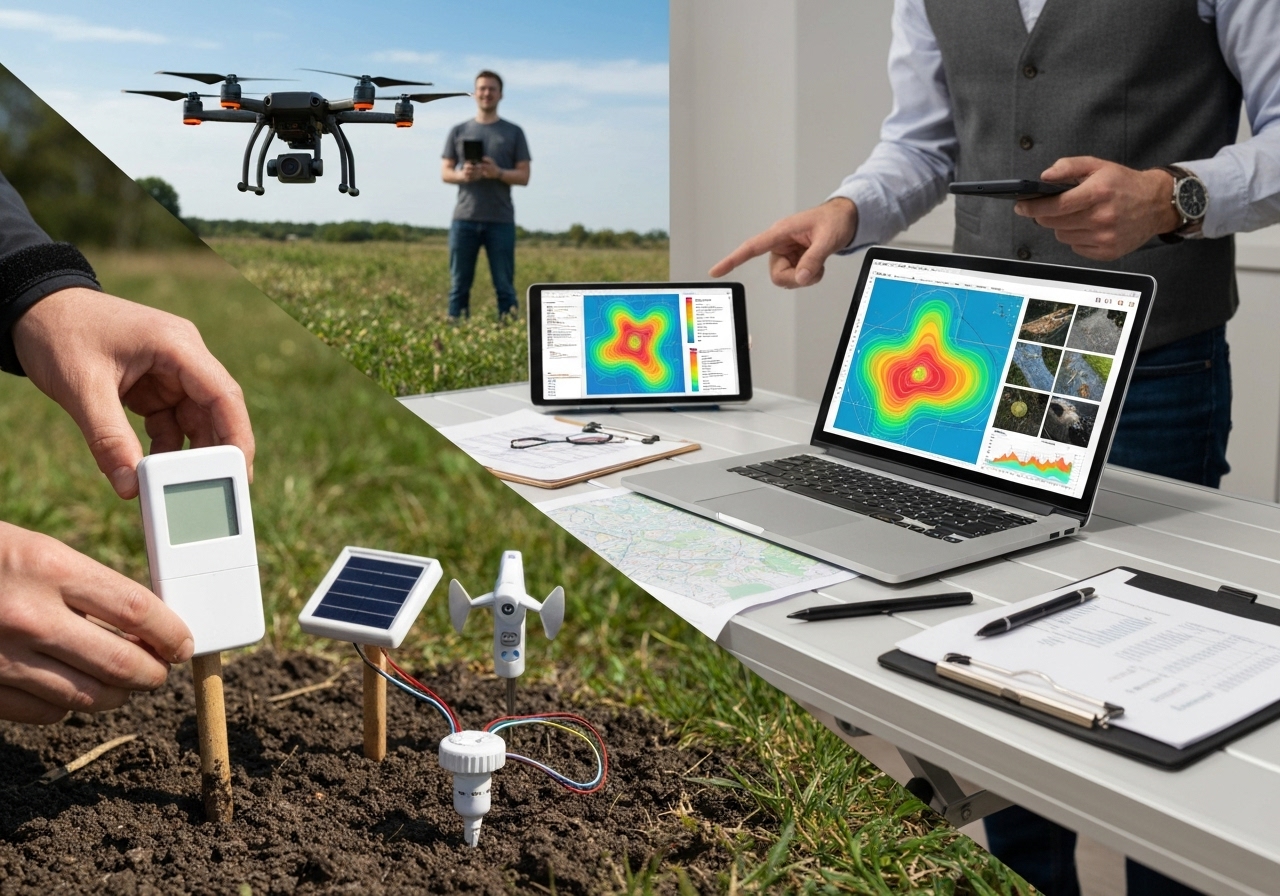
Answer: choose a mix of sensors, mobile measurements, drones and remote sensing depending on budget and scale.
Small farms can build useful maps with affordable tools. Combine stationary sensors, mobile data collection, and occasional drone surveys for an effective mapping program.
Low-cost methods (best for most small farms)
- Handheld infrared thermometers for surface temperature checks.
- Battery-powered soil moisture probes (capacitance or TDR) for spot checks.
- Low-cost weather stations or single-point loggers (temperature/humidity) placed in representative microzones.
- Mobile transects: walk the field and record measurements at regular intervals (grid or transect sampling).
- Smartphone GPS and simple mapping apps (e.g., mobile GIS, KML layers) to geotag observations.
Intermediate methods
- Networked soil moisture sensors with data loggers for continuous monitoring.
- Wireless temperature/humidity loggers that upload via cellular or Wi‑Fi.
- Thermal and multispectral cameras on consumer drones to detect crop stress and surface temperature patterns.
- GIS software such as QGIS (open source) for layer integration and map production.
Advanced methods
- LiDAR or high-resolution multispectral drone surveys to map canopy structure and micro-topography.
- Integrated sensor networks (soil, atmosphere, plant health) feeding into farm management platforms.
- Machine learning models to predict microclimate zones from terrain, vegetation, and historical weather.
How to design a practical microclimate mapping program?
Answer: follow a 10-step implementation plan tailored to small-farm scale and regenerative goals.
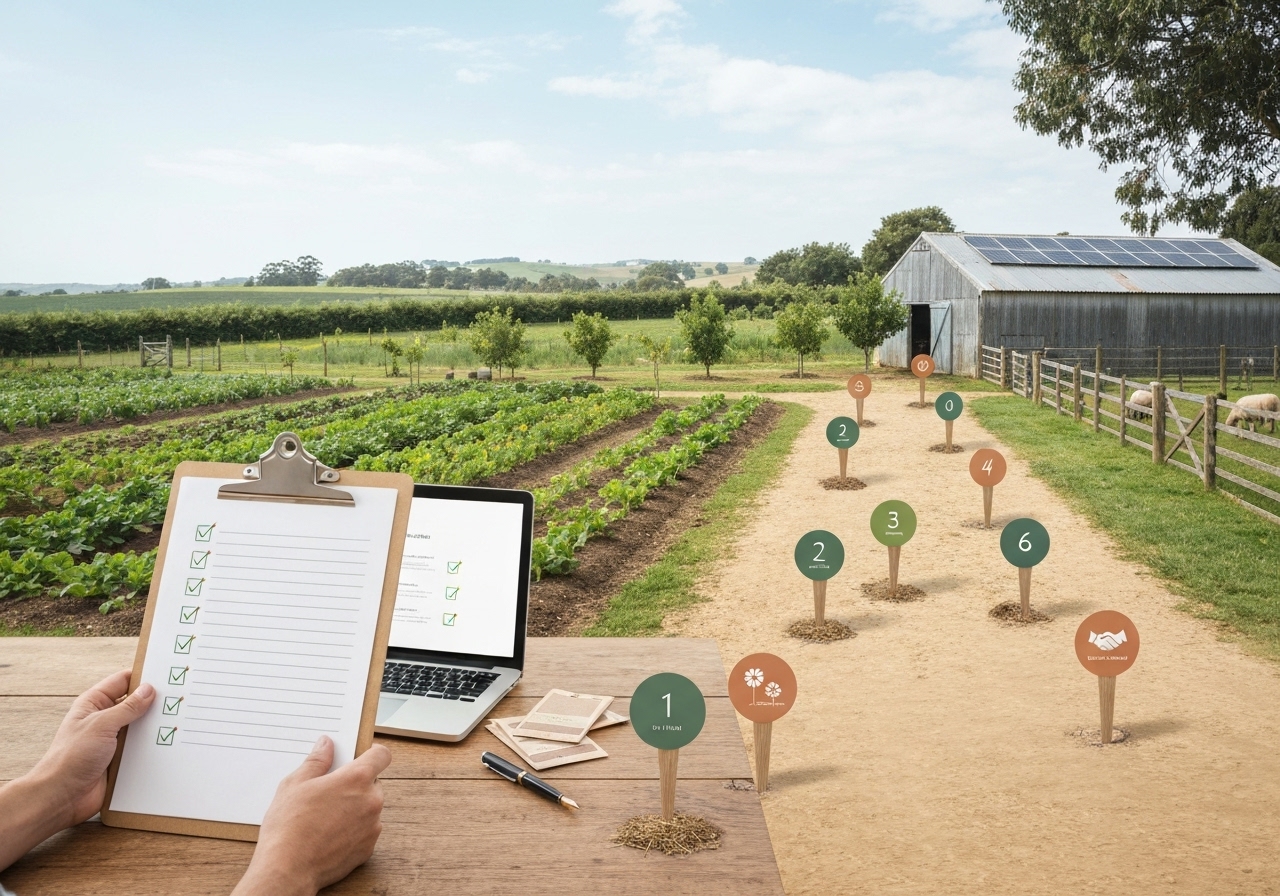
- Set objectives: define what regenerative outcomes you want (soil carbon increase, irrigation reduction, pollinator habitat).
- Map assets: create a base map with property boundaries, infrastructure, elevation contours, and existing vegetation.
- Select variables: choose the core variables to measure (see previous section).
- Choose methods: decide which mix of low-cost and advanced tools fits budget and timeline.
- Design sampling: set grid size or transect spacing (10–50 m spacing works for variable small fields).
- Deploy sensors: place stationary loggers in representative microzones and mark locations on the base map.
- Collect mobile data: perform transects with handheld probes and drone flights during key periods (pre-dawn frost checks, midday heat, post-rain).
- Integrate data: import sensor logs, GPS points and drone imagery into GIS for layering and interpolation (IDW, kriging, or simple averaging).
- Translate to actions: identify management zones and prioritize regenerative interventions (see next section).
- Monitor and adapt: track key metrics over seasons and adjust sensor density and management responses.
How to turn microclimate maps into regenerative practices?
Answer: use mapped zones to guide targeted plantings, water management, soil-building practices, and animal integration.
Maps become valuable when they lead to location-specific regenerative actions.
Planting and species selection
- Locate drought-tolerant crops on high-radiation, well-drained ridges.
- Plant shade-tolerant understory or agroforestry species on cooler north-facing slopes or near shelterbelts.
- Design pollinator strips and floral resources in sheltered moist corridors identified by the map.
Water and soil management
- Install swales, berms, or infiltration basins in moisture-deficient areas to capture runoff and raise water tables.
- Adjust mulching and organic matter application to moisture-retentive versus free-draining zones.
- Schedule irrigation by soil moisture zones rather than uniform timing to reduce water use and runoff.
Vegetative and structural design
- Sow windbreaks or shelterbelts along wind-exposed edges identified by wind maps.
- Create temperature buffers (hedgerows, tree lines) to reduce frost risk and stabilize microclimates.
- Integrate agroforestry strips in thermal transition zones to provide shade and biomass.
Grazing and livestock integration
Use microclimate maps to rotate livestock into areas that will benefit from compaction alleviation, nutrient recycling, and targeted biomass removal. For connected practices, review smart pasture techniques and sensor-driven grazing described in smart pasture management using drones and sensors.
How does soil microbiome mapping interact with microclimate mapping?
Answer: combining soil microbiome and microclimate maps refines regenerative choices for cover crops and amendments.
Soil microbial communities respond to moisture and temperature gradients. Pair microclimate maps with soil microbiome data to choose cover crop species, inoculants, and organic inputs that suit local microbial conditions. For methods and protocols on profiling soil biology on small farms, see practical approaches described in soil microbiome mapping techniques for small-scale climate farms.
What software and tools work best for small-farm mapping?
Answer: combine free GIS tools with commodity sensor platforms for affordable map production and analysis.
Recommended tools:
- QGIS — open-source GIS for layering sensor outputs, drone imagery, and topography.
- OpenDroneMap or Pix4D for processing drone imagery into orthomosaics and thermal layers.
- FarmOS or simple cloud spreadsheets for sensor data logging and metadata.
- Low-cost IoT platforms (LoRaWAN gateways, ThingsBoard, or provider dashboards) to aggregate sensor data.
- R or Python for customized spatial interpolation and basic analytics if you need predictive models.
How to prioritize interventions from microclimate maps?
Answer: rank actions by regenerative impact, cost, and urgency and pilot small changes first.
Prioritization framework:
- Urgency — address frost pockets or erosion-prone slopes first to avoid immediate losses.
- Impact — prioritize actions with high soil-carbon, biodiversity, or water-saving potential per dollar.
- Feasibility — implement low-cost demonstrations before large investments.
- Scalability — choose interventions that can expand across similar microzones.
What metrics track success after interventions?
Answer: monitor soil health, water use, crop yields, biodiversity indicators, and microclimate stability.
Key metrics to monitor quarterly and annually:
- Soil organic matter and infiltration rate.
- Soil moisture variability and irrigation volumes.
- Crop yields by microzone and harvest quality.
- Pollinator and beneficial insect counts in habitat strips.
- Microclimate variance: reduced maximum temperatures, fewer frost events, lower wind speed peaks.
What are typical costs and budget options?
Answer: budgets range from a few hundred dollars for simple mapping to tens of thousands for advanced drone+LiDAR setups.
Example budget tiers:
- Low-cost (< $1,000): handheld sensors, 2–4 data loggers, a smartphone map app, and basic GIS training.
- Mid-range ($1,000–$8,000): networked soil sensors, regular drone surveys with thermal camera, and paid processing software.
- Advanced ($8,000+): LiDAR, permanent sensor networks, professional drone services, and custom analytics.
Start small: pilot one field with low-cost sensors before committing to the mid-range setup.
What common pitfalls and troubleshooting tips should small farmers know?
Answer: avoid sparse sampling, ignore metadata, and delay calibration; instead design repeatable sampling and validate sensors.

- Do not under-sample: too few points yield misleading interpolations. Use a denser grid in heterogeneous areas.
- Calibrate sensors: check probes against known standards seasonally.
- Record metadata: include time of day, recent weather events, and sensor orientation with every reading.
- Avoid overfitting: do not over-interpret one-off anomalies — look for repeated patterns across seasons.
- Migrate data safely: back up sensor logs and geospatial files to cloud storage.
How do microclimate mapping and regenerative philosophy fit together?
Answer: maps make regenerative choices site-specific and efficient, reinforcing ecological processes rather than uniform interventions.
Regenerative agriculture favors diversity, living roots, and adaptive management. Microclimate mapping gives the spatial resolution needed to place those practices where they will thrive and accelerate on-farm ecological recovery. For broader sustainable farming strategies that align with regenerative mapping, see principles in eco-friendly and sustainable farming approaches.
What are practical next steps for a small farmer interested in starting?
Answer: begin with a clear objective, a small pilot plot, and a simple sensor kit; scale after learning.
Action checklist:
- Decide on a primary objective (reduce frost loss, save irrigation water, increase forage quality).
- Map property basics: boundaries, access, slope, and existing vegetation.
- Buy or borrow 2–4 loggers and a handheld moisture probe.
- Perform transect sampling at different times of day and process results in QGIS or a simple mapping app.
- Design a small intervention (e.g., a shelterbelt, mulch strip, or swale) in the highest priority microzone and monitor changes.
Summary: what value does regenerative microclimate mapping deliver for small farms?
Answer: it delivers targeted, cost-effective regenerative outcomes by connecting local climate patterns to on-the-ground practices.
Microclimate mapping empowers small farms to match species, soil-building practices, water infrastructure, and grazing patterns to the fine-scale realities of their land. By combining low-cost sensors, mobile measurements, and simple GIS, farmers can create maps that reduce risk, increase productivity, and accelerate regenerative change. Start with a clear objective, pilot small, and scale interventions that yield the greatest ecological and economic returns.
Further reading: explore practical applications of sensors and grazing in smart pasture management using drones and sensors, or learn how soil biology complements mapping through soil microbiome mapping techniques. For broader sustainable practice context, see eco-friendly and sustainable farming approaches.
Implement microclimate mapping as a continuous learning tool: measure, act, monitor, and adapt. That iterative cycle turns spatial data into resilient, regenerative farms.


