
Sensor-Guided Microclimate Farming for Urban Orchards
What is sensor-guided microclimate farming for urban orchards?
Sensor-guided microclimate farming is the practice of using distributed sensors and automated controls to monitor and manage the local climate around trees in urban orchards. This approach relies on real-time data from air, soil, and plant sensors to adjust irrigation, shading, ventilation, and pollination supports at the tree or plot level.
Sensor-guided systems make micro-scale weather decisions rather than relying solely on regional forecasts. They reduce water use, lower disease risk, and increase fruit quality by tailoring interventions to local microclimates created by buildings, pavement, and urban heat islands.
Why use sensor-guided microclimate farming in urban orchards?
Sensor-guided microclimate farming improves productivity, resource efficiency, and resilience for urban orchards. Sensors enable precise irrigation scheduling, early disease and frost detection, and targeted microclimate modification, which together increase yield consistency and reduce inputs.
- 1. Save water: reduce irrigation by 20–50% through soil moisture and evapotranspiration monitoring.
- 2. Prevent losses: detect frost pockets and humidity spikes before visible damage occurs.
- 3. Improve fruit quality: manage sun exposure and water stress to optimize sugar and acid balance.
- 4. Increase biodiversity: enable targeted supports for pollinators and beneficial microbes.
What core components make a sensor-guided microclimate system?
A sensor-guided microclimate system consists of sensors, networking, analytics, actuators, and user interfaces. Each component must be selected and placed with urban constraints in mind, such as limited space, variable shading, and vandalism risk.
Sensors
Sensors collect data on the variables that define microclimate and plant health. Use the following sensor types:
- Air temperature and relative humidity sensors for canopy microclimate.
- Soil moisture, temperature, and salinity probes at multiple depths.
- Leaf wetness sensors for disease risk modeling.
- PAR (photosynthetically active radiation) sensors or light sensors for shading and solar exposure.
- Anemometers or wind sensors in exposed sites to manage spray drift or wind protection.
- CO2 and VOC sensors for advanced canopy respiration and stress detection.
Networking and power
Networking delivers sensor data to local controllers or cloud analytics. Choose wired or wireless networking depending on site density and interference.
- LoRaWAN for low-power long-range urban penetration.
- Wi‑Fi for high-bandwidth cameras and local hubs.
- Cellular (NB-IoT or 4G/5G) for distributed installations without local gateways.
- Power via solar panels with battery buffering for off-grid nodes.
Actuators and controls
Actuators change the microclimate based on analytics. Common actuators include variable-rate drip valves, automated misting or frost fans, shade sails, and heating cables for frost protection.
Analytics and decision rules

Analytics translate data into actions. Use layered rules: 1) threshold triggers (e.g., soil moisture < 20% triggers irrigation), 2) predictive models (frost prediction based on radiative cooling), and 3) machine learning models that learn tree water-use patterns over seasons.
How do sensors and microclimate control improve irrigation?
Sensors enable irrigation on demand and at tree-scale, reducing waste and improving root-zone health. Calibrate irrigation schedules using soil moisture depletion curves and evapotranspiration (ET) estimates.
Steps to optimize irrigation
- Install soil moisture sensors at root depth (2–3 sensors per tree zone).
- Define target volumetric water content ranges per species and soil type.
- Use thresholds and time-of-day constraints to avoid nighttime overwatering that increases disease risk.
- Implement variable-rate emitters controlled by local valves or a centralized controller to deliver precise volumes.
How do you monitor and manage disease and frost risk with sensors?
Monitor humidity, leaf wetness, and canopy temperature to predict and prevent disease outbreaks and frost events. Sensors detect microclimate pockets where pathogens and frost appear before they impact the entire orchard.
Practical disease-risk actions
- Trigger targeted fungicide applications only when leaf wetness and humidity patterns match pathogen thresholds.
- Delay irrigation if leaf wetness remains high after sunset to reduce infection windows.
- Activate misting/fan systems or low-energy heaters when radiative cooling indicates frost formation risk.
How does sensor-guided microclimate farming support pollination?
Sensor-guided systems increase pollination effectiveness by managing flower microclimate and integrating pollinator supports. Monitor temperature and humidity during bloom to schedule supplemental pollinators or robotic assistance.
Integrate pollination strategies with microclimate controls: warming frost-prone patches during bloom and providing shaded refuges in heatwaves improves pollinator activity. Pair these interventions with pollinator technology where needed, such as robotic pollinators and lab-based solutions in areas with low wild pollinator abundance.
What role does soil biology play in a sensor-guided orchard?
Soil biology drives nutrient cycling and water retention; sensors cannot replace biological assessment but can complement it. Use microbiome mapping and periodic bioassays to guide biological amendments and interpret sensor data in context.
Combine continuous physical measurements with periodic biological sampling to reveal how microclimate changes affect microbial activity and root health. For detailed approaches to mapping soil biology for climate-minded farms, review methods used in soil microbiome mapping for small-scale climate farms.
How should sensors be placed in an urban orchard?
Place sensors to capture spatial microclimate variability created by buildings, streets, trees, and pavements. Use a stratified placement strategy focusing on known microclimate drivers.
Placement best practices
- Place air sensors at canopy height to measure conditions experienced by flowers and fruit.
- Place soil probes in the root zone on both sunny and shaded sides of tree rows.
- Locate leaf wetness sensors in representative canopy sections prone to nighttime moisture accumulation.
- Install radiation sensors above tree tops where possible to measure direct sun exposure.
How do you integrate sensor data and farm management systems?
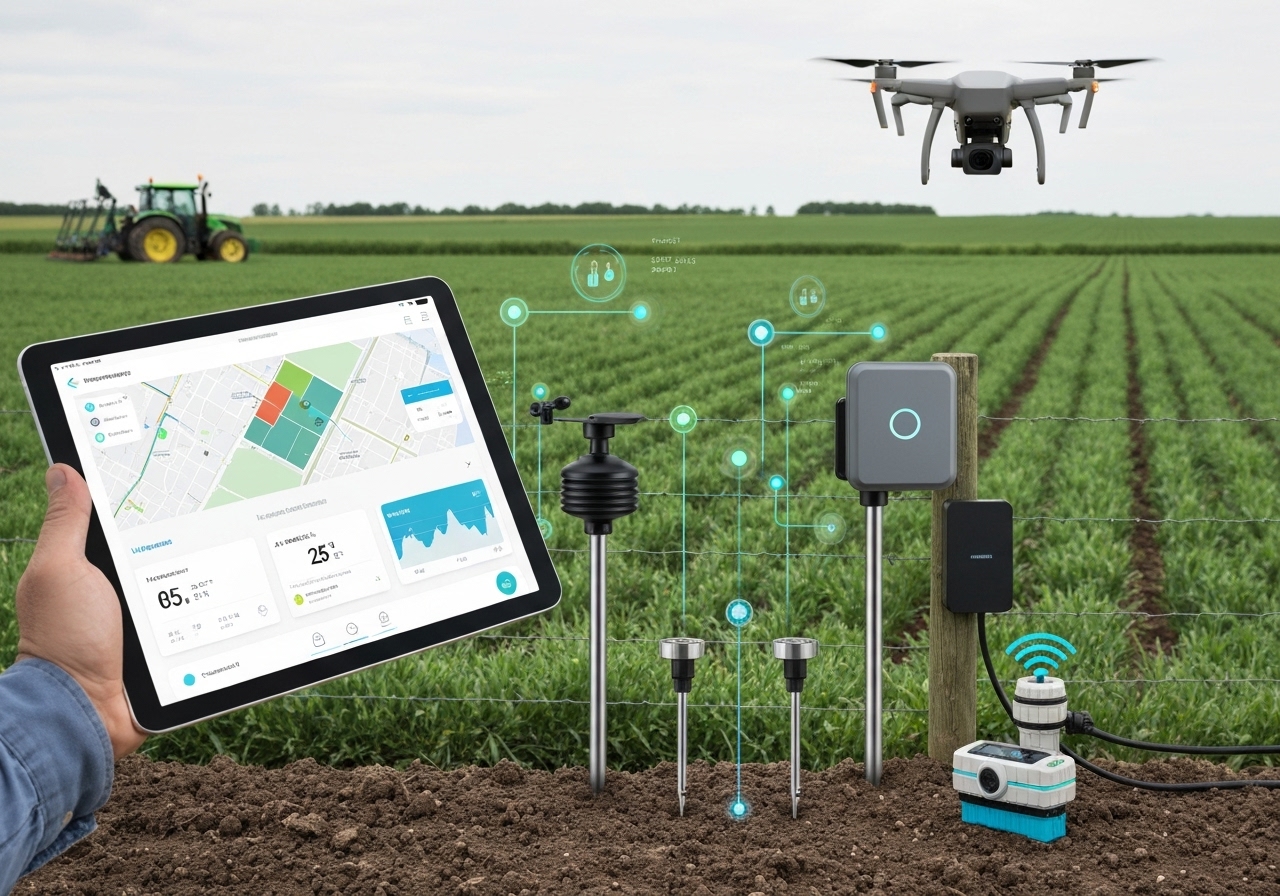
Integrate sensor streams into a central platform that supports visualization, alerting, and actuator control. Use APIs and standardized protocols to avoid vendor lock-in and to enable modular upgrades.
Data workflows
- Collect: stream from edge nodes to a gateway.
- Store: time-series database for historical analysis.
- Analyze: run real-time rules and periodic machine learning training.
- Act: issue control commands to actuators or create alerts for operators.
Analytics features to prioritize
- Frost pocket prediction using night-time radiation and temperature gradients.
- ET-based irrigation scheduling calibrated per tree species.
- Event-based alerts for storm, heatwave, and disease risk windows.
What are practical microclimate control strategies?
Apply targeted controls to modify local microclimate around trees rather than trying to change the whole urban environment.
Cooling strategies
- Light-reflective mulches to reduce soil heat accumulation.
- Automated shade sails deployed during heat spikes to reduce sunburn and excessive transpiration.
- Misting systems for evaporative cooling targeted at midday heat pockets.
Warming strategies
- Low-energy infrared heaters or thermal blankets for frost-sensitive trees.
- Water-based frost protection using regulated overhead sprinklers when soil sensors indicate root vulnerability.
- Windbreaks and localized heaters placed in radiation-prone hollows.
How do you measure economic value and ROI?
Measure ROI by comparing yield and quality improvements, water savings, and avoided losses against capital and operating costs. Use a 3–5 year model for payback when including hardware, installation, and data services.
Key metrics
- 1. Water saved (m3 per year)
- 2. Yield increase (kg or tons per tree)
- 3. Quality premiums received (price per unit)
- 4. Disease and frost damage avoided (estimated historic loss reduction)
- 5. Total cost of ownership (hardware + comms + service)
Example: A retrofit that reduces irrigation by 30% and avoids a single frost event that would have killed 10% of bloom can pay back sensors and controllers within 2–4 seasons in mid-value orchards.
How do you implement sensor-guided microclimate farming step-by-step?
Implement sensor-guided microclimate farming in staged steps to manage risk and cost.
Implementation steps

- Assess site microclimate variability and identify priority blocks for intervention.
- Set clear objectives: water saving, frost prevention, or quality improvement.
- Choose a starter sensor kit: soil moisture + air temp/humidity + leaf wetness + light sensor.
- Deploy sensors in a pilot area of 10–20 trees and run 1 season to collect baseline data.
- Build control rules from baseline data and automate one actuator (e.g., irrigation valves).
- Iterate with additional sensors (wind, CO2) and actuators (shade, misting) in subsequent phases.
- Scale to full orchard after achieving stable automations and measurable benefits.
What are common challenges and how do you mitigate them?
Common challenges include sensor drift, data overload, vandalism, and urban interference. Mitigate them with redundancy, routine calibration, and robust physical protection.
Mitigation strategies
- Redundancy: use duplicate sensors in critical locations.
- Calibration schedule: verify probe accuracy seasonally.
- Edge filtering: run basic thresholds on local devices to reduce cloud traffic.
- Physical protection: lock boxes and tamper alarms in public spaces.
- Community engagement: visible signage and orchard programs reduce vandalism and increase local stewardship.
How can urban orchards use sensor-guided systems to support sustainability goals?
Sensor-guided systems directly support sustainability goals by reducing inputs, increasing carbon sequestration through healthier trees, and enabling regenerative practices. Use precise irrigation and microclimate management to conserve water and reduce chemical use.
Link sensor-guided practices with broader sustainable frameworks and resources such as eco-friendly and sustainable farming guides to align microclimate actions with community-level sustainability targets.
What policy or community considerations are important?
Plan sensor deployments with local authorities and stakeholders in mind. Address data privacy, urban planning constraints, and neighborhood aesthetics up front.
Community integration checklist
- Confirm permitting requirements for non-standard structures (shade sails, small masts).
- Establish data-sharing agreements if sensor data informs municipal water systems.
- Create community outreach programs to demonstrate benefits and gather volunteers for monitoring.
What future innovations will shape sensor-guided urban orchards?
Future innovations include integrated microbiome-informed control, robotic pollination augmentation, and more autonomous edge analytics. Combining soil biology insights with climate controls will allow adaptive treatments that favor beneficial microbes and root health.
Explore related innovations in landscape-scale sensor application such as precision grazing and pasture monitoring to understand cross-sector technology transfers (smart pasture monitoring examples).
How do you design a pilot project for a city orchard?
Design a pilot by defining objectives, selecting representative sites, and setting measurable KPIs such as water saved, percent yield change, and incidence of frost damage. Keep pilots short (one full season) and focused on a single problem to show quick wins.
Pilot project template
- Objective: reduce irrigation by 30% without yield loss.
- Site: 20 trees across three microclimate types (sunny, shaded, pavement-adjacent).
- Sensors: soil moisture at 3 depths, canopy temp/humidity, PAR.
- Actions: automated variable-rate drip and shade deployment.
- KPIs: volumetric water use, fruit set rate, leaf disease incidence.
What are practical examples and case studies?
Case studies of urban microclimate systems show 25–40% water savings and 10–25% yield improvement when irrigation and frost protection are automated and targeted. In mixed-use urban settings, combining microclimate management with habitat supports increases pollinator visitation and fruit set.
What are recommended next steps for orchard managers?
Start with a site audit and objectives, then run a small pilot using low-cost sensors and off-the-shelf networking. Prioritize soil moisture and canopy humidity sensors first, then expand to active microclimate control and predictive analytics.
For managers new to tech-driven farming, combine sensor systems with proven agronomic practice guides and local expertise. Use internal knowledge resources on crop and orchard practices to expand skillsets; foundational reading such as what crop farming entails and innovation briefs like opportunities and innovations in crop farming can help frame strategic decisions.
Conclusion: What is the long-term value of sensor-guided microclimate farming?
Sensor-guided microclimate farming makes urban orchards more efficient, resilient, and productive. By shifting decisions from regional averages to tree-scale realities, orchard managers reduce inputs and avoid losses linked to frost, drought, and heat. Long-term value accrues through consistent yields, improved fruit quality, and stronger community engagement with urban green infrastructure.
Adopt a phased approach, pair sensors with biological assessments, and integrate with community and policy frameworks to maximize benefits. Sensor-guided microclimate farming is a practical pathway to resilient urban orchards that deliver ecological, social, and economic returns.


