
Soil Microbial Cocktails: New Paths for Regenerative Farms
What are soil microbial cocktails?
What are soil microbial cocktails? Soil microbial cocktails are tailored mixtures of beneficial microorganisms—bacteria, fungi, archaea and sometimes protozoa—designed to restore, enhance, or reconfigure soil biological communities to support plant health, nutrient cycling and ecosystem resilience on farms.
What are soil microbial cocktails composed of? Typical components include nitrogen-fixing bacteria (e.g., Rhizobium, Azotobacter), phosphate-solubilizing bacteria (e.g., Pseudomonas), mycorrhizal fungi (e.g., Glomus spp.), plant growth-promoting rhizobacteria (PGPR), and decomposer consortia that accelerate organic matter breakdown.
Why do soil microbial cocktails matter for regenerative farms?
Why do soil microbial cocktails matter for regenerative farms? Regenerative farms rely on living soils to sequester carbon, improve water retention, and support productive agroecosystems; microbial cocktails accelerate those goals by reintroducing missing functional groups, rebalancing microbial interactions, and improving nutrient availability without synthetic inputs.
Why do microbial communities influence farm outcomes? Healthy soil microbiomes reduce disease pressure, increase nutrient use efficiency, improve drought tolerance and support crop quality. Microbial cocktails help shift degraded soils toward more diverse, stable ecological states that underpin long-term farm resilience.
How are soil microbial cocktails formulated?
How are soil microbial cocktails formulated? Formulation begins with defining farm goals, sampling soils, and selecting strains that provide complementary functions. Formulators choose microbial strains for traits such as nitrogen fixation, phosphorus solubilization, hormone production (e.g., auxins), pathogen suppression and organic matter decomposition.
Sampling and diagnostic steps

Sampling and diagnostic steps: First, collect soil and root samples across fields to capture spatial variability. Second, run soil chemical tests (pH, CEC, available P, K), aggregate stability, and baseline microbial biomass. Third, perform microbiome sequencing or targeted assays to identify deficits or dominant taxa.
Selection criteria and compatibility
Selection criteria and compatibility: Choose microbes with proven field efficacy, compatibility with local soil chemistry, and the ability to survive formulation and storage. Prioritize native or locally adapted strains when possible to avoid ecological mismatch. Ensure that combined organisms do not antagonize each other and that their metabolic niches complement one another.
Which production and delivery methods work on farms?
Which production and delivery methods work on farms? Production uses fermentation (liquid culture) for bacteria and spore-based production for fungi. Delivery formats include seed coatings, granular carriers, compost inoculants, liquid foliar or soil drench applications, and slow-release biochar or polymer matrices.
On-farm inoculation techniques
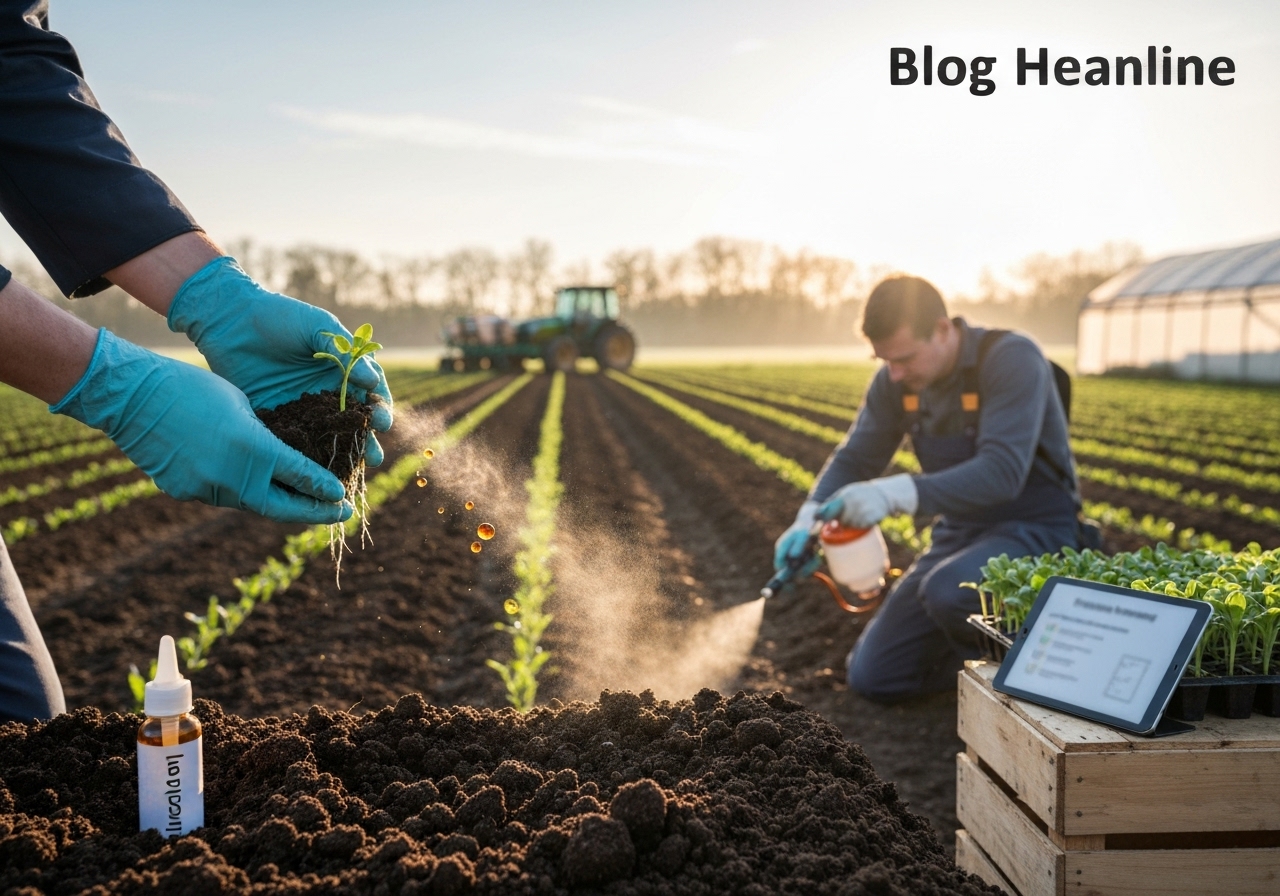
On-farm inoculation techniques: Apply microbial cocktails as seed treatments before planting to ensure root colonization. Use soil drenches at transplanting or critical growth stages. Mix cocktails into compost or anaerobic digestate to scale inoculation across beds or pastures. Use precision application tools such as seeders and dribblers to place microbes in the rhizosphere zone.
Integration with machinery and sensors
Integration with machinery and sensors: Integrate microbial delivery with variable-rate applicators guided by soil maps, and use soil moisture sensors to time applications when microbes establish best. Combine approaches from precision management to improve efficacy; for example, pair inoculation with targeted irrigation and organic amendments.
How to design a microbial cocktail for a specific farm problem?
How to design a microbial cocktail for a specific farm problem? Define the problem precisely—nutrient deficiency, compaction, disease, low organic matter or drought stress. Match microbial functions to the constraint: decomposers and cellulose degraders for low organic matter, nitrogen-fixers for N-limited systems, mycorrhizae for low-phosphorus soils, and antagonists for disease suppression.
How to prototype and test? Set up small randomized field trials with untreated controls. Monitor plant growth, root colonization, soil chemistry, and yield. Use multiple seasons or crop rotations to determine persistent versus transient effects.
What monitoring and diagnostics are needed after application?
What monitoring and diagnostics are needed after application? Monitor microbial establishment via qPCR or sequencing assays for target taxa. Track soil health indicators: organic matter percentage, aggregate stability, respiration rates, available nutrients, and plant metrics such as root mass and nutrient content.
What role does mapping play? Mapping soil microbiome variation across fields helps place microbial cocktails where they will have the greatest impact. Use microbiome mapping for small-scale climate farms as a model to locate hotspots of deficit or resilience and to guide inoculation zones.
What benefits can farmers expect and on what timeline?
What benefits can farmers expect and on what timeline? Expect short-term benefits within a single season such as improved seedling vigor, reduced fertilizer needs and better nutrient uptake. Medium-term benefits (1–3 years) include increased soil organic matter, higher water-holding capacity, and lowered disease incidence. Long-term benefits (3+ years) include improved soil structure, stable microbial community shifts, and enhanced carbon sequestration.
What variables change outcomes? Outcomes vary by soil type, climate, crop, farm management history and the accuracy of the microbial match. Success improves when microbial inoculation complements regenerative practices—cover cropping, reduced tillage, diversified rotations and organic inputs.
How do microbial cocktails fit into regenerative farming systems?
How do microbial cocktails fit into regenerative farming systems? Microbial cocktails are a tool, not a replacement for whole-farm regenerative practices. Use cocktails to accelerate recovery of degraded soils, to enhance the function of cover crops, and to increase the return-on-investment for organic amendments.
How to combine with pasture and livestock practices? Combine microbial approaches with managed grazing to boost pasture resilience and nutrient cycling. For technical examples, adapt strategies from smart pasture operations and sensor-driven grazing described in smart pasture management: drones, soil sensors and grazing, which explains integrating technology and biological inputs.
What are risks, regulatory issues, and ecological considerations?
What are risks, regulatory issues, and ecological considerations? Risks include introducing non-native strains that could outcompete local microbes, unintended effects on non-target organisms, and variable product quality. Regulatory frameworks vary by country; many jurisdictions require registration of microbial products and biosafety evaluation.
What governance practices reduce risk? Use locally adapted strains, test for pathogenicity, secure regulatory approvals, and apply adaptive monitoring. Work with extension services or accredited labs to validate claims and ensure biosafety compliance. Avoid mass releases of genetically modified strains unless regulations and risk assessments are complete.
How to source or produce reliable microbial cocktails?
How to source or produce reliable microbial cocktails? Source from reputable companies with peer-reviewed efficacy trials and transparent strain lists. For on-farm production, partner with universities or labs for strain isolation, quality control, and fermentation protocols. Maintain sterility and standardized propagation procedures to avoid contamination.
Quality control checklist
- Verify strain identity with molecular assays.
- Confirm viability and shelf life under farm storage conditions.
- Check absence of known pathogens or toxin-producing genes.
- Test efficacy in small-scale field trials before full-scale application.
What are practical steps to implement microbial cocktails on a regenerative farm?
What are practical steps to implement microbial cocktails on a regenerative farm? Follow a stepwise approach:
- Assess—Collect soil, crop and management history data to identify limiting factors.
- Plan—Define objectives, choose compatible microbes and delivery formats.
- Pilot—Run replicated small plots or paddocks with untreated controls.
- Monitor—Track soil and plant indicators and adapt the formula or timing.
- Scale—Apply across fields using precision tools and continue long-term monitoring.
What farm practices enhance success? Combine microbial cocktails with organic amendments, cover crops, minimal tillage, and diversified rotations. Keep soil moist during establishment, and avoid heavy pesticide use that kills inoculated microbes.
Which case studies illustrate success and limitations?
Which case studies illustrate success and limitations? Case studies show that mycorrhizal-rich cocktails increase phosphorus uptake and yield in P-limited soils; multi-strain PGPR cocktails reduce applied nitrogen needs by improving plant nitrogen assimilation. Limitations appear when soil physical constraints (compaction, extreme pH) dominate—microbes alone cannot overcome structural problems without remediation.
Which lessons emerge? Lessons include: test locally, expect variable results across seasons, integrate biological strategies with soil physical and chemical management, and measure return-on-investment rather than assume immediate ROI.
How do microbial cocktails support sustainability and climate goals?
How do microbial cocktails support sustainability and climate goals? Microbial cocktails can increase soil carbon sequestration by accelerating the formation of stable organo-mineral complexes and by improving plant growth that returns more biomass to soils. They reduce dependence on synthetic fertilizers, lowering greenhouse gas emissions from production and application.
How do they relate to broader sustainable farming practices? Use microbial cocktails as part of an overall sustainable strategy that includes careful nutrient budgeting, reduced chemical inputs and habitat diversity. For a broader context on sustainable approaches, review principles in eco-friendly and sustainable farming to align microbial interventions with whole-farm sustainability objectives.
What metrics should farmers use to evaluate success?

What metrics should farmers use to evaluate success? Use a mix of biological, chemical and production metrics:
- Biological: microbial biomass, diversity indices, root colonization rates, soil respiration.
- Chemical: available N, P, K, pH, electrical conductivity.
- Physical: aggregate stability, infiltration rate, bulk density.
- Production: germination rate, biomass, yield, nutrient content of produce.
- Economic: input reductions, profit margin change, cost per hectare of inoculation vs yield benefit.
What research gaps and innovation opportunities remain?
What research gaps and innovation opportunities remain? Key gaps include understanding long-term ecological succession after inoculation, mechanisms of microbe–microbe interactions in situ, and improved delivery technologies that enhance survival and establishment. Opportunities exist in combining microbial cocktails with soil amendments like biochar, developing slow-release carriers, and creating decision-support tools that match cocktails to field conditions.
Opportunities for small-scale and high-tech farms
Opportunities for small-scale and high-tech farms: Small farms can use microbiome mapping and decentralized fermentation to produce localized inoculants, while high-tech farms can integrate drones, sensors and robotic applicators to place cocktails precisely—linking to innovations in crop and pasture management.
Which frequently asked questions do farmers ask?
Will microbial cocktails replace fertilizers?
Will microbial cocktails replace fertilizers? It depends. Microbial cocktails can reduce the need for synthetic fertilizers by improving nutrient efficiency; they rarely eliminate fertilizers immediately. Expect reduced rates over multiple seasons as soil processes rebuild.
Are microbial cocktails safe?
Are microbial cocktails safe? Yes when they are composed of well-characterized, non-pathogenic strains and when producers follow regulatory guidance. Vet products through independent labs and use trials to confirm safety on your farm.
How much do cocktails cost?
How much do cocktails cost? Costs vary widely based on strain complexity, formulation and scale. Budget for trial plots before farm-wide adoption and include monitoring costs when estimating ROI.
How to integrate microbial cocktails into your farm plan today?
How to integrate microbial cocktails into your farm plan today? Start with a soil health assessment and a small pilot. Pair inoculation with regenerative tactics—cover crops, reduced tillage and organic matter additions—to amplify benefits. Document outcomes and adjust plans seasonally.
How to learn more and connect with resources? Attend extension workshops, partner with local labs for microbiome mapping and follow practical innovation guides. Explore related topics on sustained farm practices and innovations in crop farming and technology to build a resilient system—for example, review posts on innovations and methods in crop production to expand your approach.
Conclusion: What are the takeaways?
Conclusion: Soil microbial cocktails are a promising addition to regenerative farming toolkits. They deliver targeted functions that can accelerate soil recovery, improve nutrient cycling, and increase resilience to stressors. Use careful diagnostics, pilot testing and ongoing monitoring to realize benefits. Combine microbial cocktails with broader regenerative practices and technology-enabled management for the greatest impact.
Conclusion: With sound stewardship and evidence-based implementation, microbial cocktails can be a scalable, sustainable pathway for farms seeking to restore soil life and meet production and climate goals.


