
Solar-Powered Microgreen Farms for Urban Food Security
What are Solar-Powered Microgreen Farms for Urban Food Security?
Solar-powered microgreen farms are compact, year-round growing systems that pair photovoltaic (PV) electricity with controlled-environment cultivation to produce nutrient-dense microgreens inside urban spaces.
Solar-powered microgreen farms reduce reliance on long supply chains. They deliver fresh greens near points of consumption. They can operate on rooftops, balconies, shipping containers, and vacant lots.
Why do microgreens matter for urban food security?
Microgreens matter because they provide high nutrient density, fast crop cycles, and low space requirements compared with mature vegetables.
Microgreens provide concentrated vitamins, minerals, and antioxidants. Multiple peer-reviewed studies report vitamin and carotenoid concentrations 4–40 times higher in many microgreens than in mature leaves. Microgreens mature in 7–21 days. Microgreen systems yield harvests 10–50 times per year on the same footprint.
How do solar-powered microgreen systems work?
Solar-powered microgreen systems work by converting sunlight to electricity, storing energy, and powering LED lighting, pumps, and sensors that sustain indoor-grown microgreens.
Photovoltaic generation and energy storage
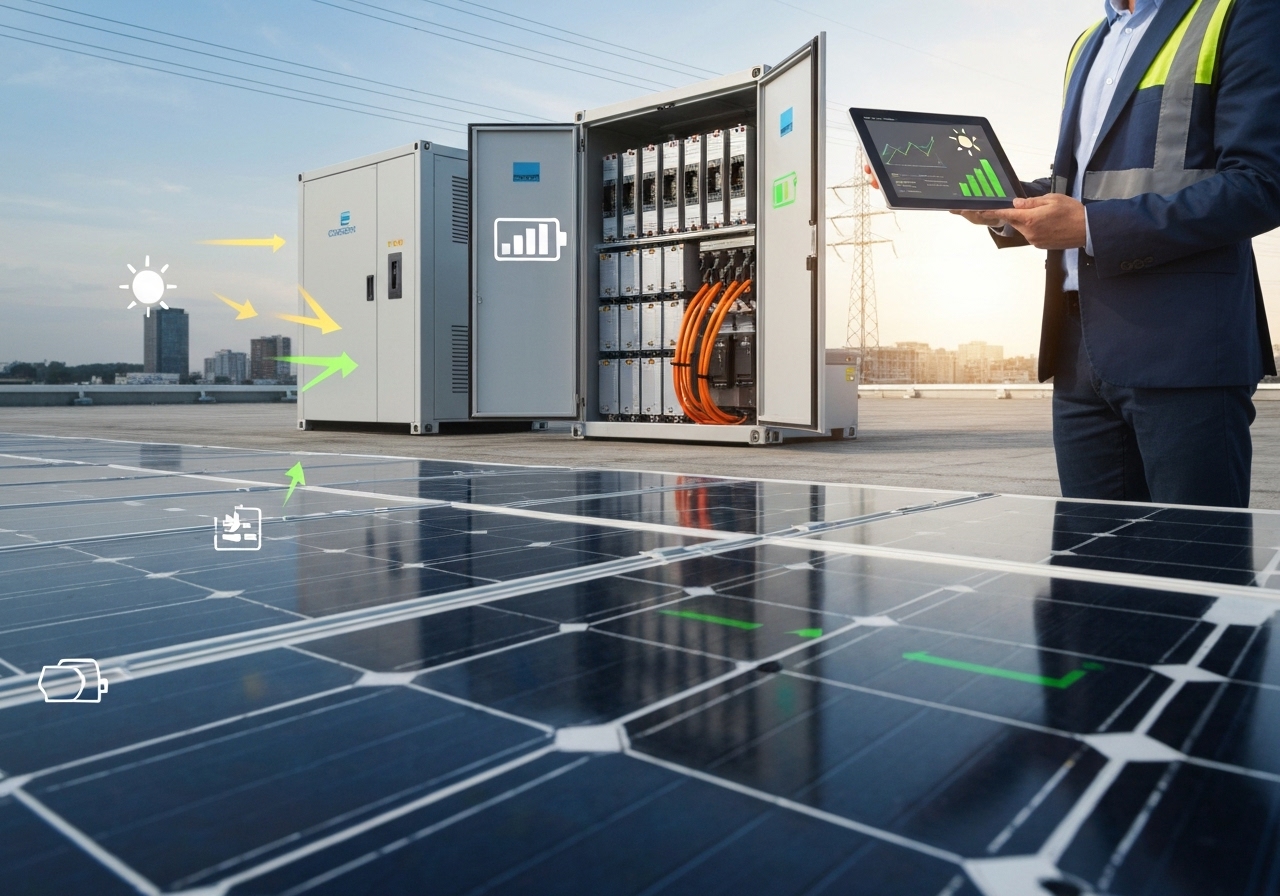
Photovoltaic panels generate DC electricity during daylight. Batteries or grid-tied inverters store or convert power for nighttime LED lighting and pumps. System design balances daily PV production with lighting schedules to maintain consistent microgreen growth.
Controlled-environment growing
Controlled-environment growing uses racks, trays, and hydroponic or soil media with precise light, water, and climate control. LEDs supply the photosynthetic spectrum with programmable intensity and photoperiods.
Automation and monitoring
Automation and monitoring use timers, sensors, and simple controllers to manage irrigation, nutrient dosing, and lighting. Remote monitoring reduces labor and improves consistency.
What design components are essential for a solar-powered microgreen farm?
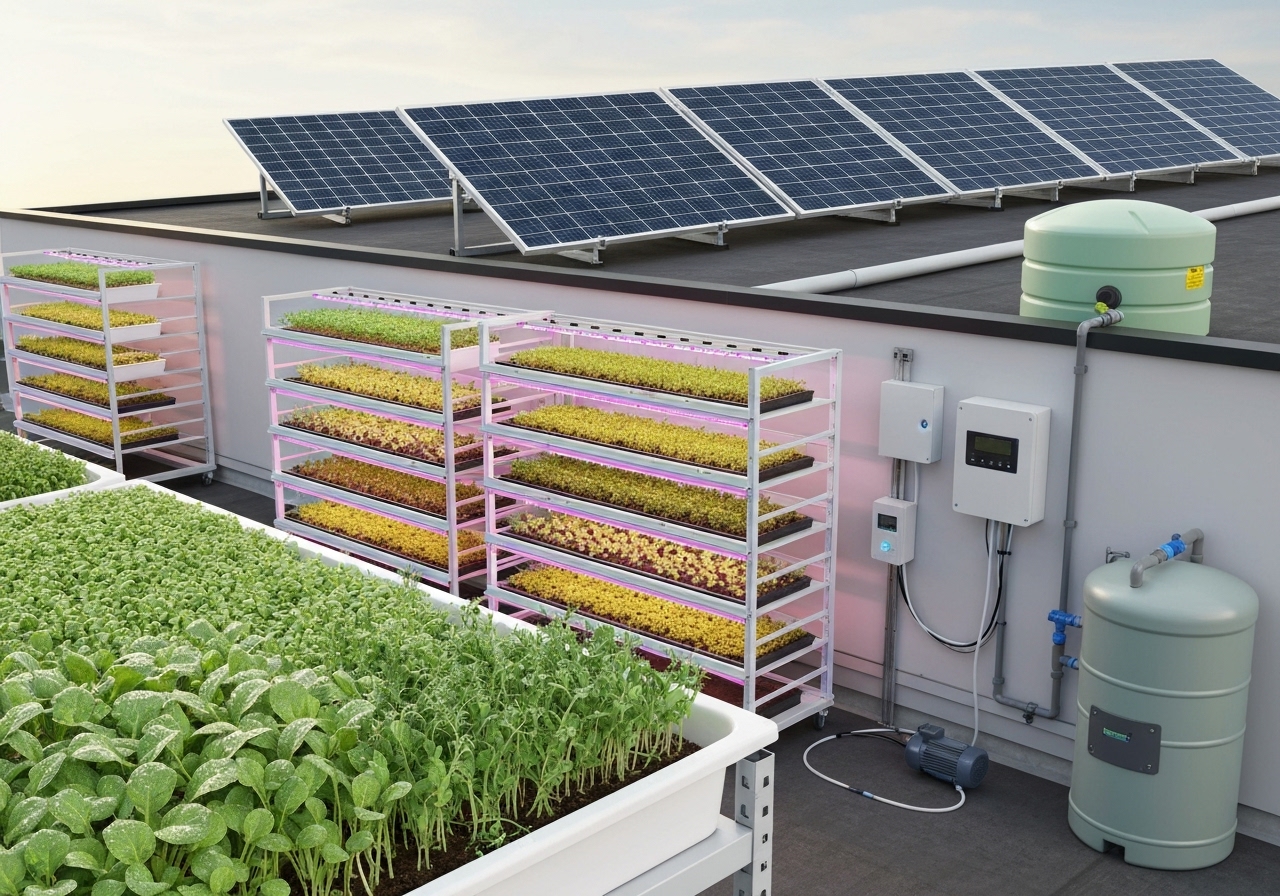
Essential components include PV panels, a charge controller, inverter or DC drivers for LEDs, battery bank (optional), racks and trays, irrigation system, nutrient solution management, and climate controls.
Solar array and power sizing
Solar array and power sizing start with a load audit. Estimate daily LED, pump, and fan energy use. Multiply by days of autonomy required. Add a safety margin of 20–30% for cloudy days and growth-stage variation.
Grow infrastructure
Grow infrastructure includes multi-tiered racks, stacked tray systems, and reflective surfaces to maximize light use. Use modular racks to scale from 1 m2 to hundreds of m2.
Water and nutrient delivery
Water and nutrient delivery include ebb-and-flow, flood tables, or simple tray misting. Use nutrient monitoring to maintain electrical conductivity (EC) and pH within target ranges for each crop.
Which microgreens are best for solar-powered urban farms?
Best microgreens are species that combine short growth cycles, high yield per tray, and strong market demand.
Top commercial microgreens
- Sunflower (Helianthus annuus): 7–10 days, high yield, crunchy texture.
- Pea shoots (Pisum sativum): 10–14 days, mild flavor, high biomass.
- Radish (Raphanus sativus): 6–9 days, spicy flavor, quick turnover.
- Basil (Ocimum basilicum): 12–21 days, premium price points.
- Broccoli (Brassica oleracea): 7–12 days, high nutrient density.
Rotate crops by market and season
Rotate crops to match local demand, product variety, and nutrient management. Rotate trays every 1–3 weeks to maintain continuous production and cash flow.
How much energy do microgreen farms use and how large must the PV system be?
Energy use varies by lighting strategy, photoperiod, and scale; typical small commercial systems use 8–30 kWh per m2 per month under continuous LED lighting schedules.
Estimate procedure
Estimate procedure: 1) Calculate LED watts per tray. 2) Multiply by daily lighting hours. 3) Multiply by number of trays and days in cycle. 4) Add pump and fan consumption. 5) Convert daily kWh to PV array size by dividing by local peak-sun-hours and accounting for system losses (approx. 1.3 factor).
Practical examples
Practical examples: A 10 m2 microgreen room using 200 W of LED power per m2 for 16 hours/day uses 32 kWh/day. In a location with 4 peak sun-hours, a 10 kW PV array would be required to offset daytime use, plus batteries or grid tie for night use.
What water and nutrient strategies work best for microgreens?
Water and nutrient strategies that work best are low-volume hydroponics, controlled dosing, and recycling with filtration to minimize waste and maintain consistent growth.
Substrate vs. hydroponic media
Substrate systems use coco coir, peat-free blends, or composted fibers. Hydroponic systems use thin-film or ebb-and-flow methods. Choose substrate for simplicity and hydroponics for water efficiency and yield control.
Water efficiency tactics
- Use recirculating systems with mechanical and biological filtration.
- Capture and reuse run-off after disinfection or nutrient rebalancing.
- Monitor EC and pH at least twice per week.
How do you integrate smart systems and sensors?
Integrate smart systems and sensors by adding light meters, EC and pH probes, temperature and humidity sensors, and simple controllers that log data and trigger alerts.
Benefits of smart integration
Benefits of smart integration include reduced labor, higher yield uniformity, faster troubleshooting, and data for scaling decisions. Smart monitoring complements urban farming innovations such as sensor networks described in broader precision agriculture approaches.
Smart monitoring aligns with techniques used in larger systems, such as those discussed in smart monitoring and sensors for pasture and field systems, adapted to indoor microgreen racks.
How does soil microbiome matter for microgreens?
Soil microbiome matters when using living substrates because microbial communities influence seedling health, disease resistance, and nutrient availability.
Microbiome best practices
Microbiome best practices include using pasteurized or controlled substrates, introducing beneficial microbes intentionally, and testing substrate biology when problems appear.
Microbiome strategies benefit from targeted analysis. Learn techniques for mapping and managing microbial communities in small-scale systems from resources on soil microbiome mapping for small-scale climate farms.
What are the economics of a solar-powered microgreen farm?
Economics depend on yield per m2, price per unit, labor, capital cost of PV and infrastructure, and local market access.
Costs
Costs include initial capital for PV, LEDs, racks, trays, substrate, and irrigation. Typical small commercial setups range from $10,000 to $80,000 depending on scale and automation.
Revenue and payback
Revenue depends on retail or wholesale pricing. Microgreens commonly sell for $20–$60 per kg wholesale and $40–$120 per kg retail depending on crop and branding. Typical payback for combined PV and growing infrastructure is 3–8 years when optimized for market and energy savings.
Profit drivers
- Direct sales to restaurants and grocery stores.
- Subscription boxes and CSA models.
- Premium crops (basil, edible flowers) with higher margins.
- Energy savings from on-site PV lowering operating costs.
How can city planners and communities implement solar microgreen programs?
City planners and communities implement programs by identifying rooftops and vacant spaces, establishing supportive zoning and incentives, and providing training and microgrants to local operators.
Steps for municipal rollout
- Map suitable rooftops and vacant lots with structural and sun exposure assessments.
- Create pilot hubs for workforce training and community access.
- Offer subsidies or tax credits for rooftop PV and urban farming equipment.
- Partner with local restaurants, hospitals, and food banks for guaranteed offtake.
Community benefits
Community benefits include local job creation, fresh produce access in food deserts, educational opportunities, and reduced food miles and carbon emissions.
What policy and funding mechanisms accelerate adoption?
Policy and funding mechanisms that accelerate adoption include grants, low-interest loans, rooftop PV incentives, expedited permitting, and inclusion in urban agriculture plans.
Examples of effective incentives
- Feed-in tariffs or net metering for excess PV generation.
- Grants for community food projects and workforce development.
- Tax abatements for building owners hosting farms on rooftops.
What risks and limitations should operators plan for?
Risks and limitations include variability in sunlight, system failures, pest and disease outbreaks, market volatility, and building structural constraints.
Risk mitigation strategies
- Design for redundancy in power and irrigation systems.
- Use integrated pest management and strict sanitation protocols.
- Diversify product lines and sales channels to reduce market risk.
- Conduct structural assessments before rooftop installations.
How do solar-powered microgreen farms connect to broader sustainable farming practices?
Solar-powered microgreen farms connect to sustainable practices by reducing transport emissions, optimizing resource use, and enabling circular water and nutrient systems.
Complementary sustainable tactics
- Use reclaimed water and rainwater harvesting where regulations allow.
- Implement composting of spent substrate and local organic waste streams.
- Source low-impact substrates and recycle trays and packaging.
Urban microgreen operations fit into wider sustainability frameworks used in sustainable agriculture. For further context on sustainable farming approaches, see resources on eco-friendly and sustainable farming.
What partnerships and value chains support success?
Partnerships with chefs, grocers, community organizations, energy utilities, and training institutions support successful scale-up and market access.
Operational partnerships
- Restaurants and culinary schools for product feedback and steady demand.
- Local grocers and farmers markets for retail sales.
- Utilities for demand-response programs and incentives for battery storage.
- Universities and extension services for crop and system optimization.
How do you start a pilot solar microgreen farm (step-by-step)?
Start a pilot by defining goals, selecting a site, sizing power and grow systems, building a small-scale prototype, and piloting production and sales over 3–6 months.
Step-by-step checklist

- Define objectives: community food access, profit, education, or research.
- Assess site: sun exposure, rooftop bearing capacity, permits.
- Prepare a budget for PV, racks, lighting, and supplies.
- Install a 1–5 m2 prototype to test crops and workflows.
- Record yields, energy use, and labor hours for optimization.
- Scale incrementally based on validated metrics and sales.
What are real-world examples and outcomes?
Real-world pilots and small businesses report faster time-to-harvest, higher per-area yields, and improved access to fresh greens in urban neighborhoods.
Measured outcomes
Measured outcomes typically include 60–90% reduction in time from harvest to plate, 70–95% lower food miles, and significant fresh-produce availability in neighborhoods previously underserved.
How will technology trends change solar microgreen farms in the next 5–10 years?
Technology trends will deliver higher-efficiency LEDs, integrated AI monitoring, lower-cost batteries, and modular turnkey systems that reduce capital and management barriers.
Emerging innovations to watch
- Adaptive LED spectra tuned by crop stage.
- AI-driven nutrient and lighting optimization using image analysis.
- Plug-and-play containerized farms for rapid deployment.
- Cross-application of agricultural robotics, including pollination and handling systems.
Emerging robotics and automation research may expand into urban controlled-environment farms, building on work in areas like robotic pollination and crop support for diversified urban cropping systems.
What final recommendations increase the chance of success?
Final recommendations: start small, prioritize energy and water efficiency, validate markets before scaling, and document metrics for yield, energy, and labor.
Checklist for operators
- Validate customer demand with pre-sales or contracts.
- Record and analyze energy use to optimize PV sizing and lighting schedules.
- Build simple SOPs for seeding, harvest, cleaning, and waste handling.
- Engage the community for workforce development and local buy-in.
Where can readers learn more or find technical resources?
Readers can learn more by consulting local extension services, urban agriculture networks, and technical guides on PV system design and controlled-environment agriculture.
For additional context on crop production methods and innovation opportunities, consider reviewing broader guides on opportunities and innovations in crop farming and practical methods summarized in guides to modern farming techniques.
Conclusion: How do solar-powered microgreen farms strengthen urban food security?
Solar-powered microgreen farms strengthen urban food security by enabling distributed, year-round production of nutrient-dense greens near consumers while lowering energy and transport impacts through on-site renewable power.
Solar-powered microgreen farms are scalable, climate-resilient solutions. They fit diverse urban contexts from community hubs to commercial kitchens. They combine renewable energy, efficient lighting, and precision water and nutrient management to deliver fresh nutrition and local economic benefits.


