
Vertical Microgreen Cooperatives Transforming City Farming
Introduction
Vertical microgreen cooperatives are reshaping city farming by combining stacked production, cooperative ownership, and local market systems. This article explains how vertical microgreen cooperatives work, why they are effective in dense urban contexts, and how communities can start and scale them. The piece covers technology, operations, economics, policy, and environmental impact to help urban farmers, community organizers, and municipal planners adopt this model.
What are vertical microgreen cooperatives?
Vertical microgreen cooperatives are member-owned enterprises that grow microgreens using vertical racks and controlled-environment techniques inside urban spaces. They organize as cooperatives to share capital, labor, skills, and market access while delivering highly nutritious, fast-turnaround produce to local consumers, restaurants, and retailers.
Why focus on microgreens?
Microgreens are young vegetable greens harvested after the first true leaves appear. They require 7–21 days from sowing to harvest, demand minimal footprint, and produce high value per square foot. Microgreens provide concentrated flavors and nutrients, making them attractive to chefs and health-conscious consumers. Their short cycles fit the cooperative model that benefits from frequent cash flow and strong product rotation.
How do vertical microgreen cooperatives operate?
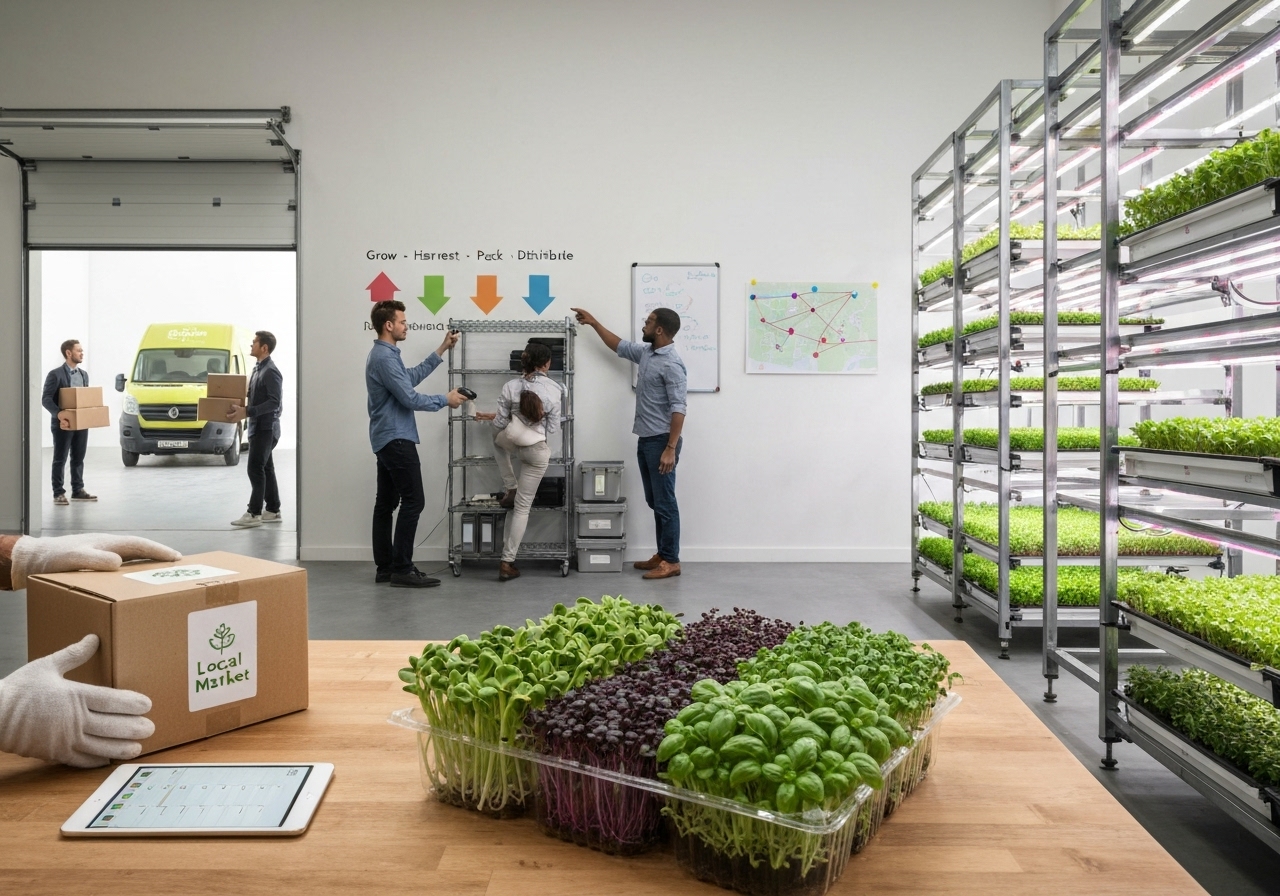
Vertical microgreen cooperatives operate through coordinated functions: production planning, seed and input sourcing, facility management, post-harvest handling, marketing, and distribution. The cooperative structure allocates tasks and profits based on membership rules while pooling risk and capital.
Typical operational workflow
- Seed selection and procurement: Choose fast-germinating, high-yield varieties.
- Sowing and propagation: Use trays on vertical racks with uniform seeding patterns.
- Controlled environment cultivation: Manage light, humidity, temperature, and airflow.
- Harvesting and post-harvest cooling: Harvest at peak flavor and rapidly cool to extend shelf life.
- Packaging and local distribution: Use sustainable packaging and short supply chains to markets and CSAs.
Why cooperative governance matters
Cooperative governance aligns incentives. Members share decision-making and profits, lowering the barrier to entry compared with individual startups. Cooperatives encourage reinvestment in shared assets—lighting, HVAC, racks, and processing equipment—and promote training and knowledge transfer across members.
What technologies support vertical microgreen cooperatives?
Technology choices determine yield, quality, and labor requirements. Key technologies include LED lighting, rack systems, hydroponic or substrate trays, environmental sensors, and simple automation for seeding and irrigation.
Essential equipment and systems
- Vertical racking: Maximize production per floor area by stacking trays in adjustable racks.
- LED grow lights: Use spectrum-optimized LEDs for efficient photosynthesis and low heat output.
- Hydroponic trays and substrates: Select between soil, coco coir, or hydroponic mats depending on consumer preference and cost.
- Environmental controls: Employ thermostats, humidistats, and fans to stabilize the microclimate.
- Sensors and data logging: Monitor light intensity, temperature, humidity, and electrical usage to improve yields and reduce energy waste.
Advanced tools that scale impact
Cooperatives can adopt digital inventory and ordering systems to improve market responsiveness. When local partners or nearby farms require more sophisticated diagnostics, integrate tools from adjacent practices such as soil microbiome analysis; see how soil microbiome mapping for small farms can inform substrate choices and disease prevention strategies in mixed systems.
Which growing methods work best—soil, hydroponics, or aeroponics?

It depends on priorities: flavor, cost, labor, and consumer expectations. Soil-grown microgreens often have strong consumer appeal for natural labeling and flavor, while hydroponics offers faster turnover, cleaner operations, and easier reuse of substrates. Aeroponics can minimize water use but requires higher technical skill.
Compare methods
- Soil/substrate: Lower tech, strong flavor, more waste management.
- Hydroponics: Efficient water use, faster cycles, easier sanitation.
- Aeroponics: Ultra-efficient, technical, higher capital cost.
How do cooperatives manage economics and financing?
Cooperative financing combines member equity, community loans, grants, and impact investments. The economics of microgreens are favorable due to high turnover and high price per unit weight, but success depends on managing labor, energy, and distribution costs.
Typical cost and revenue drivers
- Capital costs: Racks, lighting, and environmental controls.
- Recurring costs: Seeds, substrates, electricity, labor, packaging.
- Revenue: Direct sales to restaurants, farmers markets, CSAs, grocery stores, and beverage/meal-kit companies.
Financial strategies for cooperatives
- Diversify revenue streams: Wholesale, retail, subscription boxes, and education workshops.
- Bundle services: Offer culinary microgreen blends, value-added products, and cooperative-branded CSAs.
- Access grants and community funds: Apply for urban agriculture grants, food access funding, or workforce development programs.
- Adopt energy-efficient technologies: Reduce operational costs through efficient LEDs and demand-response programs.
What marketing and distribution models succeed for city microgreen cooperatives?
Cooperatives succeed with multi-channel local strategies that emphasize freshness, transparency, and community benefit. Short supply chains reduce spoilage risk and strengthen local brand identity.
High-value distribution channels
- Direct-to-chef sales: Build recurring relationships with restaurants and catering services.
- Community-supported agriculture (CSA): Include microgreen add-ons in neighborhood CSAs.
- Farmers markets and pop-ups: Engage customers and test new varieties quickly.
- Retail partnerships: Supply small grocers and specialty stores with consistent weekly deliveries.
Branding tips
Emphasize cooperative structure, local production, and environmental benefits. Use story-driven labels that highlight member farmers and production practices. Offer tasting events and chef partnerships to raise awareness.
How do vertical microgreen cooperatives deliver social and environmental impact?
Microgreen cooperatives deliver multiple measurable benefits in cities: improved access to fresh leafy greens, job creation, training and entrepreneurship opportunities, and reduced food miles. They also use less land and water than conventional production and can reuse underutilized urban spaces.
Environmental benefits
- Land efficiency: Vertical stacks produce far more per square meter than horizontal fields.
- Water savings: Hydroponic systems use up to 90% less water per kilogram than field-grown crops.
- Reduced transport emissions: Short local supply chains cut distribution miles and spoilage.
Social returns
- Local employment: Create entry-level and technical jobs in cultivation, logistics, and sales.
- Food access: Provide fresh greens in neighborhoods lacking retail produce options.
- Education and skills: Train residents in controlled-environment agriculture and cooperative business practices.
What are common challenges and practical solutions?
Common challenges include energy costs, food safety compliance, labor scheduling, and market saturation. Cooperatives mitigate these challenges through shared systems, quality controls, and flexible product mixes.
Challenge: Energy and operational costs
Reduce costs by installing energy-efficient LEDs, optimizing light schedules, and adopting demand-response or time-of-use energy plans. Explore rooftop solar for partial offsets and cooperative purchasing to lower equipment costs.
Challenge: Food safety and shelf life
Implement standardized sanitation protocols, regular testing, and rapid-cooling chains. Document processes for traceability and training. Where applicable, integrate relevant insights from broader sustainable agriculture practices such as those discussed in eco-friendly and sustainable farming practices.
Challenge: Market competition
Differentiate on freshness, variety, and cooperative mission. Offer subscription models and unique blends unavailable from larger suppliers. Collaborate with other urban farms and distribute risk across products and seasons.
How to start a vertical microgreen cooperative: step-by-step

Follow these operational steps to launch a cooperative focused on microgreens in an urban context.
Step 1: Gather stakeholders and define mission
Bring together interested growers, community members, chefs, and local institutions. Define the cooperative’s purpose, membership structure, and core values.
Step 2: Perform a feasibility study
Assess local demand, potential sites, zoning, available labor, and startup capital needs. Identify anchor customers—restaurants or institutions willing to purchase in advance.
Step 3: Choose a legal structure and governance model
Incorporate according to local cooperative laws. Draft bylaws that cover membership shares, profit distribution, voting rights, and exit terms.
Step 4: Secure location and equipment
Find a modular indoor site: garage, basement, vacant storefront, or converted warehouse. Plan racks, lighting, sanitation areas, and delivery access. Optimize layout for workflow and biosecurity.
Step 5: Build production protocols and training
Standardize seeding, irrigation, lighting, and harvesting schedules. Train members on food safety, record-keeping, and customer service.
Step 6: Launch markets and refine operations
Start with pilot batches to restaurants and markets. Collect feedback, adjust varieties and packaging, and scale up production cycles as demand grows.
What role can cities and policy play?
Municipal policy can accelerate cooperative growth through zoning flexibility, incubator spaces, grant funding, tax incentives, and workforce development. Public procurement policies for schools, hospitals, and city agencies can create reliable markets for cooperatives and strengthen local food systems.
How do microgreen cooperatives connect to broader crop farming innovations?
Vertical microgreen cooperatives are part of a continuum of innovations in urban and small-scale agriculture. They complement outdoor and pasture-based systems by supplying high-value greens year-round. For readers exploring broader innovations, see related research and practical frameworks in opportunities and innovations in crop farming, which helps align urban micro-production with regional supply chains.
Case studies and practical examples
Example 1: A 10-member cooperative in a mid-size city converted a 1,200 sq ft warehouse into stacked microgreen production. They invested $25,000 collectively in racks, LEDs, and processing equipment. Within six months they secured recurring orders from three restaurants and a weekly farmer’s market, reaching break-even in month nine.
Example 2: A neighborhood cooperative partnered with a community center to train youth in cultivation. The cooperative supplied a local food pantry and sold surplus to a nearby grocer. The model combined workforce training with guaranteed social procurement.
What are the future trends for vertical microgreen cooperatives?
Anticipated trends include increased automation for seeding and harvesting, integration of energy management systems, and scaling through cooperative networks that share aggregation facilities. Cooperatives may leverage data-driven optimization and partner with research programs to improve cultivar selection and production efficiency.
Potential technology synergies
- Shared cold-storage hubs for cooperative networks to expand distribution reach.
- Modular container farms enabling franchised cooperative units in multiple neighborhoods.
- Data-sharing platforms for yield benchmarking and predictive ordering.
Frequently asked questions (FAQ)
Can microgreens be grown year-round in cities?
Yes. Controlled-environment vertical systems enable year-round production independent of weather, producing continuous harvest cycles.
Do vertical microgreen cooperatives compete with traditional farms?
No. They are complementary. Microgreen cooperatives provide high-value fresh greens, while traditional farms supply bulk vegetables and staples. Collaboration across systems builds resilient local food networks.
How much space is needed to start?
It varies. A small pilot can start in as little as 200–400 sq ft with a few racks. Cooperative models allow pooling space and capital to achieve scale faster.
Conclusion
Vertical microgreen cooperatives offer a pragmatic and scalable approach to expanding fresh food access, creating local jobs, and reclaiming urban spaces for productive use. By combining stacked production, cooperative governance, and local market strategies, communities can build resilient microfood systems. The model fits into larger sustainable agriculture trends and can integrate learnings from soil microbiome research and broader crop innovation efforts. Whether starting small or scaling across neighborhoods, cooperative microgreen production is a proven pathway to transform city farming.
Resources and next steps
Explore local zoning rules, identify prospective members, and pilot a small rack system. Learn more about mapping soil and microbial health as relevant to broader production systems in soil microbiome mapping for small farms. For inspiration on innovation and market opportunities, review opportunities and innovations in crop farming.


