
Designing Perennial Vegetable Beds by Root Depths and Yield
Designing perennial vegetable beds by root depths and yield organizes your homestead planting for long-term productivity and lower labor. This guide explains how to assess site conditions, map rooting zones, choose perennial vegetables by depth and expected yield, plan bed geometry and access, build soil and microbial life, and track outputs so perennial beds contribute reliably to household food supply.
What is a perennial vegetable bed and why plan by root depth and yield?
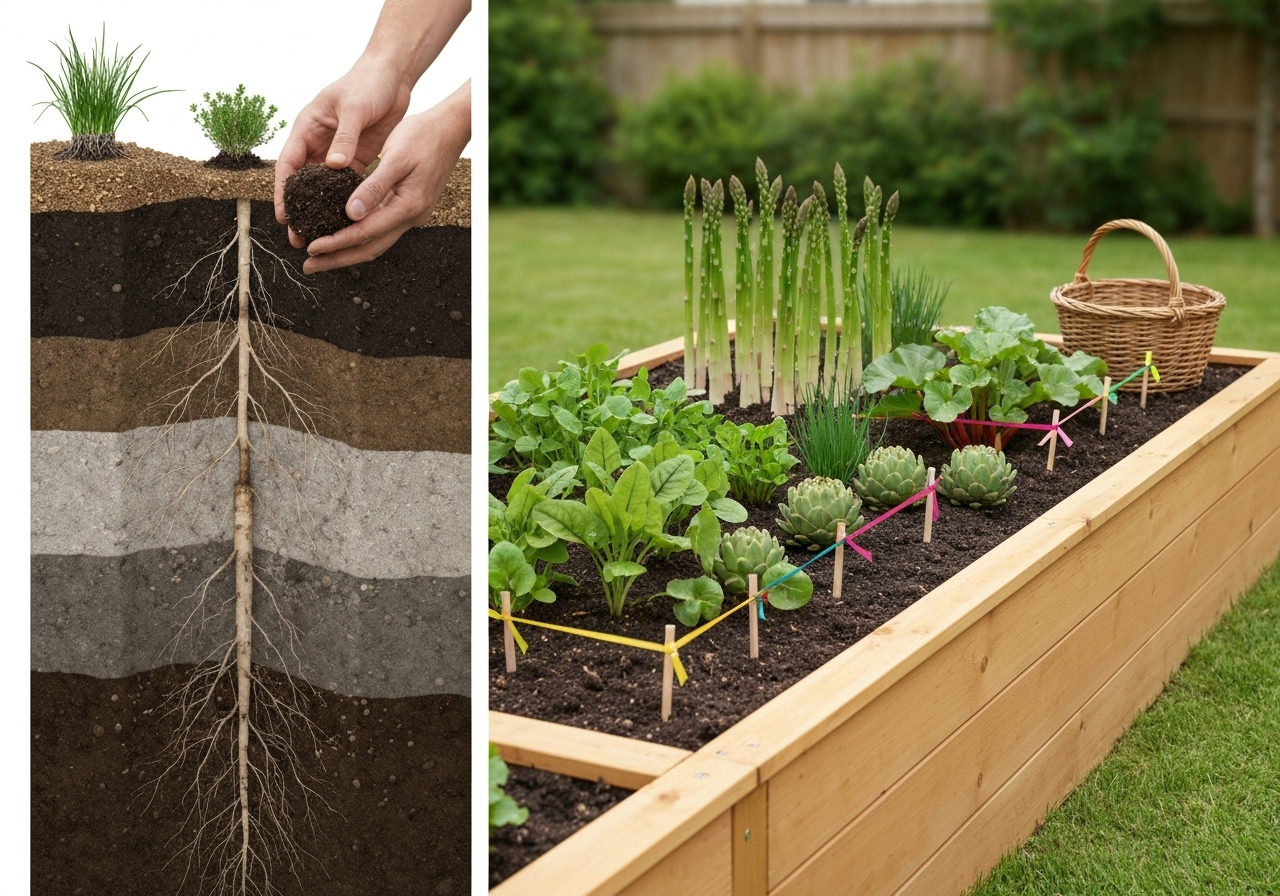
Designing perennial vegetable beds by root depth and yield groups crops into compatible rooting zones and productivity roles to reduce belowground competition, improve water and nutrient use, and maximize harvestable calories per square meter. Planning beds this way stabilizes soil life, simplifies irrigation, and lets you layer annuals and perennials for stacked yields.
How do I assess site conditions before mapping perennial beds?
Start with light, slope, soil texture, drainage, and microclimate mapping to decide bed placement and species choices. Measure sun hours in summer and winter, note prevailing wind, mark frost pockets, and map seasonal water flow. Test soil for pH, organic matter, available phosphorus and potassium, and texture. Record existing trees and roots that will compete or provide shade.
Begin site assessment by using microclimate maps to fine tune placement; consult local crop calendars and microclimate practices to match species to exposures (see microclimate crop maps for small farms).
What are practical root depth zones for perennial vegetables?
Use three practical root-depth zones: shallow (-30 cm / -12 in), medium (30-60 cm / 12-24 in), and deep (>60 cm / >24 in). Design beds so shallow-rooted perennials occupy topsoil pockets, medium-rooted occupy mid zones, and deep-rooted occupy dedicated strips or borders.
Define root zones precisely: shallow-rooted herbs and leafy perennials exploit -30 cm; medium-rooted tap- or clump-formers reach 30-60 cm; deep-rooted perennial tubers, rhizomes and shrubs access below 60 cm. Matching roots to soil volume reduces competition.
How do I choose perennial vegetable species by root depth and expected yield?
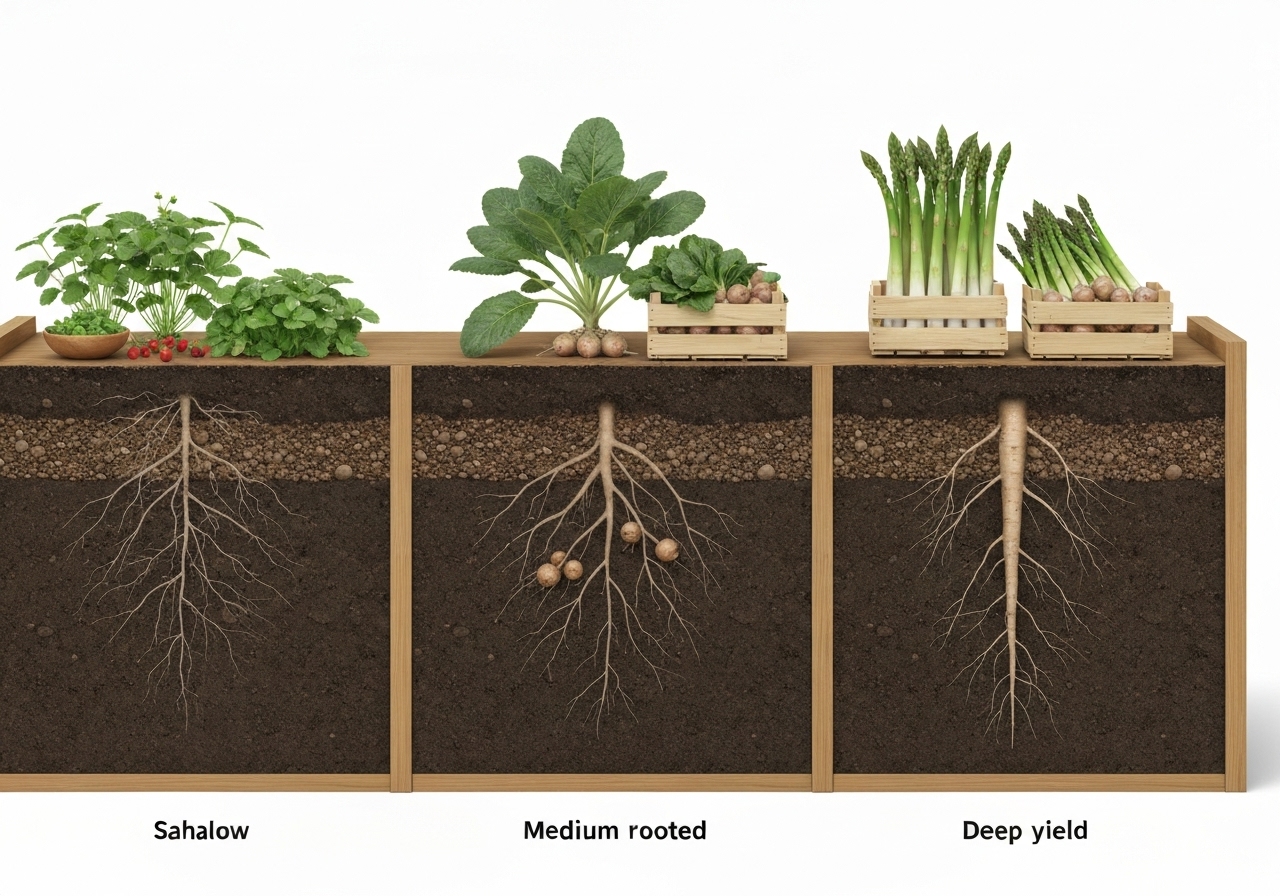
Choose species for each root zone based on documented yields, harvest frequency, and spatial needs to optimize per-area productivity. Below is a practical species list with typical yields and spacing. Use local extension data for region-specific yield adjustments (state extension services and published trials provide regional baselines).
Which shallow-root perennial vegetables work best and what yields can I expect?
Shallow-root perennials include salad herbs, chives, sorrel, and some perennial leafy greens that produce frequent harvests but lower biomass per plant. Examples and approximate yields per mature clump or m2 under good fertility:
- Chives: plant 10-20 per m2; harvest .1-.3 kg per m2 per month in season (.5-2 kg/year per m2) depending on cut frequency.
- Sorrel: spacing 20-30 cm; yield .5-1.5 kg per plant per season (3-6 kg/m2/year with frequent harvest).
- Good King Henry (blite or perennial spinach): spacing 30-40 cm; yield 1-2 kg per plant/year.
- Perennial kales (e.g., tree collards): young plants give .5-1 kg per plant first year, mature bushes 3-6 kg/year.
- Salad greens like winter lettuce (perennial types): 1-3 kg/m2/year for continuous cut-and-come-again harvesting.
Which medium-root perennial vegetables should I plant and what yields are realistic?
Medium-root perennials include rhubarb, asparagus, lovage and seakale-type crops that yield substantial harvestable biomass annually after establishment. Examples and yield ranges:
- Rhubarb: spacing 75-100 cm; yield 3-8 kg per crown per year after 2-3 years (University extension data shows 4-6 kg average for mature crowns).
- Asparagus: spacing 30-45 cm in beds, standard yield .5-1 kg per plant per season once established (3-6 kg/m2 over the harvest months cumulatively for mature beds).
- Lovage: spacing 50 cm; harvest 1-3 kg leaf stalks annually per plant.
- Sea kale (Crambe maritima): spacing 60-90 cm; harvest ~2-5 kg per plant over season for blanched shoots.
Which deep-root perennial vegetables and productive perennials should I include and what yields do they provide?
Deep-root perennials include tuberous crops, rhizomes, and woody edibles such as Jerusalem artichoke, horseradish, and perennial tuber beds that produce heavy caloric yield per area. Examples and typical yields:
- Jerusalem artichoke (sunchoke): spacing 30-60 cm; tuber yields 2-6 kg per plant per season (8-20 t/ha scaled to small beds).
- Horseradish: spacing 30-60 cm; root yields 1-3 kg per plant in harvest year.
- Yacon: spacing 60-90 cm; tuber yield 3-8 kg per plant in suitable climates.
- As well, productive berry shrubs or low trees (seaberry, Goumi) in deep zones provide fruit yields from 1-6 kg per shrub annually depending on species and age.
How should I lay out beds to separate root-depth zones while maximizing yield?
Organize beds as layered strips or concentric bands, placing deep-rooted perennials at bed edges or central trenches, medium-root in core, and shallow-root perennials in surface pockets and borders. Use 1.2 m to 1.5 m bed widths for easy access; reserve deeper beds or terraces for rhizomes and shrubs.
Start layout with access paths every 1.2 to 1.5 m. Place deep-rooted belts on the downhill edge to capture and infiltrate water and reduce root competition with shallow herbs. Use edge plantings of tall perennials to double as windbreaks and summer shade for shade-tolerant perennials.
What planting densities and spacing maximize yield for perennial beds?
Use species-specific spacing: shallow herbs 10-30 cm spacing, medium perennials 30-100 cm, deep perennials 30-120 cm depending on clump size and harvest method. Plan plant counts per m2 to estimate yield: sparse shrubs may be .5 plants/m2 while dense herbs 10-25/m2.
Calculate expected yield by multiplying mature-per-plant output by planned plant count. Track real yields for 3 years to tune density; many perennial plantings benefit from thinning or interplanting annuals to boost early yields.
How can I stack annuals and perennials to increase early and total yields?
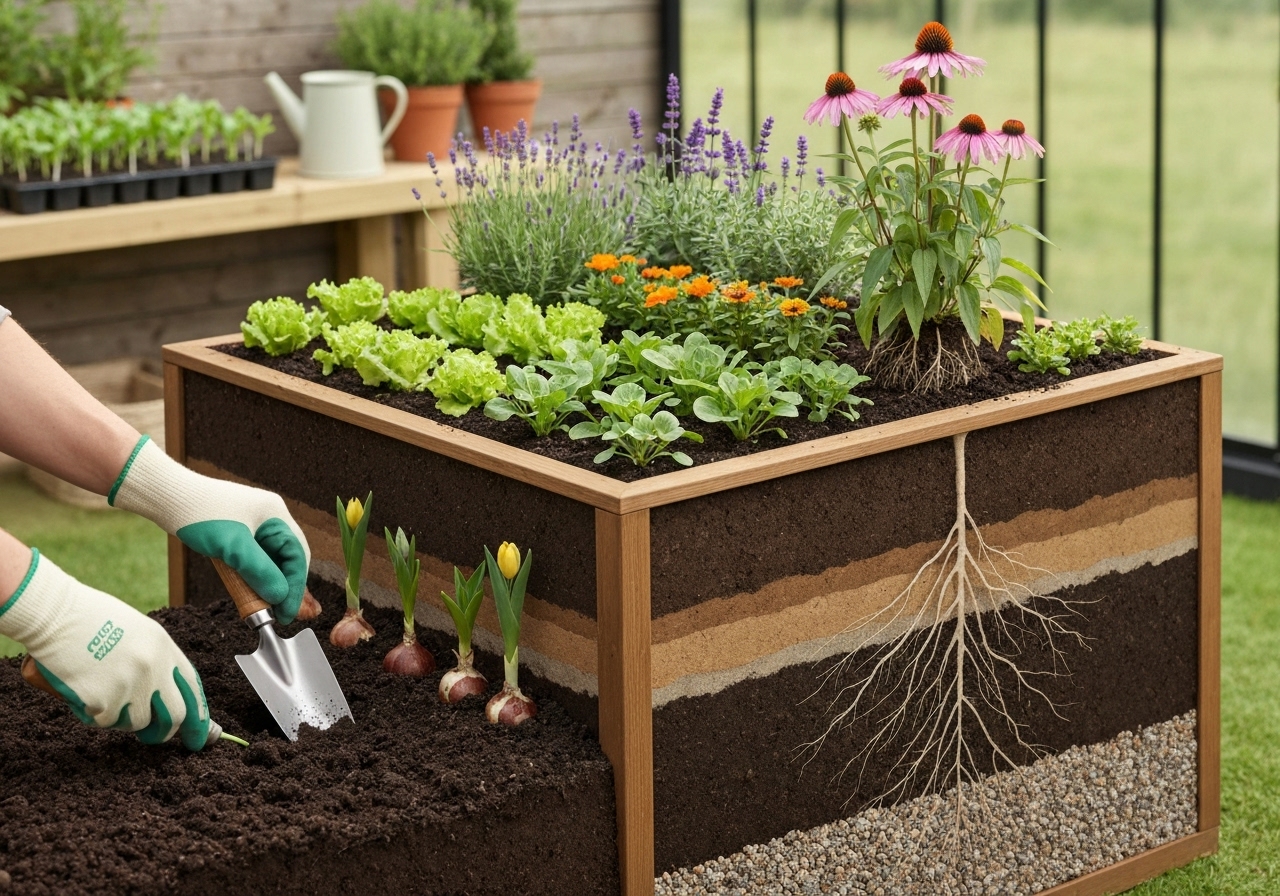
Interplant fast-growing annuals in the gaps between perennials and use vertical supports and understory crops to stack production in time and space. Plant quick salad greens, radishes, and bush beans in the first one to three years before perennials fully occupy the area. Use trellises along deep-root belts for vining annuals to add vertical yield.
Stack plantings by season: spring bulbs and greens use early light before canopy closure; summer annuals exploit mid-season; autumn crops capture residual light. This reduces bare soil periods and accelerates return on investment in bed preparation.
How do I build and maintain soil fertility for perennial vegetable beds?
Build deep, biologically active soil with layered organic matter, targeted mineral amendments, mulches and microbial inoculation to support perennials indefinitely. Start with a soil test and correct pH and major nutrients. Add 5-15 cm of compost and high-carbon mulch to feed microbes and retain moisture.
Design on-farm microbial consortia to enrich soil by incorporating compost teas, microbial inoculants, and crop residues that support target plant symbionts (see guidance on designing on-farm microbial consortia for soil health).
How should irrigation and water management be handled in perennial beds?
Use deep, infrequent irrigation for deep-rooted perennials and surface drip or micro-sprinklers for shallow-rooted zones; design swales, permeable berms or mulch to retain rainfall. Group species by water needs and install separate irrigation zones controlled by timers or sensors to avoid overwatering shallow perennials while meeting deep-root needs.
Implement regenerative micro-irrigation techniques to conserve water and deliver targeted moisture to root zones; maintain mulch to reduce evaporation and prevent surface crusting.
How do I prevent and manage competition from weeds and invasive perennials?
Prevent weeds with initial sheet mulching, surface mulch, and dense planting; manage established invasives with targeted removal and physical barriers for aggressive spreads like mint and horseradish. Hand-weed around seedlings until canopy closure. Use root barriers at edges for aggressive clonal species. Retain a 10 to 20 cm buffer with mulch to inhibit weed germination.
How should I integrate crop rotation principles in a perennial bed system?
Use rotational planning around perennial beds for adjacent annual plots, move annual families between surrounding beds, and adjust intercrops annually to disrupt pests and balance nutrient flows. Although perennials remain in place, rotate annual companions and cover crop sequences to reduce disease and feed the perennials with varied residues. Consult low-input adaptive rotation plans to coordinate perennials and annuals on the homestead (see adaptive low-input rotation plans for small farms).
How do I estimate yields and monitor productivity in perennial beds?
Track per-plant harvest weight, harvest frequency, and area yield annually; record changes in soil organic matter and plant vigor to assess long-term productivity. Create a simple spreadsheet logging harvest date, weight per bed and per species. Compare to your baseline expected yields and adjust spacing, fertility and species mix after the first three full production years.
How do I design for resilience and low input maintenance?
Choose adapted perennials, build deep fertility, diversify species, and design water-holding features to reduce ongoing inputs and increase resilience to drought and pests. Favor local proven varieties, increase genetic diversity for disease buffering, and use multi-species groundcovers to suppress weeds and maintain soil moisture. Combine perennial beds with hedgerows and pollinator plantings to enhance ecosystem services.
What are practical bed-building techniques for perennial vegetables?
Construct 15-30 cm raised beds in heavy soils; build sunken beds or swales in arid slopes; use hugelkultur beds for deep-root crops when woody materials are available. Shape beds to provide 30-50 cm of friable topsoil where possible. For heavy clays, add compost and sand or use deep deep-root furrows for deep perennials to access loosened subsoil.
How do I manage pests and diseases in perennial beds?
Monitor regularly and prioritize cultural controls: sanitation, resistant varieties, mixed planting, and beneficial insect habitat before resorting to targeted organic treatments. Remove infected material promptly. Use trap crops and biological controls for common pests. Promote soil health; healthy plants resist pathogens better. Where needed, use labeled organic sprays sparingly and strategically.
How long before perennial beds reach full production?
Expect 2-5 years for many perennials to reach full yield; shallow herbs may yield in year one, medium perennials in 2-3 years, and deep tuberous crops in 2-4 years depending on species and site. Plan early intercropping with annuals to generate food while perennials establish. Track yield ramp-up to plan household food budgets.
What design checklist should I follow before planting perennial vegetable beds?
Use a checklist: microclimate map, soil test, bed geometry, root-depth zoning, species selection, irrigation plan, soil building plan, pest strategy, and yield tracking setup. Confirm access paths, harvest logistics and storage proximity. Index beds with labels and keep a planting map for future rotation and expansion decisions.
Which simple sample layout works for a 10 x 10 m homestead perennial plot?
Use three parallel beds: deep-root belt on the downhill edge (3 m wide), two central medium beds (each 3 m wide), and shallow-root pocket strips along the sunny edge; 1 m access paths between beds. Plant Jerusalem artichoke and berry shrubs in the deep belt. Plant asparagus and rhubarb in the central beds. Fill edges and between crowns with chives, sorrel, perennial kales and annual salad intercrops until the perennials fill space.
Which records and metrics should I track for continual improvement?
Record planting dates, species and varieties, plant counts, harvest weights, inputs, pest events, and soil test results annually. Use those metrics to calculate yield per m2, input per kg of food, and time to payback of bed establishment. Adjust species mix and densities after year three based on performance.
Where can I find additional resources and examples for implementing this design?
Consult regional extension publications, perennial vegetable specialists, and on-farm case studies for species-specific advice; use microclimate and rotation planning resources to integrate perennials with annual cropping systems. For mapping microclimates and selecting crop maps, review microclimate crop resources to place beds optimally. For integrating perennials into broader farm plans, consult adaptive rotation guides to coordinate annual and perennial systems. For building soil life, review practices for microbial consortia to enrich long-term fertility.
What mistakes should I avoid when designing perennial vegetable beds?
Avoid placing shallow herbs under deep-rooting trees, underestimating access needs, overcrowding, and failing to plan for weeds and aggressive spreaders. Do not plant invasive perennial species without barriers. Avoid homogenous single-species blocks; diversify species to reduce pest and disease risk.
How do I scale perennial beds from home garden to small homestead market production?
Scale by modular bed units, measure per-module yield, and replicate successful modules; size irrigation, harvest logistics and storage to match increased yield and market timing. Use consistent bed widths for mechanized or semi-mechanized tasks and centralize packing and wash areas. Record yields per module to calculate marketable supply and labor costs per kilogram.
Designing perennial vegetable beds by rooting depth and yield converts space into reliable, layered food production. Use mapping, soil biology, irrigation zoning, and staged planting to balance early returns with long-term biomass. Track yields and tweak densities to evolve a resilient homestead food system that needs lower inputs over time.
Relevant further reading: microclimate crop maps for diversified small farms, adaptive low-input rotation plans for coordinating perennials and annuals, and designing on-farm microbial consortia for building the biological foundation of perennial beds.


