
Farm Waste to Soil Carbon: Practical Circular Solutions
Farm Waste to Soil Carbon: Practical Circular Solutions
Convert common farm wastes into stable soil carbon through low-cost, practical circular systems that reduce emissions, feed soil biology, and generate on-farm value. This guide explains methods, step-by-step practices, measurement, economics, and implementation timing for small and medium farms.
What is farm waste to soil carbon?
Farm waste to soil carbon is the practice of transforming biodegradable farm residues into stable organic matter that increases soil carbon stocks.Farm waste includes crop residues, manure, processing byproducts, expired feed, pruning material, and food scraps.
Farm waste to soil carbon reduces greenhouse gases by capturing carbon in soil pools.According to the Food and Agriculture Organization, diverting organic waste from open burning or unmanaged decomposition lowers methane and CO2 emissions when managed into stable soil carbon.
Why should farms convert waste into soil carbon?
Convert waste to soil carbon to improve soil health, increase water holding capacity, and reduce fertilizer dependency.Multiple studies show higher soil organic matter improves yield stability and drought resilience (IPCC 2019 synthesis; USDA NRCS guidance).
Convert waste to soil carbon to create revenue opportunities and circular resource flows.Soil carbon credits, compost sales, and reduced input costs make the practice economically attractive for many farms (see recent small-farm carbon market analyses).
Which on-farm methods build stable soil carbon from waste?
Use composting, biochar, anaerobic digestion, managed grazing residues, and microbial enhancement to turn waste into stable carbon pools.Each method varies in carbon permanence, labor, capital, and co-benefits; adopt a mix to match farm scale and goals.
How does composting convert waste into soil carbon?
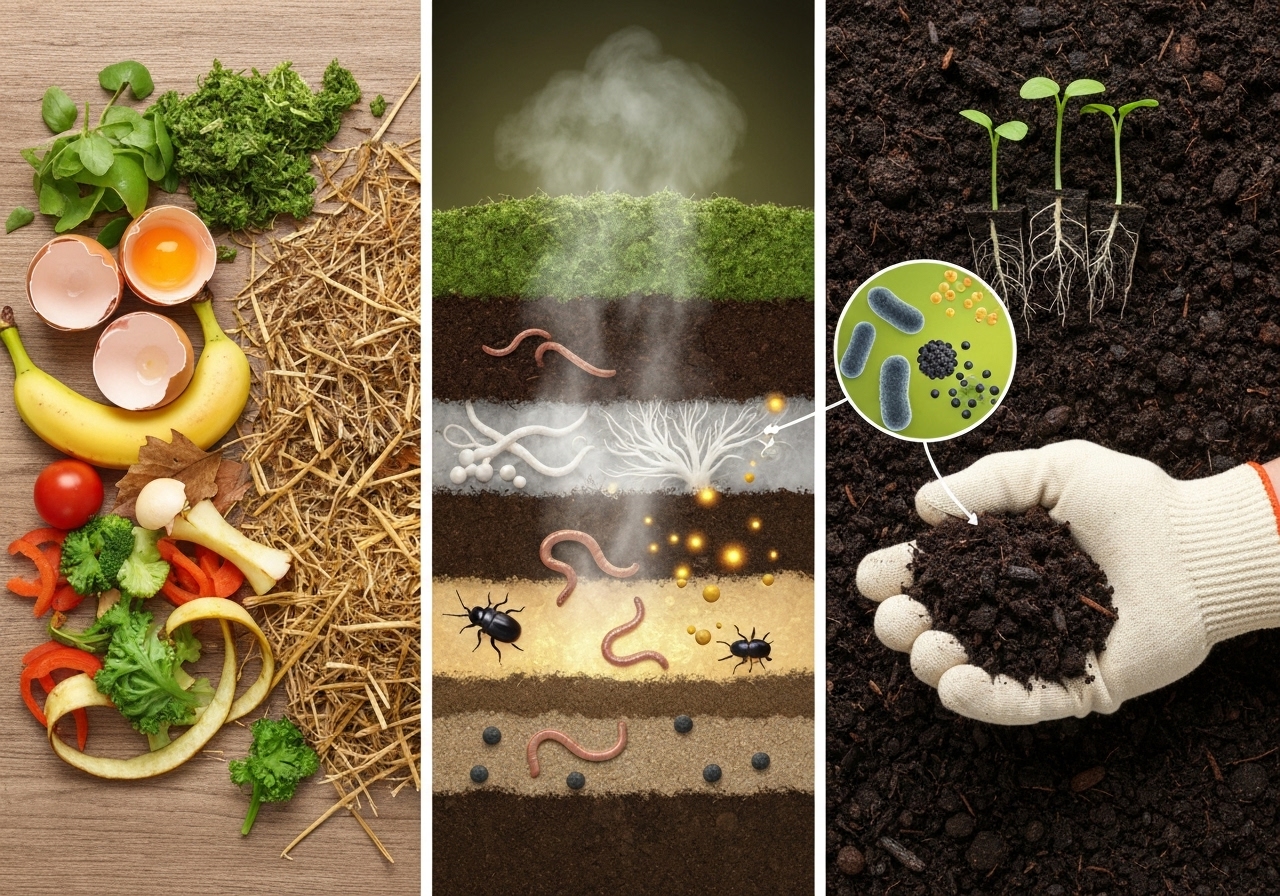
Composting stabilizes labile carbon into humus-like material that increases soil organic matter when applied.Active aerobic composting reduces pathogens and weed seeds when managed to reach thermophilic temperatures (55-65 C) for sufficient time.
Follow these steps for effective on-farm composting:
- Collect and sort waste streams: separate meat/dairy from plant residues when producing compost for food crops.
- Balance carbon-to-nitrogen (C:N) ratio to 25:1 to 35:1 by mixing high-carbon materials (straw, wood chips) with nitrogen sources (manure, green waste).
- Construct static piles, windrows, or in-vessel systems depending on scale; maintain moisture at 40-60% and turn to aerate.
- Monitor temperature and cure compost for 4-12 weeks before use; test maturity and nutrient content.
Composting permanence varies; a portion of compost carbon remains labile but increases soil aggregation and microbial habitat. The Rodale Institute and multiple meta-analyses report compost applications raise soil organic carbon and crop productivity over time.
How does biochar stabilize carbon from farm waste?
Biochar converts biomass into highly stable carbon via pyrolysis, delivering century-scale carbon storage when mixed into soils.Biochar is produced by heating organic material in low-oxygen conditions, creating porous charcoal rich in aromatic carbon bonds resistant to decomposition.
Apply these biochar practices:
- Feedstock selection: use crop residues, orchard prunings, or wood waste free of treated wood.
- Pair biochar with compost or manure to charge surfaces with nutrients and microbes before soil application.
- Incorporate at .5-5% by volume in topsoil, focusing on degraded or low-carbon fields.
Meta-analyses in Global Change Biology and long-term field trials indicate biochar increases soil carbon persistence and often improves nutrient retention and water infiltration, especially on coarse-textured soils.
How does anaerobic digestion convert farm waste into carbon and energy?
Anaerobic digestion captures methane from wet organic wastes and produces a stabilized digestate that contributes to soil carbon when applied.AD systems break down organic matter in oxygen-free tanks, producing biogas and a nutrient-rich effluent.
Implement AD on farms as follows:
- Select suitable wastes: manure, wet crop residues, food processing byproducts.
- Choose scale-appropriate digesters: farm-scale plug-flow or covered lagoons for livestock farms; modular systems for co-digestion.
- Use produced biogas for on-farm heat or electricity to offset fossil fuel use; apply pasteurized digestate as a soil amendment.
Digestate tends to be more plant-available and less emission-prone than raw manure; a 2018 synthesis by the European Commission notes AD reduces net greenhouse gas emissions when designed and managed properly.
How does managed grazing and manure handling build soil carbon?
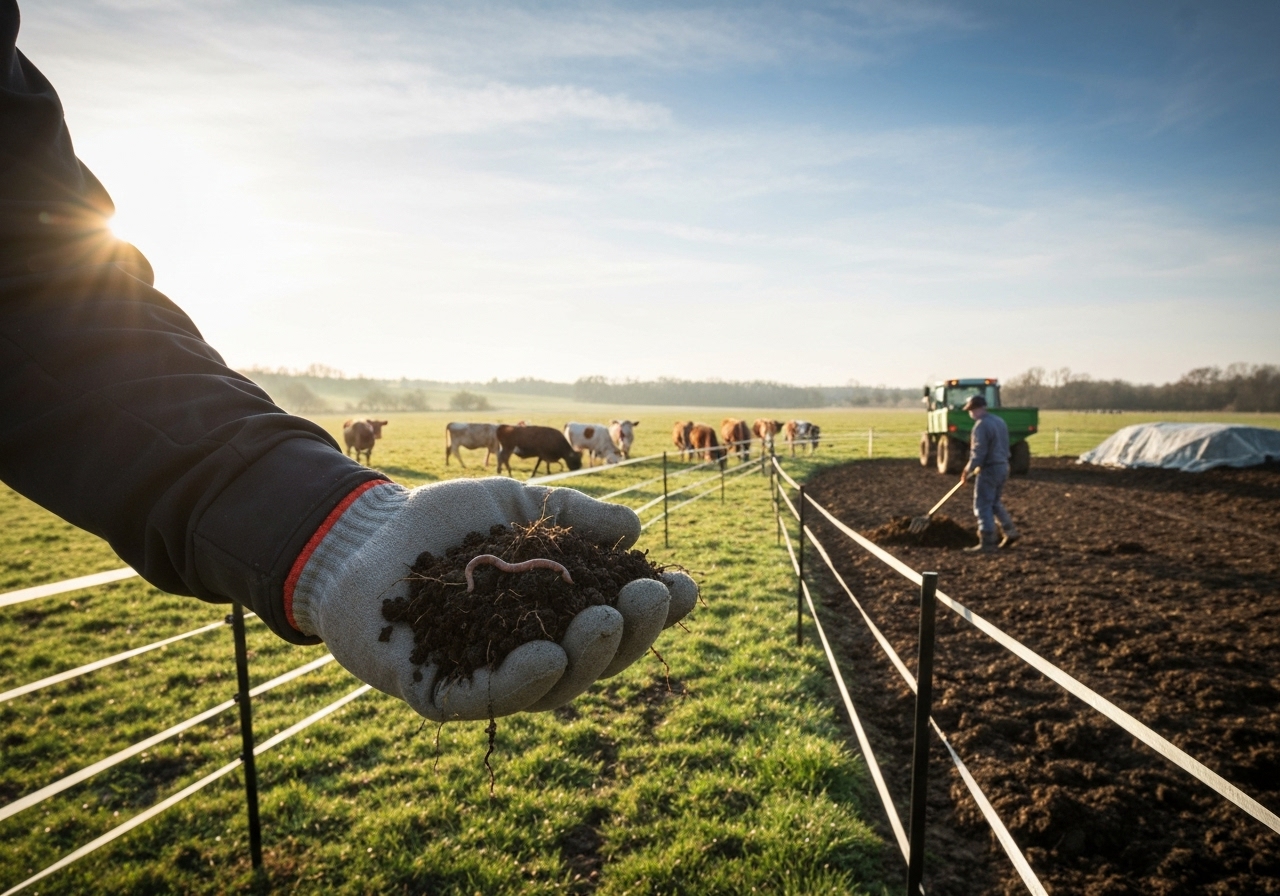
Use rotational or adaptive grazing and composted manure to increase plant productivity and return stable organic matter to soils.Well-managed grazing stimulates root growth and allocates more carbon belowground; manure applied as compost or integrated with tillage reductions enhances soil carbon accrual.
Follow these best practices:
- Rotate paddocks frequently to maintain plant vigor and residue cover.
- Stock at adaptive densities, not maximum, to balance forage regrowth and soil protection.
- Compost manures before field application where practical to stabilize nutrients and reduce pathogen and nitrate leaching risks.
Studies coordinated by USDA and academic partners show rotational grazing with extended recovery intervals builds more soil carbon than continuous grazing on similar lands.
How can vermicomposting and in-vessel systems help small farms?
Use vermicomposting and small in-vessel reactors to quickly process kitchen scraps and other small-volume wastes into high-quality soil amendments.These systems are low-footprint and scalable for market gardens and diversified farms.
Design considerations:
- Vermicompost in shallow beds or bins for rapid decomposition and nutrient-rich castings.
- Deploy small in-vessel systems to control odors and vectors while treating food-processing residues.
- Blend outputs into potting mixes, transplanting media, or field topdressings.
How to design a circular on-farm waste-to-carbon system?
Design a circular system by mapping waste streams, selecting treatments by scale, and returning stabilized products to appropriate fields.Start with a simple flowchart: source -> treatment -> product -> field application -> monitoring.
Use these steps to build the system:
- Inventory all waste: list volumes, moisture, and seasonal peaks.
- Prioritize streams by carbon potential and contamination risk.
- Match treatment: compost high-fiber residues; digest wet manures; pyrolyze woody waste.
- Plan storage, biosecurity, and application timing to prevent runoff or nutrient losses.
- Integrate with cropping plans and livestock cycles to ensure steady feedstock and amendment demand.
Integrate waste planning with crop rotation to maximize carbon retention and reduce inputs; see guidance on flexible rotations in adaptive rotation planning.
How to use microbial consortia to increase carbon stabilization?

Apply tailored microbial consortia to enhance decomposition pathways that favor stable soil aggregation and carbon formation.Microbial inoculants can accelerate humification and reduce nitrogen losses when matched to feedstock chemistry.
Leverage on-farm microbial strategies by consulting field-tested designs; for actionable approaches see the principles in microbial consortia for soil enrichment.
Can small farms monetize soil carbon increases?
Yes, small farms can access soil carbon markets and other revenue streams, but success depends on measurement, protocols, and transaction costs.Newer market models, including cooperative aggregation and blockchain tracing, reduce barriers for family farms.
Consider these revenue options:
- Soil carbon credits under verified protocols (project-level or bundled).
- Premium pricing for compost-amended or regenerative-labeled products.
- On-farm energy from AD or biochar sales to landscapers.
Case studies in recent sector reports show small farms can achieve net positive income from credits when grouped or when co-benefits (reduced inputs, yield gains) are counted; explore program designs summarized in soil carbon credits: small farm revenue.
How to measure and verify soil carbon changes on farms?
Measure soil carbon using baseline sampling, periodic lab analysis, and established protocols combined with remote sensing and modeling for verification.Verification requires a clear baseline, control or reference plots, and standardized sampling depth (commonly -30 cm).
Follow this measurement plan:
- Establish baseline with 10-20 composites per field depending on variability.
- Use consistent depth and lab methods (dry combustion preferred) and report in mass per area (tons C/ha).
- Monitor annually or every 3-5 years depending on the protocol; supplement with modeling and imagery.
- Document management actions, amendment rates, and provenance for auditing.
Protocols from recognized bodies (ICROA, Verra, USDA pilot frameworks) specify sampling density and permanence requirements; consult these standards when aiming for credits.
What are environmental, regulatory, and safety considerations?
Address air, water, and biosecurity risks by following local manure rules, composting standards, and application timing restrictions.Avoid surface application before heavy rains; manage nitrate risks by testing and staging applications.
Implement safety procedures:
- Train staff in pathogen controls and safe handling of compost and digestate.
- Comply with manure and waste spread limits and buffer zones for watercourses.
- Monitor odors and neighbors; use containment or covers for digesters and piles near sensitive receptors.
Cite national extension guidance and local environmental regulations when planning systems; many agencies offer decision trees and permitting advice.
How to schedule farm waste-to-carbon activities across a year?
Schedule feedstock collection during harvest peaks, compost during warmer months, pyrolyze woody residues in winter, and apply amendments before planting or during fall incorporation.Stagger activities to use storage capacity and to match soil application windows.
Example annual calendar:
- Spring: apply cured compost and digestate; topdress cover crop plantings.
- Summer: active composting and turning; biochar production from pruning.
- Fall: incorporate residues, spread compost, and seed cover crops.
- Winter: process woody waste; plan next-year feedstock flows and equipment maintenance.
Use crop maps and microclimate calendars to time applications for best uptake; consult regional scheduling resources like diversified small-farm crop maps to align practices with local microclimates.
What are the costs, returns, and simple ROI examples?
Estimate capital costs for equipment, labor, and permits against returns from lower input costs, increased yields, compost sales, energy capture, and potential carbon payments.Small-scale composting needs minimal capital; digesters and pyrolysis units have higher upfront costs but offer energy and stable carbon outputs.
Run the following simple ROI checks:
- Calculate avoided disposal fees and fertilizer costs.
- Estimate increased yield or reduced irrigation cost after soil carbon gains.
- Model potential carbon credit revenue and add co-benefits value to the farm.
Many farms reach payback within 3-7 years when energy offset and input savings are combined with compost sale or carbon income; perform farm-specific cash flow analysis before investing.
What quick operational tips improve carbon permanence?
Keep soils covered, minimize inversion tillage, and combine amendments with root-promoting crops to lock carbon belowground.Cover crops and reduced tillage move carbon into protected aggregates and deeper root zones.
Follow these operational rules:
- Never leave soils bare for extended periods.
- Use deep-rooting species in rotations to transfer carbon deeper.
- Incorporate biochar with compost to protect labile carbon.
What monitoring and recordkeeping are required for best practice?
Keep records of feedstock volumes, compost recipes, application rates, sampling results, and management actions for verification and improvement.Digital logs and photographs simplify audits and continuous improvement.
Maintain these records:
- Feedstock receipts and pile composition.
- Temperatures, turning dates, and curing times.
- Application fields, rates, dates, and weather conditions.
Frequently asked questions about turning farm waste into soil carbon
Will composting eliminate all pathogens?
No, composting reduces many pathogens if thermophilic conditions are reached, but pasteurization or testing may be required for certain uses.Follow validated temperature-time regimes and test before using on produce with direct contact.
Does biochar always increase yields?
It varies; biochar most often improves yields on degraded, sandy, or nutrient-poor soils and when charged with nutrients or compost.Trials show heterogeneous yield responses — perform a small trial before large-scale adoption.
Are carbon credits accessible to a one-acre market garden?
It depends on program rules but typically small farms need aggregation or simplified protocols to participate cost-effectively.Join cooperatives or regional aggregators to pool credits and share verification costs.
Where to find further technical and policy resources?
Consult national extension services, FAO resources, and recognized carbon protocol documents for technical specifics and compliance requirements.University extension bulletins provide region-specific compost recipes, AD feasibility tools, and biochar guidelines.
For practical on-farm examples linking soil biology and carbon strategies, explore posts describing microbial design and microclimate practices across small farms such as microbial consortia for soil enrichment and crop planning resources like the diversified small-farm calendar.
What are the next steps for a farm starting this transition?
Start with a waste audit, select one pilot stream, and run a 12-month trial to refine operations and document outcomes.Scale activities once material balance, storage, and market pathways are validated.
Implement these starter actions:
- Perform a one-week material inventory by volume and type.
- Create a simple pest and odor management plan.
- Build one pilot compost pile, or partner with a nearby digester or biochar service.
- Collect baseline soil samples and plan monitoring.
Treat farm waste as a resource: stabilize its carbon, feed your soil, and build a resilient, circular farm system. Practical, documented steps lead to measurable soil carbon gains and stronger farm economics.


