
Mapping Microclimates for Precise Succession Planting
Mapping microclimates enables precise succession planting by locating where and when crops will thrive across a field, allowing growers to shift planting dates, varieties, and management to extend harvests and increase yield stability.
What is succession planting and why map microclimates?

Succession planting is planting the same crop or complementary crops in sequence to provide continuous harvests; mapping microclimates refines succession planting by locating pockets of heat, cold, wind, slope, and soil moisture so you plant each succession where it will succeed.
How does mapping change simple succession plans?
Mapping converts blanket planting windows into site-specific windows that extend harvests by 2 to 8 weeks in many systems. Extension programs such as university cooperative extensions and USDA guides document consistent gains from microclimate-aware planting.
How do you identify microclimates on a farm?
Identify microclimates by combining observation, simple sensors, and mapping. Walk fields at multiple times, note frost pockets, hot ridges, wind corridors, water seepage and shade. Install temperature loggers and soil moisture probes in representative spots for at least one season.
What low-cost sensors measure useful variables?
Use temperature loggers (e.g., USB thermometers), soil moisture sensors (capacitance or TDR), and leaf wetness sensors. Add light meters for shaded niches. Use smartphone-connected sensors to reduce labor and collect time-stamped data.
How do you convert observations into a microclimate map?
Digitize observation points using a smartphone GPS or a handheld GPS, then plot points in a simple GIS or even Google My Maps. Interpolate zones by comparing elevations, proximity to windbreaks, and recorded extremes to draw microclimate polygons.
What are the common microclimate zones to map?
Map these functional zones: frost-prone hollows, early-warm south-facing slopes, late-warm north-facing cold pockets, high-wind corridors, irrigated moist strips, and shaded understory edges. Each zone requires different crop timing and variety choices.
Which microclimate attributes most affect planting date?
Temperature extremes, soil moisture, frost dates, and cumulative heat (growing degree days) most affect planting date. Use growing degree day calculations by zone to refine sowing and transplant dates.
How do you build a succession calendar from microclimate maps?
Build a succession calendar by assigning crops and cultivar maturities to each microclimate polygon, then stagger plantings by germination and maturity requirements so harvests overlap and supply remains steady.
What are the steps to create a microclimate-based succession calendar?
Follow these steps: 1) Map microclimate polygons, 2) Record local last and first frost dates by zone, 3) Calculate GDD (growing degree days) per zone, 4) List crop windows and maturity days, 5) Assign successive planting dates and areas, 6) Schedule season extension actions where needed.
How to calculate planting dates using GDD and maturity days?

Calculate cumulative GDD from your zone data and match cultivar heat requirements. Subtract seed-to-harvest days from target harvest windows to find planting windows. Use zone-specific GDD rates to adjust planting by microclimate.
Which crops and sequences work best for succession planting?
Use short-season crops and multiple cultivars for continuous supply. Typical sequences: early salad greens -> mid-summer brassicas -> late-season root crops; early baby greens -> second sowing for full-size greens; spring brassicas -> fall brassicas in cooler pockets.
What crop families and maturities should be prioritized?
Prioritize families with varied maturities and temperature responses: Brassicaceae (quick to cool), Asteraceae (lettuce series), Chenopodiaceae (beets, chard), Cucurbitaceae (summer crops in warm zones), and Fabaceae (successional peas/beans). Use early, mid, and late-maturing cultivars to extend harvests.
How do you integrate crop rotation with succession planting?
Integrate rotation by mapping both microclimates and rotation blocks so successions do not repeat the same family on the same soil within the rotation interval. Use rotation to manage pests, diseases, and soil fertility while maintaining succession timing.
Where to find rotation frameworks that work with succession planning?
Use adaptive rotation frameworks that group by functional roles: cash crops, legumes, deep-rooted restorative crops, and cover crops. Plans like adaptive low-input rotation plans help align rotation blocks with succession timing.
What season-extension tools help extend successions by microclimate?
Use row covers, low tunnels, high tunnels, windbreaks, and mulches to shift microclimate windows. Row covers can advance harvest by 2 to 3 weeks; tunnels can extend production 4 to 12 weeks depending on local conditions.
How to choose season-extension by microclimate zone?
Place cold-sensitive crops in warm polygons or under tunnels; place frost-tolerant late crops in frost pockets if harvest is after entry into hard frost. Use mulches in hot, dry zones to preserve soil moisture for late successions.
How do soil health and microbial management affect succession planting?
Soil health determines crop resilience across successions. Improve structure, organic matter, and microbiome to reduce transplant shock, speed germination, and increase nutrient turnover between successions.
Which soil microbial strategies help quick successions?
Use cover crops for quick nutrient cycling, targeted compost teas for microbial inoculation, and seed or transplant microbial coatings to accelerate establishment. See research on microbial consortia for targeted soil enrichment in successive plantings and designing on-farm microbial consortia for practical methods.
How to set up irrigation and fertility for staggered plantings?
Set irrigation zones to match microclimate polygons so differing moisture needs are met. Use fertigation or side-dress schedules keyed to each succession batch. Install moisture sensors across zones to avoid over- or under-watering.
How to schedule fertilizer for successive crops?
Apply baseline fertility based on soil tests, then apply targeted side-dress for nitrogen-hungry successions. Use legume successions to biologically fix N between heavy feeders.
How much labor and cost does microclimate mapping add?
Labor investment is front-loaded: mapping takes 1 to 2 seasons of observation and sensor logging. Costs can be as low as a few hundred dollars for basic sensors or several thousand for automated sensor networks; savings come from reduced crop loss and higher marketable yields.
What are recommended low-cost starting steps?
Begin with walking maps, 4-6 temperature loggers, and 2-4 soil moisture probes. Use free mapping tools and spreadsheets to create a succession calendar. Expand sensors only after you see actionable variation between zones.
What tools and templates help implement microclimate succession plans?
Use a calendar-based spreadsheet that lists microclimate zones, crop, variety, planting date, expected harvest, and required interventions. Add a field map layer to your farm plan and update each year using recorded GDD and frost data.
Can farm management software help?
Yes. Use basic tools (Google Sheets) for initial plans and scale to farm management software for automated reminders, sensor integration, and record-keeping when operations grow.
How to test and iterate your succession plan?
Test by running parallel plantings across two distinct microclimate polygons for the same crop. Record emergence, maturity, pest pressure, and yields. Adjust planting dates, varieties, and inputs based on measured differences.
What metrics matter most for iterative improvement?
Track emergence percentage, days to maturity, marketable yield, pest/disease incidents, and labor per harvest. Use those metrics to decide whether a zone should host an earlier or later succession next year.
What common mistakes reduce success of microclimate succession planting?
Common mistakes include mapping only once, ignoring soil variability, forcing a single calendar across the farm, and failing to adapt to year-to-year climate shifts. Avoid these by collecting multi-season data and incorporating rotation constraints.
How to avoid overcomplicating maps?
Keep maps functional. Limit polygons to 6 to 12 meaningful zones. Use zones that change management (planting date, variety, or protective structure) rather than overly granular divisions that add no action.
How have other farms applied microclimate mapping to succession planning?
Case examples show small farms extending salad green production by 6 weeks and doubling market supply in shoulder seasons by moving late-sown crops to warm microclimate ridges and using low tunnels in cool pockets. Practical guides and calendars such as the diversified small-farm calendar model document stepwise implementation.
What research supports microclimate-based successions?
Extension programs and USDA resources show predictable frost and GDD differences across short distances. University trials consistently report yield and harvest-window extensions from site-specific planting adjustments.
What is a sample microclimate succession calendar for temperate small farms?
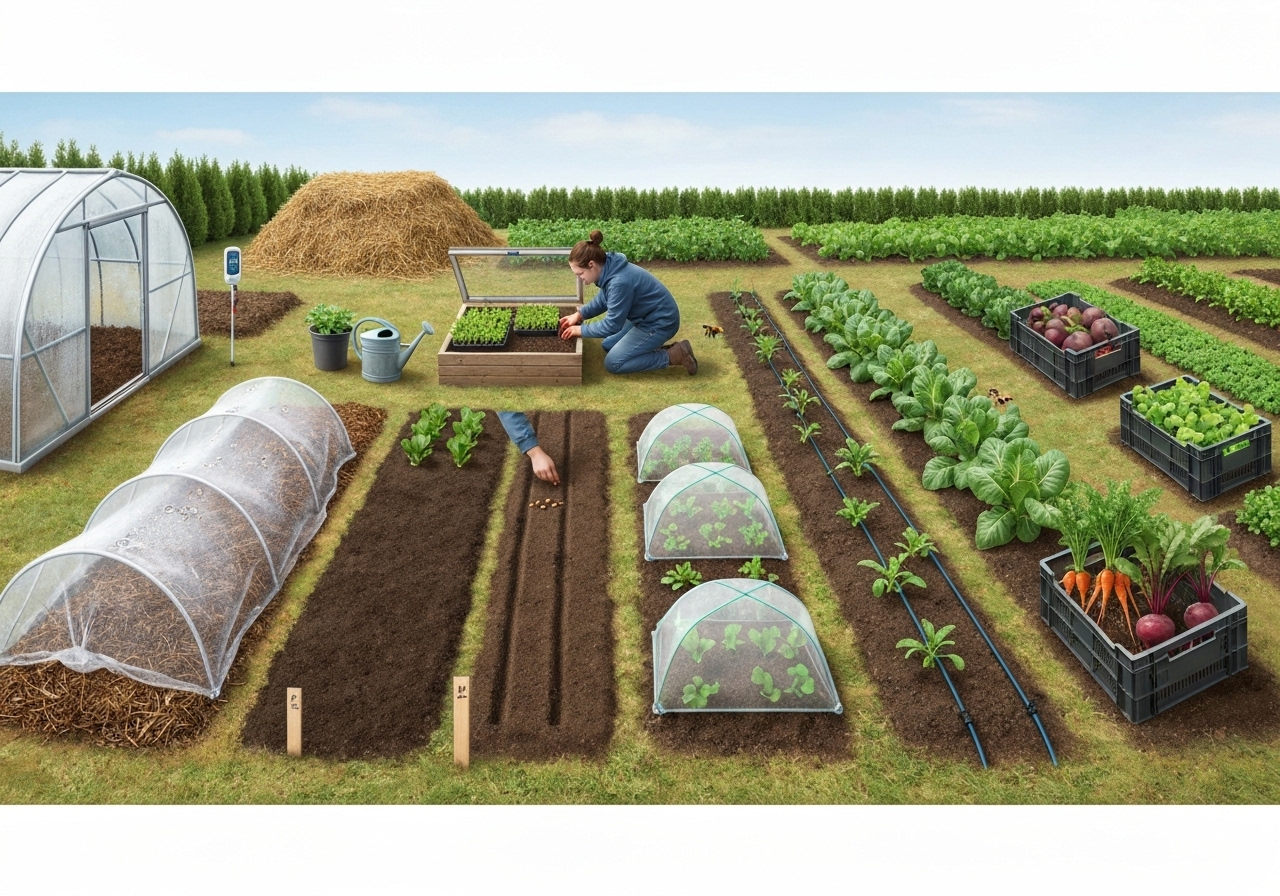
Sample calendar: early-spring (warm ridge): sow spinach and early lettuce in late March; mid-spring (benchland): direct-sow carrots mid-April; summer (lowland irrigated zones): transplant tomatoes late May; late-summer (shaded east edge): sow fall brassicas late July for fall harvest in September; fall (warm south slope): seed quick-maturing salad greens in August for fall supply.
How to translate sample calendar to your farm?
Translate the sample by substituting local last frost, local GDD rates by zone, and cultivar days-to-harvest. Use trial blocks each year to validate and refine dates.
How to combine microclimate mapping with other farm innovations?
Combine mapping with regenerative practices such as targeted cover cropping, microbial seed or soil amendments, and irrigation zoning. Integrate mapping outcomes into broader climate resilience strategies and market planning.
Which integrated practices add the most value?
Integrate mapping with microbial enrichment and cover crops to speed succession transitions. For design examples and microbial mapping strategies see posts on on-farm microbial consortia and field-scale microbial mapping.
What are quick-start checklists for the first year?
Quick-start checklist: 1) Walk the farm and mark frost pockets, hot spots and shade, 2) Deploy 4-6 sensors across distinct spots, 3) Collect data through key transition months, 4) Create 6 microclimate polygons, 5) Draft a succession calendar assigning varieties and planting dates by polygon, 6) Run 2 pilot successions and record outcomes.
When should you re-map?
Re-map after major changes: new windbreaks, irrigation shifts, terracing, or after two seasons of different weather trends. Update annually for small adjustments based on last season’s data.
What final practices ensure long-term success of microclimate-informed succession planting?
Adopt continuous monitoring, keep short feedback loops, and align market windows with mapped production capacity. Train staff to recognize microclimate signals, and maintain records to convert site knowledge into reliable, scaled succession systems.
Relevant further reading: microclimate zoning approaches to boost yields on small farms and microclimate mapping for urban regenerative farming provide complementary mapping methods and scaling strategies.


