
Engineering Root-Scaffold Crops to Break Soil Compaction
Engineering Root-Scaffold Crops to Break Soil Compaction
Engineering root-scaffold crops uses crop selection, mixtures, rotation timing, and microbial partnerships to physically fracture compacted layers and restore pore networks. This practical guide explains which species work, how to design rotations and mixtures, when to include mechanical interventions, how to monitor progress, and what economic tradeoffs farmers should expect.
What are root-scaffold crops and how do they reduce soil compaction?
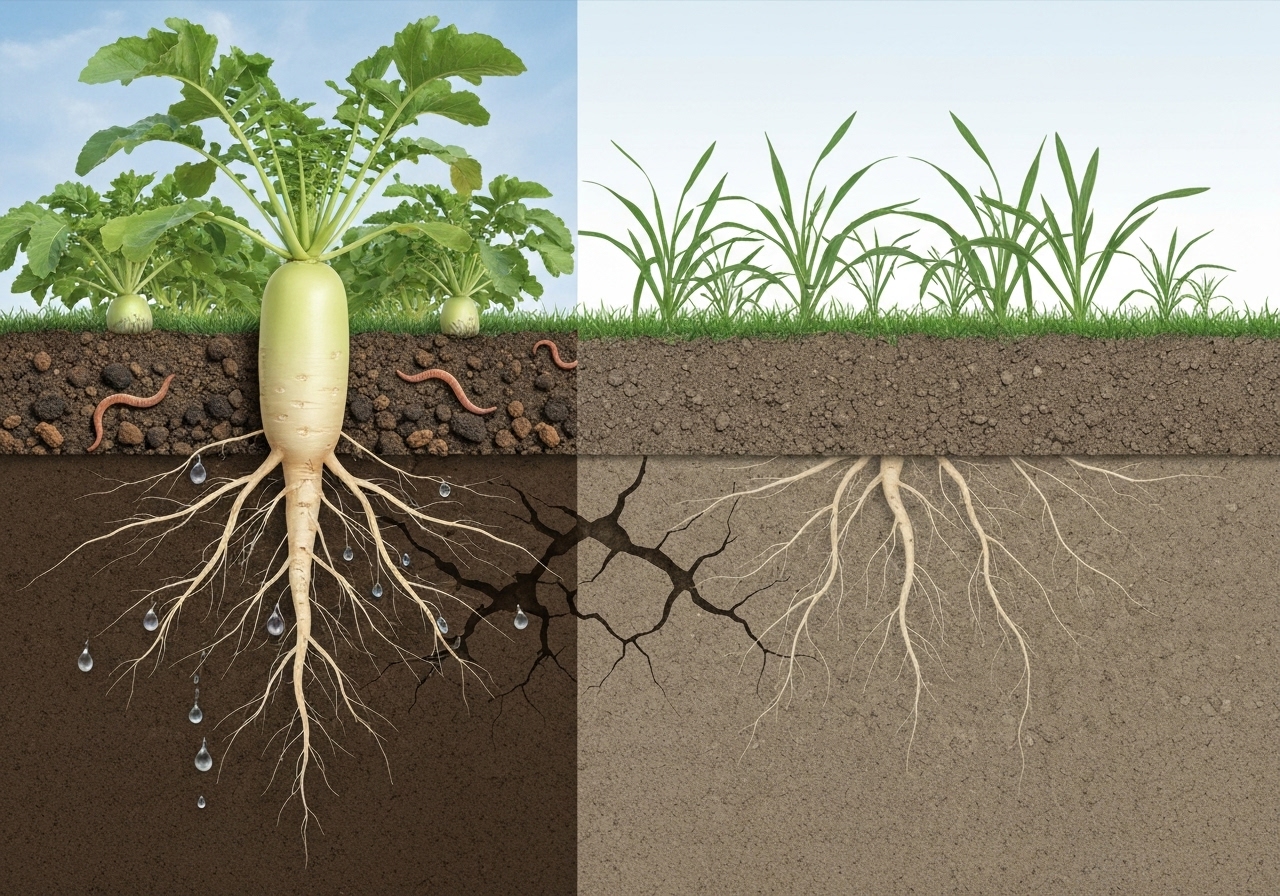
Root-scaffold crops are plants chosen or bred for root traits that penetrate, loosen, or stabilize compacted soil layers. Research and conservation practice demonstrate that deep, stiff taproots and dense fibrous root mats create channels and aggregate soil, increasing porosity and water infiltration.
Root-scaffold crops reduce compaction by four mechanisms: 1) physical penetration of dense layers (bio-drilling); 2) root-induced aggregate formation that resists reconsolidation; 3) increased biopores from decayed roots that persist for subsequent crops; 4) stimulation of microbial communities that bind particles and produce glues (exopolysaccharides) that improve structure.
Which species serve as effective root-scaffold crops?
Effective root-scaffold crops include species with strong taproots, woody or fibrous architectures, or persistent root systems. Examples: tillage radish (Raphanus sativus var. longipinnatus), forage radish, chicory (Cichorium intybus), summer deep-rooting brassicas, sainfoin, alfalfa, deep-rooting cover grasses like perennial ryegrass and tall wheatgrass, and certain brassica-perennial mixes.
Select species for local climate and soil type. In cool temperate zones, winter-active tillage radish creates large biopores before spring planting. In warm climates, sunn hemp and pigeon pea supply deep penetration and biomass. Perennial legumes and forage crops provide multi-year root scaffolds for chronic compaction problems.
How should farmers choose species for local soils and objectives?
Choose species by matching root traits to the compaction depth and farm goals. First, measure compaction depth and severity using a penetrometer or spade test. Then, choose plants with rooting depth greater than the compacted layer and root stiffness sufficient to penetrate it.
For short-term mitigation use annual deep-rooters like tillage radish or sunn hemp. For long-term structural recovery use perennials (alfalfa, sainfoin) or multi-year grass-legume mixtures. Combine a taprooted species with fibrous-rooted grasses to create both vertical channels and lateral stabilizing networks.
How to design crop mixtures and rotations to maximize compaction reversal?
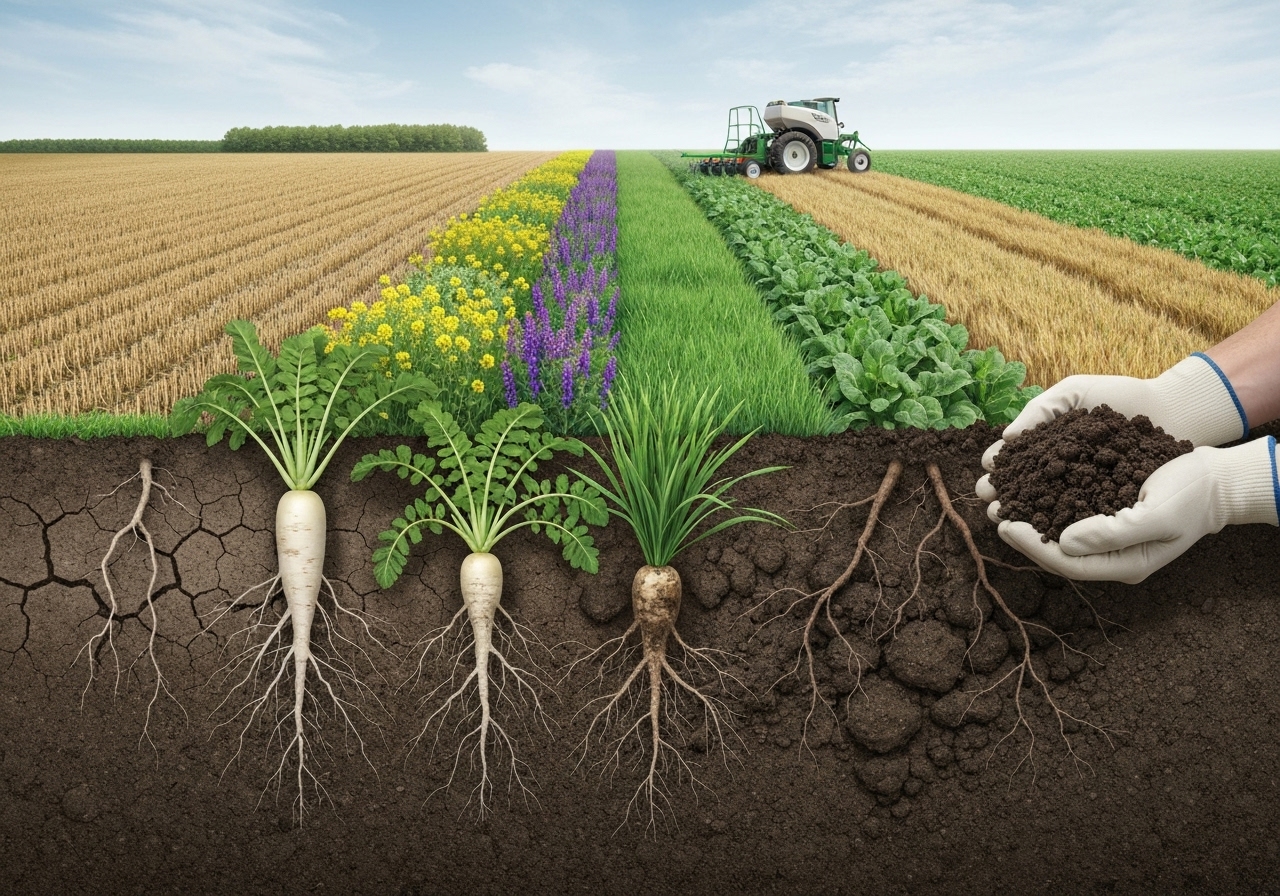
Design mixtures and rotations to sequence root functions: first, penetrate; second, stabilize and build porosity; third, exploit channels. A common sequence is: year 1 deep-rooted annual (bio-drill), year 2 fibrous grass-legume mix, year 3 cash crop following improved soil structure.
Follow these steps to design rotations: 1) map compaction zones across the field; 2) assign deep-rooters where compaction is deepest; 3) follow deep-rooters with high-root-mass stabilizers; 4) integrate low-disturbance cash crops to preserve newly formed pores. Use adaptive low-input rotation principles to fit labor and markets; see adaptive rotation plans for templates that small farms can adapt.
When should farmers use mechanical tillage in combination with root-scaffold crops?
Use mechanical tillage selectively and only when biological measures alone are insufficient. Mechanical loosening can immediately restore trafficability but risks surface sealing and organic matter loss if overused.
Combine mechanical and biological methods this way: 1) apply shallow mechanical tillage to disturb the compacted layer without pulverizing soil; 2) plant root-scaffold crops immediately to occupy created pores; 3) avoid repeated deep inversion tillage that destroys root channels. Research from conservation agriculture programs recommends minimal, strategic tillage coupled with continuous cover to sustain gains.
What management practices preserve root-created porosity?
Preserve root-created porosity by minimizing wheel traffic, using controlled trafficking lanes, and timing field operations when soils are dry enough to avoid reconsolidation. Reduce repeated tillage passes and adopt no-till or minimum-till for subsequent cash crops.
Adopt the following operational practices: 1) maintain permanent headlands or traffic lanes; 2) use flotation tires or track systems to lower contact pressure; 3) schedule fieldwork based on soil moisture sensors to avoid working wet soils; 4) keep continuous living roots or surface residue to prevent soil collapse.
How do microbial consortia support root-scaffold function?
Microbial consortia improve root-scaffold performance by accelerating organic matter turnover, producing binding agents, and promoting root growth. Specific microbes increase root penetration by reducing root-path impedance and by mobilizing nutrients that support deeper rooting.
Integrate microbial strategies by using seed coatings, compost teas, or site-tailored inoculants that promote root health and aggregate formation. Design microbial inputs around the chosen crops; see methods for designing and applying on-farm consortia in on-farm microbial consortia.
What monitoring indicators show that compaction is improving?
Monitor soil compaction using a mix of simple field tests and quantitative measures. Direct indicators: decreased penetrometer resistance in the plow layer and subsoil, increased macroporosity, and greater root penetration depth for subsequent crops.
Use these monitoring methods: 1) static penetrometer readings across years at fixed locations; 2) shovel or spade profile to observe root distribution and biopores; 3) infiltration tests (double-ring) to detect faster water entry; 4) yield and rooting depth of follow-up cash crops as functional indicators. Combine several methods for robust assessment.
How long does biological compaction reversal take?
It varies by severity, soil texture, climate, and management. Light compaction may show measurable improvement in 1 growing season with aggressive deep-rooters. Moderate to severe subsoil compaction typically requires 2 to 5 years of strategic rotations and reduced trafficking to restore structure.
Expect multi-year timelines where heavy clay subsoils and high wheel loads are present. Persist with follow-up stabilizing phases and avoid high-pressure traffic to prevent reversal. Consider combining a single mechanical fracture with multi-year biological follow-up when time-to-recovery must be accelerated.
What are the economic tradeoffs and benefits of using root-scaffold crops?
Root-scaffold systems incur seed and establishment costs and may require foregone cash income during cover phases. Benefits include reduced fuel and repair costs from fewer tillage passes, improved yields over time from better rooting and water access, and potential eligibility for soil carbon or conservation incentive programs.
Estimate costs and returns by: 1) calculating seed and planting costs; 2) valuing reduced tillage or improved yields; 3) adding potential payments from carbon or conservation programs. Use local extension services and producer networks to confirm assumptions. Programs that monetize soil carbon can further improve the business case; see background on soil carbon markets in soil carbon credits.
How to implement a field-level plan step-by-step?
Implement a field plan in five clear steps: diagnose, prioritize, design, implement, monitor.
1) Diagnose: use penetrometer, spade tests, and field history to map compaction zones. 2) Prioritize: treat the most productive or traffic-impacted zones first. 3) Design: select species, mixtures, and rotation timing with specific rooting depth targets. 4) Implement: seed deep-rooters at optimal dates and densities, manage residues, and limit traffic. 5) Monitor: measure penetrometer resistance, infiltration, and root depth annually and adapt the plan.
How to measure compaction precisely in the field?
Measure compaction with a cone penetrometer for quantitative resistance (kPa) values and with spade profile checks to observe mechanical impedance layers. Use consistent moisture conditions when measuring; penetrometer readings are sensitive to soil water content.
Record penetrometer data at fixed sampling points and depths (-30 cm, 30-60 cm, 60-90 cm) and compare over seasons. Supplement with bulk density cores for laboratory confirmation when needed.
Which root traits are most effective for breaking hardpans?

Key root traits: high tensile strength and stiffness, large root diameter, positive root thigmomorphogenesis (ability to respond to resistance with increased strength), and a combination of taproot and lateral proliferation. Persistence of root channels after decay is critical to long-term benefits.
Breeding and selection should emphasize a mix of mechanical penetration traits and biomass production. Poly-cropping and mixture design accomplish trait complementarity without waiting for new cultivars.
Can breeding and genetic selection speed up root-scaffold effectiveness?
Yes. Breeding for root diameter, depth, and root-soil interface traits can accelerate compaction reversal. Plant breeders and root phenotyping labs are increasingly selecting for deeper, stiffer roots suitable for challenging soils.
Adopt improved cultivars as they become available and consider on-farm selection by saving seed from individuals that demonstrate superior rooting on compacted plots. Combine genetic advances with management for the fastest results.
What risks or unintended consequences should farmers watch for?
Risks include shallow rooting if species are sown at the wrong time, nitrogen tie-up under high carbon residue loads, and pest or volunteer crop issues. Overreliance on a single species can create disease carrying risks.
Mitigate risks by staggering planting dates, integrating legumes to supply nitrogen, rotating species to reduce disease pressure, and monitoring pest presence. Maintain diversity in mixtures to avoid single-point failures.
How can technology and precision tools improve implementation?
Use precision mapping, remote sensing, and soil moisture sensors to target interventions. Autonomous or drone seeders can place cover crops in narrow bands for targeted compaction zones. AI-guided soil sensors can track changes in moisture, resistivity, and compaction over time.
Combine mapping with farm-scale management by using variable-rate seeding of deep-rooters only where needed. That reduces seed cost and concentrates benefits where compaction constrains yields most.
Which complementary practices maximize long-term soil resilience?
Complement root-scaffold crops with reduced tillage, continuous cover, diversified rotations, organic matter additions (compost or manure), and targeted grazing to maintain structure. Integrate microbial practices that enhance aggregate stability and root growth.
Adopt regenerative microclimate and polyculture approaches to increase root diversity and functional redundancy. For small farms, refer to diversified crop calendars and microclimate zoning that align rotations and species choices with local conditions; resources on planning can help adapt deployments to microclimates and labor windows.
Practical on-farm checklist
- Map compaction: use penetrometer and spade tests.
- Select species: match roots to compaction depth.
- Design sequence: bio-drill followed by stabilizers.
- Minimize traffic: create permanent lanes and use low-pressure tires.
- Integrate microbes: seed coatings or tailored consortia.
- Monitor: penetrometer, infiltration, and root depth annually.
Key references and practice guides
Follow technical advice from national conservation agencies (USDA NRCS, FAO) and academic reviews on deep-rooted cover crops and compaction management. Peer-reviewed literature in journals such as Soil & Tillage Research and Soil Biology & Biochemistry summarizes mechanisms and trials of bio-drilling and long-term structural recovery.
Adopt adaptive planning from crop rotation frameworks and local extension resources to scale efforts across fields and years. See adaptive rotation templates in adaptive low-input rotation plans to link compaction mitigation with farm revenue goals.
Implementing root-scaffold systems offers durable improvements in infiltration, rooting depth, and crop performance when executed as part of an integrated soil health strategy that includes traffic management, microbial support, and careful monitoring.


