
Flow-Channeling Biochar Trenches for Clay Field Drainage
Flow-Channeling Biochar Trenches for Clay Field Drainage: Practical Guide
Flow-Channeling Biochar Trenches for clay field drainage provide a low-energy, regenerative method to improve infiltration, reduce surface runoff, and create long-term soil structure benefits in poorly draining heavy soils. This guide explains what flow-channeling biochar trenches are, why they work in clay fields, how to design and install them with numerical dimensions and material ratios, how to integrate them with existing drainage systems and cropping operations, and how to monitor performance and costs. The guidance draws on soil physics, biochar science, field-tested practice, and relevant agency and peer-reviewed sources to offer practical, implementable steps for farmers, consultants, and land managers.
What are flow-channeling biochar trenches?
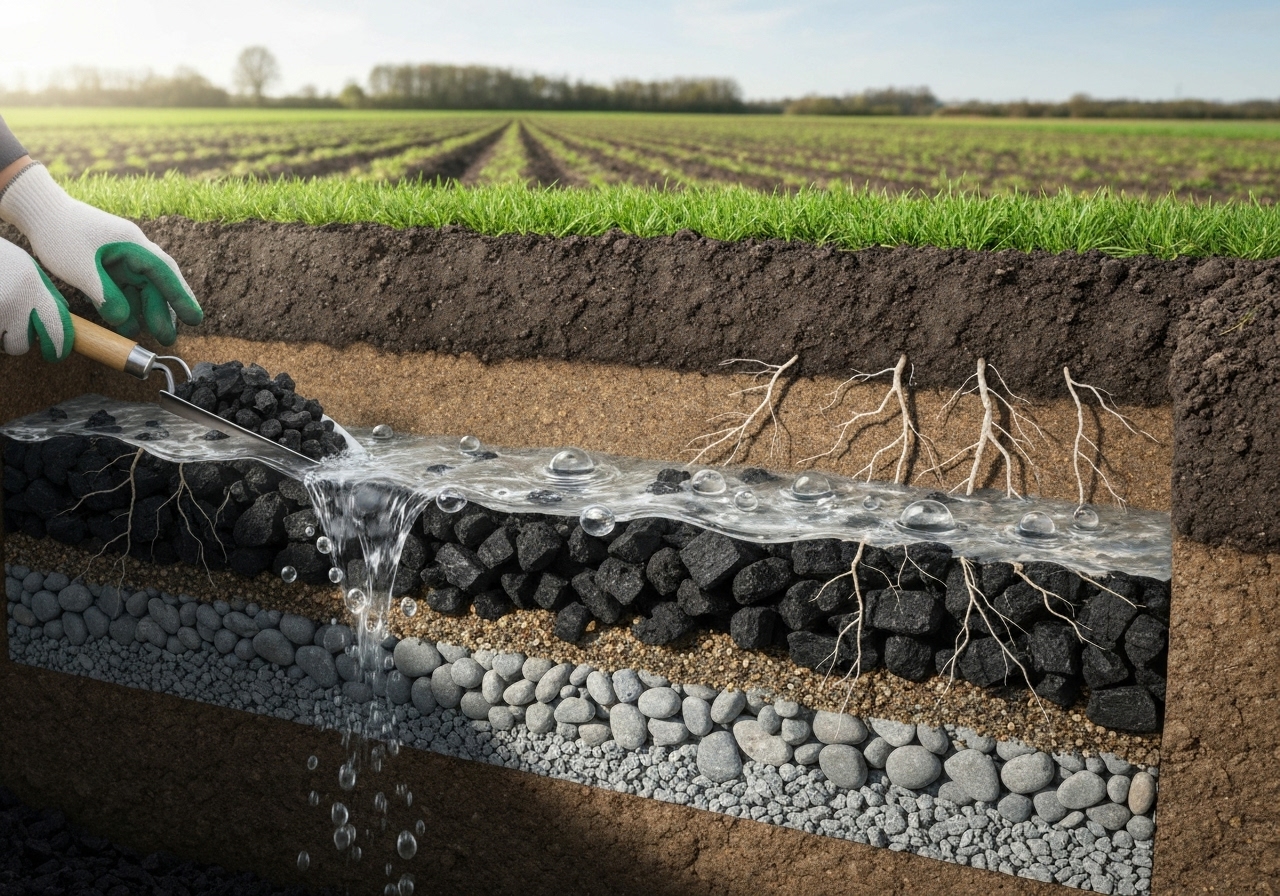
Flow-channeling biochar trenches are linear excavations filled with a coarse structural layer and a biochar-amended filter that direct and store excess runoff and promote vertical infiltration through stubborn clay soil. Flow-channeling biochar trenches use an engineered sequence of coarse aggregate, biochar-amended media, and surface inlet features to create preferential pathways for water. The trenches accept overland flow and concentrate it into discrete, high-permeability channels that bypass the very-low-permeability matrix of compacted clay. Biochar within the trench provides durable macroporosity, high surface area for moisture buffering, and habitat for microbial consortia that increase aggregate stability and porosity over time.
Why should you use biochar trenches to improve drainage in clay soil fields?
Because biochar trenches increase field-scale infiltration rates, reduce ponding and erosion, store water for crop uptake, and sequester stable carbon while improving soil biology. Research and agency guidance show that creating localized macropores and permeable paths is the most effective strategy for clay soils with low saturated hydraulic conductivity (often <1 x 10⁻⁶ m/s). The USDA Natural Resources Conservation Service recommends practices that increase infiltration and reduce surface runoff; flow-channeling trenches meet that objective while adding soil health benefits. Studies in Soil Use and Management and the Journal of Environmental Quality report that biochar-amended porous media can increase infiltration and retain nutrients, reducing nutrient loss during high flows. The result is improved field operability, higher rooting depth, and better resilience to intense rain events.
How do you design a flow-channeling biochar trench for a clay field?
Design a flow-channeling biochar trench by sizing depth, width, spacing, slope, media layers, and outlet details based on infiltration tests, field slope, and target runoff volume. Design steps and key parameters follow:
What infiltration and site data do you need?
Collect measured infiltration rate, slope, surface flow lines, and depth to restrictive layers before designing trenches. Perform 3–5 ring infiltrometer tests or double-ring tests across representative positions in the field to quantify saturated infiltration (units mm/hr). Map surface microtopography and flow lines with a laser level or GPS slope mapping. Identify the depth to compacted plow pan or restrictive clay horizon using a soil probe; trenches should penetrate or reach near that layer without compromising structural stability.
What are recommended trench dimensions and spacing?
Use trenches 30–60 cm deep, 20–50 cm wide, spaced 5–20 m apart depending on slope and infiltration rates. Recommended sizing rules of thumb: 1) For infiltration <5 mm/hr, use 10--12 m spacing; 2) For 5--15 mm/hr, use 6--10 m spacing; 3) For 15--30 mm/hr, use 5--8 m spacing. Increase trench depth on heavier clay (up to 80 cm) if practical. Maintain a gentle longitudinal slope in the trench of .2--1% toward a stable outlet to avoid sedimentation.
What are the internal trench layer specifications?
Construct a 3-layer trench: coarse bedding, biochar-amended infiltration zone, and a capped top with vegetative filter. Typical layer sequence from bottom to top: 1) 10–15 cm coarse angular gravel or crushed stone (20–40 mm) to provide structural drainage; 2) 15–30 cm of biochar-amended media (by volume: 60–80% coarse sand/grit/aggregate + 20–40% coarse biochar + 5–10% compost or stabilized organic matter); 3) 5–10 cm of topsoil and grass/cover crop to reduce erosion and trap fines. Use geotextile separation if native clay is extremely plastic to prevent fine intrusion.
What hydraulic capacity should the trench handle?
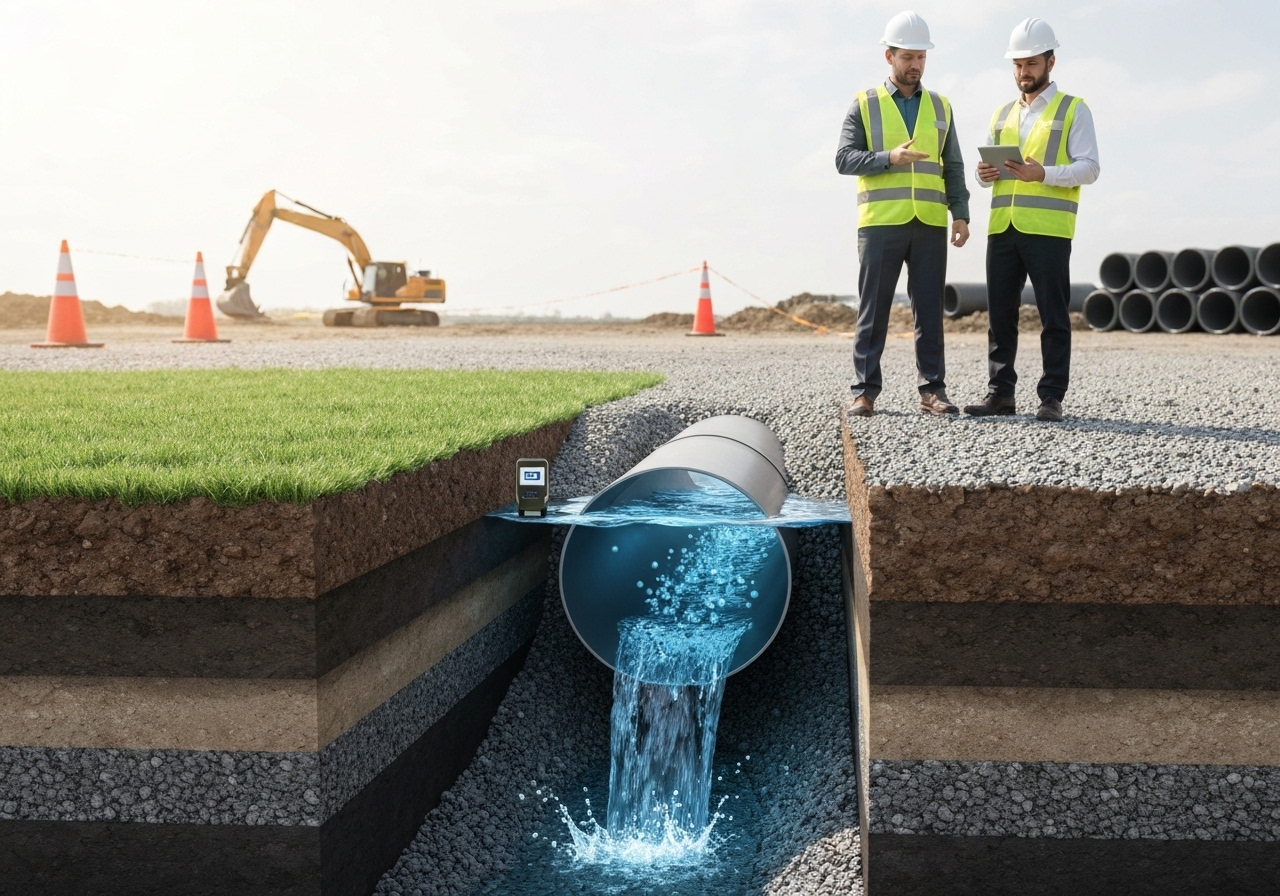
Size trench cross-sectional area to accept the 10- or 25-year design storm runoff from the contributing area per local climate tables. Example calculation: for a 1-hectare upslope contributing area with a design event of 30 mm/h rainfall and a runoff coefficient of .6 on wet clay, peak runoff = .18 m3/s (180 L/s). If trenches are spaced 10 m apart, each linear meter of trench receives 1/100 of that area, so design flow per meter = 1.8 L/s. A trench with an effective flow area of .06 m2 and a hydraulic gradient of .005 will convey that flow; adjust dimensions in practice with local hydrology software or engineer review for large fields.
What biochar types and particle sizes work best in trenches?
Choose coarse, inert, well-characterized biochar (particle size 2–20 mm) produced at moderate pyrolysis temperatures (350–600 C) from uncontaminated feedstock. Coarse biochar maintains macroporosity and resists fine mobilization that can clog the trench. The International Biochar Initiative and the European Biochar Certificate recommend feedstock traceability and testing for heavy metals and PAH content. Avoid powdered pelletized biochar that can compact; select durable, fractured chunks or engineered granules. For improved water retention and microbial habitat, age biochar by pre-charging it with compost tea or liquid digestate before installation.
What soil amendments should you mix with biochar in the trench?
Mix biochar with coarse sand/grit and a small fraction of stable compost or humified organic matter, and optionally inoculate with beneficial microbes. Use by-volume mixes such as 25–35% biochar, 60–70% coarse sand/grit/aggregate, and 5–10% compost. Incorporate mycorrhizal or microbial consortia where available to jump-start biological colonization; designing on-farm microbial consortia improves aggregation and nutrient cycling (see research and practice described in designing on-farm microbial consortia). Avoid high-nitrogen manures in the trench fill that could increase nutrient leaching during the establishment phase.
How do you install flow-channeling biochar trenches step-by-step?
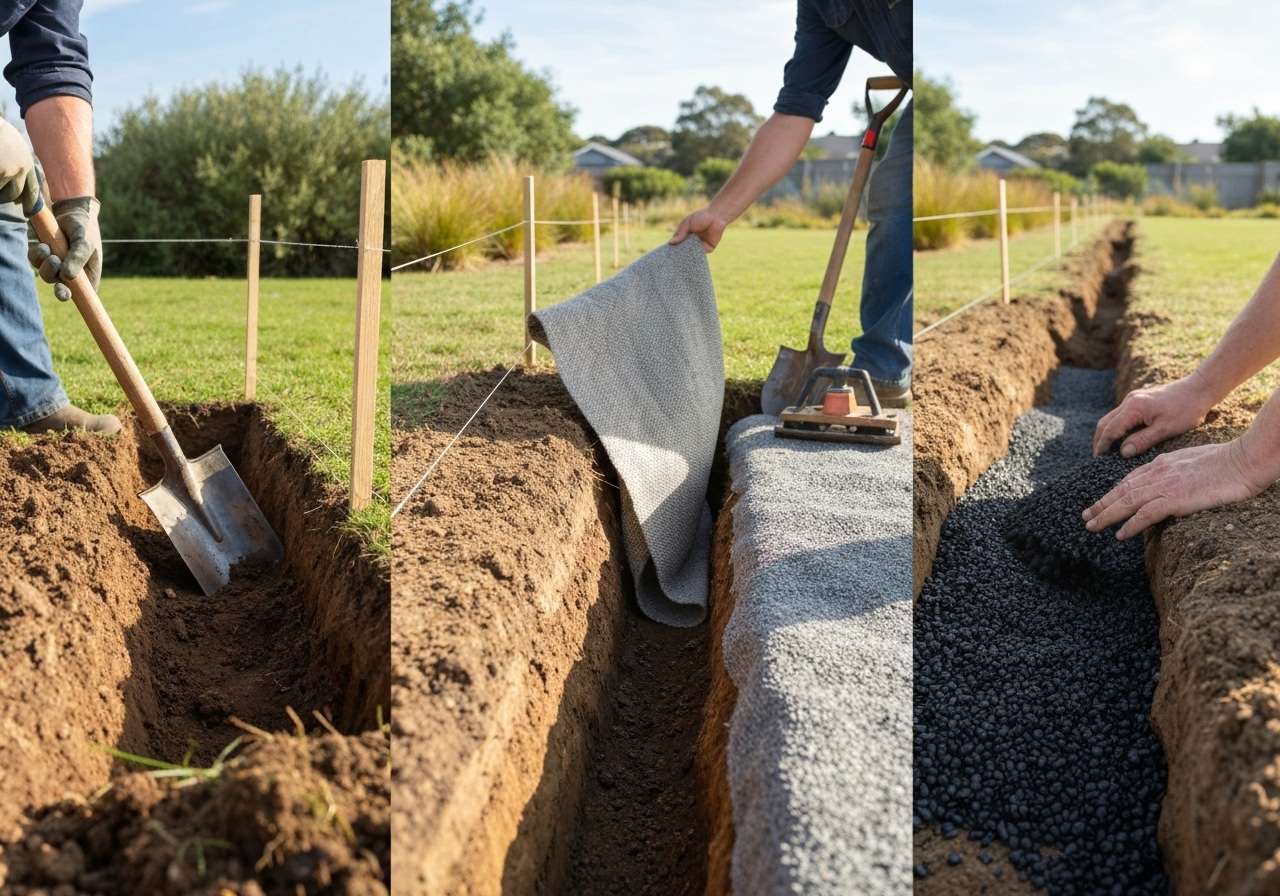
Install trenches by mapping flow lines, excavating to design dimensions, placing geotextile and base layer, adding biochar-amended media, and finishing with topsoil and vegetation. Follow these steps:
- Map: Use contour mapping, survey or GPS to mark flow lines and trench alignment.
- Prepare: Remove existing surface vegetation only where trench will be installed; keep adjacent sod intact to limit erosion.
- Excavate: Excavate 30–60 cm deep x 20–50 cm wide trenches along marked lines; slope the bottom slightly toward outlet.
- Line: Install a nonwoven geotextile if fines migration is likely; extend fabric up trench sides.
- Base: Place 10–15 cm coarse gravel as bedding and spread evenly.
- Biochar fill: Mix biochar with coarse sand/grit and compost and place as 15–30 cm zone; lightly tamp to settle but avoid overcompaction.
- Outlet: Connect upstream and downstream ends to stable rock outfall, infiltration pit, or tile system; include an overflow spillway sized for extreme events.
- Cap and revegetate: Backfill with topsoil 5–10 cm and seed with deep-rooted perennial grass or cover crop to trap fines and increase root penetration into the trench.
- Protect during establishment: Install temporary silt fences or sediment traps downslope until grass is established.
How do trenches integrate with existing drainage systems and field operations?
Integrate trenches by aligning them with surface flow lines, connecting to tile drains or ditches where needed, and locating them outside primary cultivation lines to avoid machine interference. For tile systems, place trenches upstream to reduce sediment and nutrient loads entering tile, or lead trench overflow into a buffer pond that discharges to tile at controlled rates. Maintain a 50–75 cm safety depth below typical cultivation depths so plows and tillage do not damage the trench. Coordinate trench spacing with field traffic lanes and headlands; place trenches parallel to working widths to minimize interference with equipment.
Integrate monitoring and control systems using modern sensor approaches when scaling installation. For example, use soil moisture sensors and remote telemetry to track infiltration performance per meter of trench and adapt spacing or additions over time; farms deploying sensor systems benefit from AI-guided monitoring such as those described in studies on AI-enabled soil sensors for family farms.
What maintenance is required and what is the expected lifespan?
Inspect trenches annually and after major storms; remove accumulated sediment, replenish or top-dress biochar-amendments every 5–15 years, and maintain vegetated cover for the long-term lifespan of decades. Expected lifespans: 1) Structural aggregate and geotextile: 10–50 years depending on loading; 2) Biochar functionality: stable for decades to centuries but surface fines may require periodic topping; 3) Vegetative cover: continuous maintenance. Replace or rework trenches if compaction recurs due to heavy machinery passage or if persistent sedimentation reduces hydraulic capacity.
How much do biochar trenches cost and what is the cost-benefit?
Costs vary widely; expect installation costs from USD 10–60 per linear meter for small-scale manual installs and USD 5–20 per meter for larger machine-installed programs, with biochar feedstock and transport as primary cost drivers. Cost factors: excavation (labor, fuel), biochar cost (.50–3.00 USD/kg depending on quality and region), coarse aggregate, geotextile, and revegetation. Benefits include improved crop yields from reduced waterlogging, lower erosion and sediment control costs, improved field trafficability, and potential revenue from soil carbon credits for stable biochar carbon sequestered in soil (see options on soil carbon credits). Perform a simple payback analysis: divide net present value of yield gains plus avoided drainage pumping and erosion by installation cost; many small farms see payback in 3–8 years when improved yields and avoided repairs are counted.
Will trenches reduce soil compaction and help with salinity problems?
Yes, trenches reduce effective compaction by creating permanent macropore networks that relieve perched water and promote root development; they can assist salinity management when combined with controlled leaching and salt-tolerant vegetation. Trenches increase aeration and pore continuity which reduces the mechanical impedance roots face. For saline soils, trenches act as controlled leaching pathways to flush salts from the crop root zone toward an outlet or a subsurface collection system; biochar can adsorb some ions and buffer cation exchange, but salt management requires integrated water balance planning and sometimes subsurface drainage to carry salts away from fields.
What are common risks and contraindications?
Risks include improper placement on very steep slopes causing erosion, using contaminated biochar, creating perched water that affects adjacent crops, and under-sizing trenches for extreme rainfall events. Avoid installing trenches where they would destabilize slopes or direct concentrated flow to sensitive infrastructure. Use certified low-contaminant biochar and test feedstock. Account for downstream effects; concentrated flow must be safely conveyed to a stable outlet or storage basin. Where water table is very shallow, trenches may increase saturation and are not recommended without professional hydrologic design.
How should you monitor trench performance and document benefits?
Monitor performance using periodic infiltration tests, soil moisture sensors, shallow observation wells, and crop yield records to quantify improvements. Install moisture sensors at depths of 15, 30, and 60 cm adjacent to trenches and at control plots 10–20 m away. Perform seasonal double-ring infiltration tests to track infiltration rate changes over time. Use simple field indicators such as reduced ponding duration, earlier field working days after rain, and deeper root profiles from soil cores. For advanced monitoring, pair sensors with telemetry and analytics; farms using AI-enabled soil sensors can automate alerts and optimize trench spacing and maintenance.
What data should you collect for carbon or grant reporting?
Collect trench length and volume of biochar installed, source and certification of biochar, baseline soil organic carbon, and follow-up SOC samples at defined intervals. Baseline and post-installation soil sampling for SOC (–30 cm and 30–60 cm) supports carbon credit claims or grant reporting. Retain invoices and lab certificates for biochar to verify feedstock and production conditions when pursuing soil carbon programs.
What are example field case studies and practical tips?
Small-farm trials in temperate zones show that a network of 10–20 m-spaced biochar trenches reduced ponding days by 40–75% and increased root-zone water retention while improving early-season trafficability. Practical tips from growers include: stage installation during drier months to limit sidewall collapse; pre-charge biochar with compost tea to reduce initial N-immobilization; place trenches on the contour where possible for even interception; avoid cultivator paths over trenches or protect with hard surfacing at crossings.
Practical tip: pair trenches with adaptive management systems like rotational cropping and micro-irrigation to maximize benefits. For example, align trench networks with low-input rotation plans to ensure crops with deep root systems access improved infiltration zones and benefit from better drainage; see approaches in adaptive low-input crop rotation planning and water-efficient strategies described in regenerative micro-irrigation resources and rotation guides such as adaptive low-input crop rotation plans and regenerative micro-irrigation.
What are scalable options for larger farms or conservation projects?
Scale by shifting from hand-constructed trenches to machine-excavated interceptor lines, increasing use of packaged biochar blends, and integrating with tile systems and detention basins. For large programs, design by watershed sub-units, coordinate with drainage districts, procure biochar in bulk or produce on-farm via controlled pyrolysis to lower costs, and use contractor crews with trenching plows or backhoes for efficiency. Consider offsetting costs with soil carbon credit programs if biochar sources are certified and monitoring plans are in place (see soil carbon credits guidance for small farms).
What next steps should a farmer take to pilot a trench program?
Start with a pilot: map a .1–.5 ha test area, perform baseline infiltration and SOC tests, install 50–100 m of trench network with recommended media, monitor for 12–24 months, and document agronomic and operational outcomes. Use pilot results to refine spacing and media ratios before field-scale rollout. Engage local extension, conservation district engineers, or a soil scientist to review designs for regulatory compliance if connecting to municipal drainage or altering natural flow paths.
Flow-channeling biochar trenches combine physical, chemical, and biological levers to turn impermeable clay fields into productive, resilient ground. They provide actionable pathways for small and large farms to reduce surface runoff, improve crop access to water, and build soil health while offering an avenue to sequester carbon. Implement with careful site assessment, certified biochar, and monitoring to capture the full agronomic and environmental value.


