
AI-Driven IPM: Drone & Biocontrol Integration for Crops
AI-driven integrated pest management (IPM) combines automated sensing, drone-based surveillance and application, and biological control agents to reduce pest damage, lower chemical inputs, and increase resilience on crop farms. This article explains components, workflows, biocontrol selection, drone operations, AI decision systems, regulatory and safety considerations, and a practical implementation checklist for farms of varying scale.
What is AI-driven integrated pest management for crop farms?
AI-driven IPM uses machine learning, remote sensing, and autonomous platforms to detect pest and disease threats, forecast outbreaks, and guide targeted interventions that prioritize biocontrols and minimal pesticide use.
Follow IPM decision cycles: monitor, identify, set thresholds, choose control tactics, implement, and evaluate. International agencies such as FAO promote IPM principles as the standard for sustainable crop protection.
What are the core components of drone and biocontrol integration?
The core components are sensors and data, AI analytics, drone platforms for monitoring and delivery, and a portfolio of biological control agents.
Sensors and data
Sensors collect multispectral imagery, thermal maps, high-resolution RGB photos, and on-ground trap or sensor readings. Use soil moisture and microclimate sensors to contextualize pest risk.
AI analytics and decision support
AI models perform pest detection, species identification, severity scoring, spread forecasting, and treatment optimization. Combine image classification, time-series forecasting, and agent-based simulations.
Drones for surveillance and interventions
Drones perform two tasks: (1) repeated, automated scouting flights to map pest hotspots; (2) targeted delivery of biocontrol agents or micro-dose pesticides at specific coordinates.
Biocontrol agent options
Biocontrols include predatory or parasitic insects, entomopathogenic fungi and bacteria, viral biopesticides, pheromone-based mating disruption, and botanical extracts with low non-target impacts.
How do drones improve surveillance and early detection?
Drones enable frequent, low-cost, high-resolution surveys that reveal pest hotspots before they cross economic thresholds. Use fixed flight plans and repeat imaging to detect changes over time.
Implement automated change detection: AI flags new lesions, defoliation, yellowing patterns, or vector hotspots. Ground-truth with trap checks to validate model outputs on a schedule.
What sensors and flight parameters are recommended?
Use 1) multispectral cameras for vegetation indices (NDVI, GNDVI), 2) high-res RGB for visual diagnosis, and 3) thermal sensors for canopy stress detection. Fly at 20-60 meters depending on resolution needs.
Schedule flights: 1) weekly for high-value crops, 2) biweekly for vegetables, 3) monthly for field crops outside critical windows. Increase cadence during growth stages vulnerable to specific pests.
Which biocontrol strategies work best with drone deployment?
Biocontrol strategies that require spatial targeting or timed releases scale well with drones: augmentative releases of beneficial insects, aerial dispersal of entomopathogenic fungal spores, and distributed pheromone dispensers.
How to deploy predatory insects and parasitoids from drones
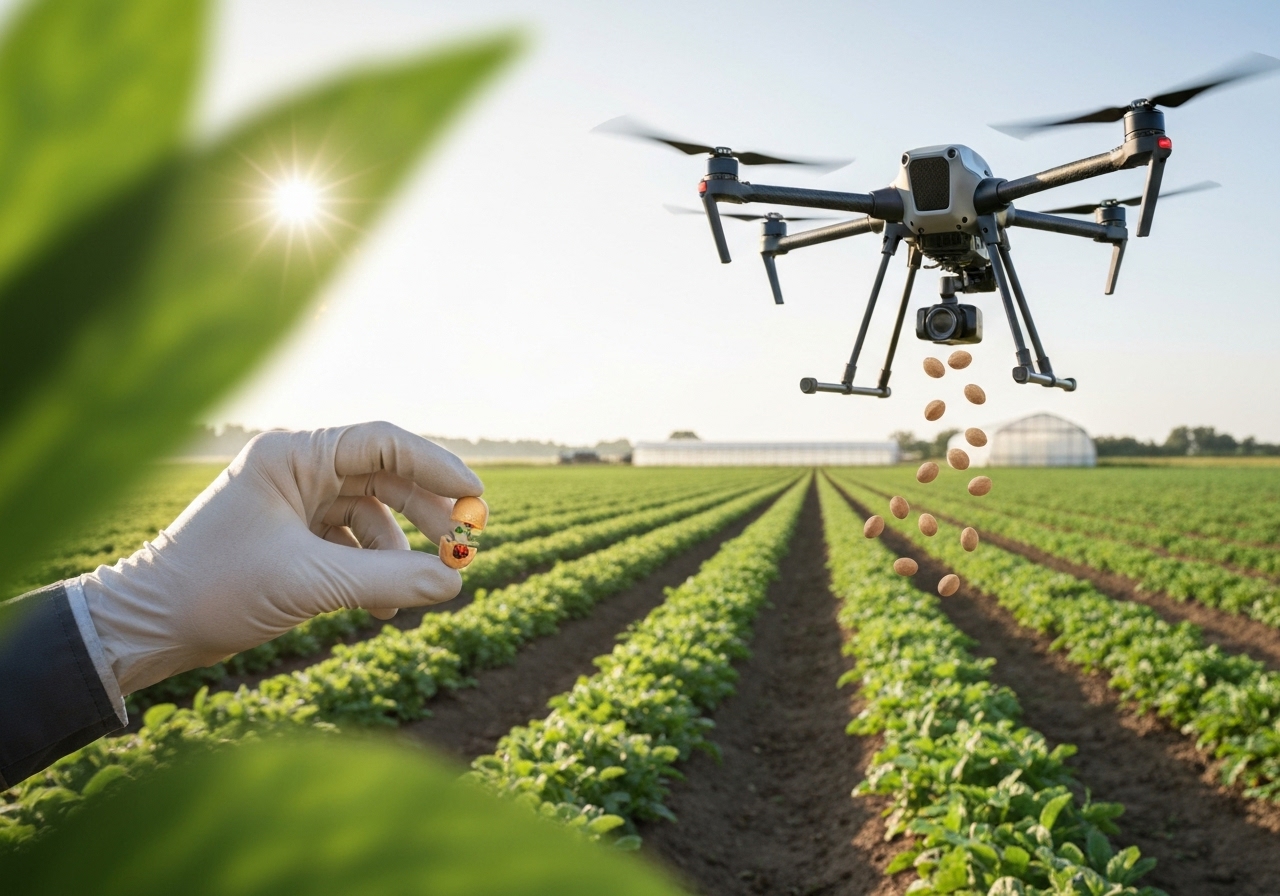
Deploy predatory mites, lacewings, and Trichogramma wasps using small-release canisters adapted for drone payloads. Program release points based on AI-identified hotspots to concentrate agents where impact is highest.
How to apply microbial biopesticides by drone
Apply liquid formulations of Bacillus thuringiensis or Beauveria bassiana in micro-droplets using low-pressure nozzles to maximize spore viability. Maintain formulation temperatures and avoid UV exposure during midday flights when possible.
How to use pheromones and mating disruption with drones
Install or drop slow-release pheromone dispensers across the orchard or field at mapped densities. Use drones to place dispensers in canopy strata inaccessible by ground teams.
How does AI guide intervention decisions and timing?
AI predicts outbreaks by integrating current surveillance, weather forecasts, crop phenology, and historical pressure. Models recommend interventions only when pest density and crop stage exceed economic thresholds to reduce unnecessary treatments.
Train models on labeled images and trap counts. Use ensemble methods: convolutional networks for imagery, gradient-boosted trees for tabular data, and probabilistic models for uncertainty quantification.
Which data inputs improve forecasts?
Include 1) high-frequency imagery, 2) trap counts and parasitoid release logs, 3) microclimate readings (temperature, humidity), 4) landscape context (adjacent crops, non-crop habitat), and 5) historical outbreak records.
How to convert AI output into actionable tasks
Translate probability maps into target polygons with recommended control types and timings. Integrate into farm management software to auto-schedule drone missions or dispatch field crews with GPS-guided waypoints.
What are practical workflows for integrating drones and biocontrol on the farm?
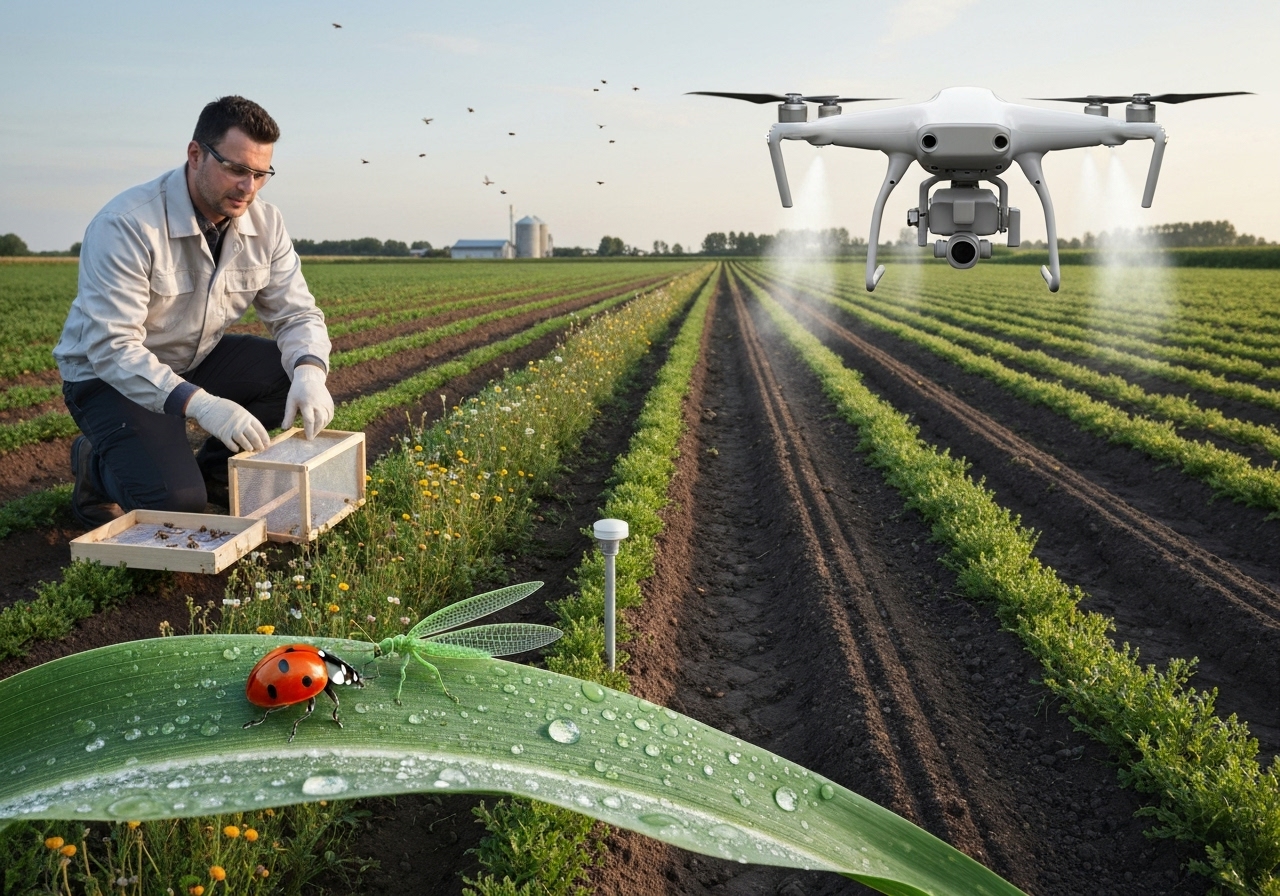
Implement four workflows: monitoring, targeted augmentation, precision application, and adaptive evaluation.
Monitoring workflow
Set automated flight plans; capture multispectral/RGB imagery; run AI detection; flag hotspots and suggest ground checks. Maintain trap networks for validation.
Targeted augmentation workflow
Map hotspot polygons; select appropriate biocontrol agent; schedule drone release at dusk or dawn to reduce predation; follow up with monitoring at 3, 7, and 14 days.
Precision application workflow
Use drone sprayers for microdoses of microbial or botanical treatments in 2-10 meter swaths over hotspots. Adjust droplet size and nozzle type to preserve agent viability.
Adaptive evaluation workflow
Compare pre- and post-intervention imagery, trap counts, and yield metrics. Retrain AI models with new labels to reduce false positives and improve ROI estimates.
What farm design and cultural controls support AI-driven IPM?
Design farm ecosystems to reduce pest establishment: crop rotations, diversified plantings, habitat for natural enemies, and microclimate zoning. Combine these measures with sensor-guided spatial planning.
Use crop rotation plans to break pest cycles and lower baseline pressure. See adaptive rotation guidance for small farms in the farm planning literature for structured rotations and staging.
Integrate cover crops and refugia to sustain predators year-round; use drone-assisted establishment of cover crops for rapid ground cover restoration.
Link to related content on soil and rotation: adaptive rotation plans and microbial consortia for soil health for integrated resilience.
How should farmers select and reared biocontrol agents?
Select agents that attack the target pest, adapt to local climate, and pose low non-target risk. Source organisms from certified suppliers, local rearing programs, or on-farm augmentation when feasible.
Rear agents using simple rearing cages, banker plants for parasitoids, or commercial formulations for microbial agents. Maintain rearing logs to track strain performance and release timing relative to crop stage.
What quality checks are necessary?
Perform genetic barcoding or morphological checks for species ID when introducing new agents. Test pathogen-free status for mass-reared insects and measure viability rates for microbial formulations.
What safety, regulatory, and environmental considerations apply?
Follow national pesticide and biocontrol regulations for registration, release permits, and environmental risk assessments. Record all drone flights and applications to ensure traceability and compliance.
Avoid releasing agents that threaten beneficial native species. Conduct small-scale pilot releases and monitoring before full deployment to document non-target effects.
How to manage biosafety when applying microbial agents by drone
Use only registered strains and maintain cold chain or stabilizers to avoid degradation. Label and store formulations according to manufacturer guidance and local law.
How to measure success: monitoring and evaluation metrics?
Track pest population trends, natural enemy abundance, crop damage percentages, treatment frequency, yield, and cost per saved yield unit. Use before-after-control-impact designs to attribute effects to interventions.
Calculate economic thresholds and measure change in pesticide use over seasons. Report carbon and environmental co-benefits where applicable to support sustainability claims and potential payments (e.g., carbon credits).
What are typical costs and ROI drivers for AI-driven IPM?
Costs: drone hardware and maintenance, sensor payloads, AI software subscriptions or development, biocontrol agent purchases or rearing infrastructure, and operational labor for validation and releases.
ROI drivers: reduction in broad-spectrum pesticide use, yield protection, premium market access for low-residue produce, labor savings from targeted treatments, and ecosystem service gains such as pollination and natural pest suppression.
How to implement AI-driven IPM on small and mid-sized farms?
Start with a phased approach: pilot monitoring, validate AI on a single field, run targeted biocontrol releases, then scale. Use service providers or co-op models to share drone and analytics costs.
Leverage existing farm plans: align IPM mapping with microclimate zones, cover crop schedules, and rotation plans to reduce redundant interventions. See mapping and microclimate resources for design integration.
Reference on microclimate mapping: crop maps by microclimates and drone-enabled polyculture practices described in related posts for integration ideas.
What are practical first-year milestones?
- Month 1: Install sensors and set baseline trap networks.
- Months 2-3: Run weekly drone scouting and label 200+ images for model calibration.
- Months 4-6: Conduct first targeted biocontrol release and monitor impact at 3, 7, and 14 days.
- Months 7-12: Evaluate pesticide use reduction, yield protection, and adjust thresholds.
What challenges and limitations should users expect?
Expect data quality issues, pest ID confusion in mixed infections, weather constraints for drone flights, and logistical limits for mass releases. Budget for model retraining and routine sensor maintenance.
Address privacy and neighbor concerns by communicating flight plans and using geofencing. Plan for redundancy: ground checks and manual traps to corroborate AI output.
What are recommendations for vendors and technology choices?
Prioritize modular systems that separate sensing, analytics, and drone platforms to avoid vendor lock-in. Choose drones with payload flexibility, proven nozzle systems for micro-dosing, and secure data export options.
Prefer AI systems with retraining capability and open data APIs so farmers can export imagery for third-party analyses or regulatory reporting.
How can farms scale IPM services regionally?
Scale using cooperative service models, mobile drone teams, or subscription analytics that pool data to improve regional models. Share anonymized data to improve detection accuracy across landscape types.
Integrate IPM outputs with landscape-level habitat planning to strengthen natural enemy populations regionally, and coordinate release timing to avoid uncontrolled migrations of pests.
What are final implementation checklists and best-practice rules?
Follow this checklist:
- Install traps and baseline sensors before deploying drones.
- Create labeled image datasets for local pest species.
- Define economic thresholds for each crop and pest.
- Select biocontrol agents aligned to pest life stage and climate.
- Use drones for targeted release and keep records of time, location, and batch IDs.
- Evaluate outcomes with standardized metrics and retrain AI every season.
Adopt these best-practice rules: prioritize prevention, validate AI outputs with ground checks, stagger releases to match pest phenology, and document all applications for compliance and learning.
Where can farmers learn more and find partners?
Consult national IPM extension services, university research centers, and agricultural technology cooperatives for training and access to co-op drone fleets. Review FAO and national agriculture agency guidance for permitted biocontrol agents and registration steps.
For case studies on robots and pollination networks that complement IPM, consult insights on drone-assisted pollination and pollinator corridor design to maximize ecosystem services.
Related reading on pollination and drone roles: drone-assisted pollination and ecosystem services and drone-enabled regenerative polycultures described in regional practice notes: regenerative polyculture workflows.
What are the next technological trends to watch?
Watch for 1) edge-AI on drones enabling on-board target detection, 2) swarm release mechanisms for synchronized biocontrol deployment, 3) improved spore encapsulation for longer aerial viability, and 4) federated learning models that improve forecasting while preserving farm data privacy.
Adopt these trends as maturity grows: begin with centralized analytics, then evaluate edge deployments to reduce latency and enable instant interventions.
This guidance equips crop managers to design AI-driven IPM systems that combine drone capabilities, predictive analytics, and ecologically sound biocontrols to reduce chemical reliance, protect yields, and enhance long-term farm resilience.


