
Integrating Micro-Wetlands to Halt Farm Nutrient Runoff
Integrating Micro-Wetlands to Halt Farm Nutrient Runoff
Integrating micro-wetlands on working farms provides a practical, low-tech, and scalable way to intercept nutrient-rich runoff before it reaches streams, rivers, and lakes. This article explains what farm nutrient runoff is, how micro-wetlands remove nitrogen and phosphorus, where to place them, how to design and maintain them, how to combine them with other practices, and how to measure and fund their implementation.
What is nutrient runoff and why does it matter?
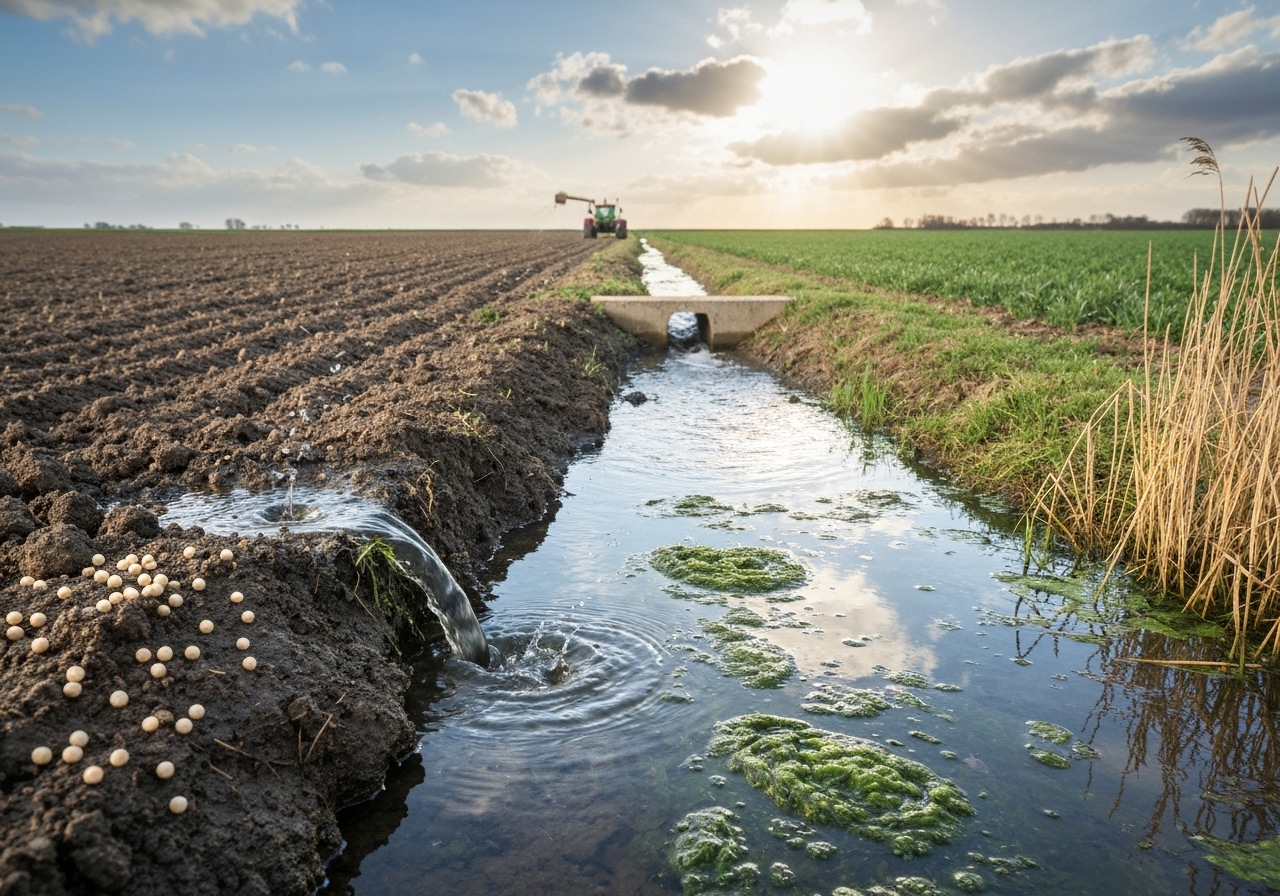
Nutrient runoff is the movement of dissolved and particulate nitrogen and phosphorus from fields into surface waters, and it causes algal blooms, oxygen loss, and ecosystem damage. Nutrient runoff originates from fertilizers, manure, soil erosion, tile drains, and failing septic systems. It reduces water quality, creates harmful algal blooms, decreases fisheries productivity, and increases water treatment costs. Federal and international agencies including the U.S. Environmental Protection Agency (EPA) and the Food and Agriculture Organization (FAO) identify agricultural nonpoint sources as a leading contributor to freshwater eutrophication.
How do micro-wetlands stop nutrient runoff on farms?
Micro-wetlands intercept runoff and use physical settling, plant uptake, microbial transformation, and adsorption to remove nitrogen and phosphorus. Micro-wetlands slow water, enabling suspended sediments and attached phosphorus to settle. Emergent vegetation takes up dissolved nutrients. Microbial communities in saturated soils convert nitrate to harmless nitrogen gas through denitrification. Organic soils and reactive substrates can adsorb or retain phosphorus. Agencies such as USDA Natural Resources Conservation Service (NRCS) and EPA promote wetland-based edge-of-field practices for nutrient control because they address both particulate and dissolved forms.
Where should micro-wetlands be located on a farm for maximum effect?
Micro-wetlands should be placed at natural low points, at tile drain outlets, along field edges, and in riparian corridors where runoff concentrates. Site placement must intercept drainage pathways to capture the majority of runoff. Locate small constructed wetlands at the outlet of a catchment or in a channel that drains a group of fields. Place wetlands downslope of areas with heavy manure application or high soil erosion risk. Positioning in riparian buffers increases co-benefits for stream shading and habitat.
What design elements make a micro-wetland effective?
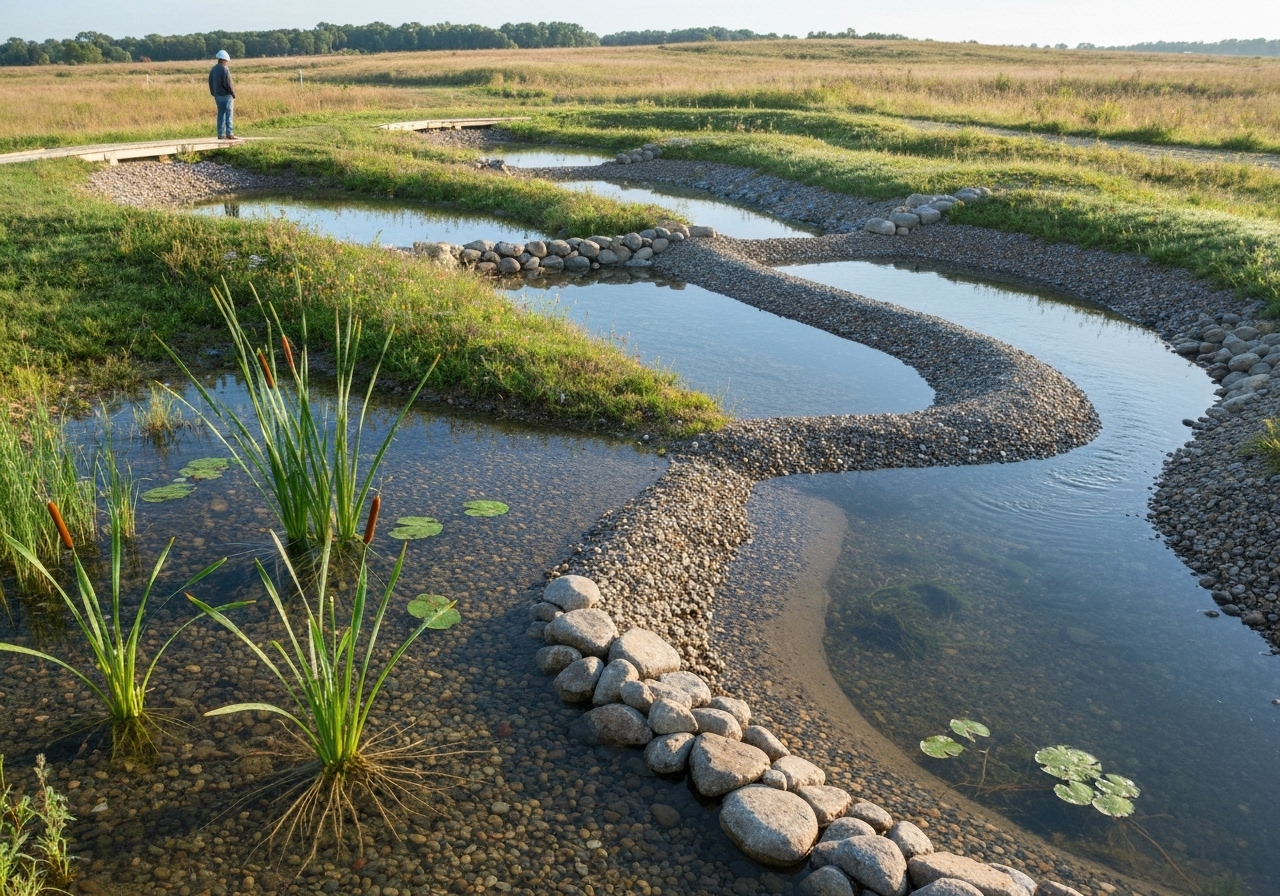
Design effective micro-wetlands by sizing for the contributing area, providing a forebay, creating varied shallow and deep zones, and ensuring sufficient residence time. Design steps include establishing an inlet structure or forebay to trap coarse sediments, creating a main treatment cell with emergent vegetation, and designing an outlet that controls flow and prevents short-circuiting. Aim for a hydraulic residence time that allows biological processes to occur; many guidance documents recommend target residence times in the range of days rather than hours for meaningful nitrate removal. Provide a sequence of shallow (.1 to .5 m) and deeper (.5 to 1. m) zones to support diverse plants and processes. Use a perimeter berm or engineered channel to manage inflows and overflow during storms.
How large should a micro-wetland be?
Size the micro-wetland to treat the expected runoff: a common rule-of-thumb is .5 to 2 percent of the contributing watershed for sediment and phosphorus control, and larger when nitrate loads are high. Exact sizing depends on soil type, slope, precipitation, and nutrient loading. For small drainage areas, a wetland area of .5 to 1.5 percent of the contributing area often yields measurable particulate and phosphorus removal. For nitrate attenuation, pair wetlands with denitrifying substrates or increase retention time, which may require wetland footprints in the range of 1 to 5 percent of the watershed. Use local NRCS design guidance and hydrologic calculations to refine size.
What hydrologic controls matter?
Hydrologic controls that matter are inlet distribution, flow path length, outlet control, and overflow routing to avoid short-circuiting during storms. Design the inlet to distribute flow evenly across the wetland surface rather than concentrating it in a single channel. Include a forebay to capture sediment and simplify maintenance. Use a simple weir or adjustable outlet to set the usual water level and allow controlled drawdown for maintenance or enhanced oxygenation during certain seasons.
Which plants and microbes should be used in micro-wetlands?
Use native emergent plants, sedges, rushes, and shallow-rooted aquatic species to maximize nutrient uptake, and encourage native microbial communities for denitrification. Effective emergent plants include cattails (Typha spp.), bulrushes (Schoenoplectus spp.), common reed alternatives where reed is invasive, and diverse sedge species. Edge shrubs and trees such as willows can stabilize banks and uptake nutrients. Promote microbial denitrifiers by maintaining organic carbon in sediments or adding a carbon-rich substrate in targeted zones. Consult regional native plant lists to avoid invasive species and to support local biodiversity.
Design microbial consortia by encouraging diverse soil and sediment communities rather than relying on single strains. Microbial communities perform nitrification and denitrification sequences. Adding organic matter such as woodchips, compost, or biochar in a subsurface zone can supply electron donors to heterotrophic denitrifiers. For more on on-farm microbial approaches to enrich soil and rhizosphere processes, review guidance on designing on-farm microbial consortia.
What construction and installation steps are required?
Construct micro-wetlands by surveying the site, preparing an inlet and forebay, shaping treatment cells, placing planting media, and installing outlet controls. Begin with a topographic survey and mapping of drainage. Excavate to shape shallow basins; amend soils only when necessary to improve retention. Install an armored inlet and a forebay to intercept coarse sediment. Prepare planting zones with locally sourced native plugs or seed. Construct an outlet control structure that sets normal pool elevation and provides an emergency spillway.
What materials and liners are appropriate?
Use natural soils where possible; consider clay liners or geosynthetics only where infiltration must be limited. Infiltrative soils may be acceptable when groundwater connections are small and the goal includes groundwater recharge, but where contaminant migration is a concern, compacted clay layers or geomembranes provide containment. Use rock-lined spillways and erosion protection at inlets and outlets to protect structures during high flow.
What are quick-build, low-cost micro-wetland options?
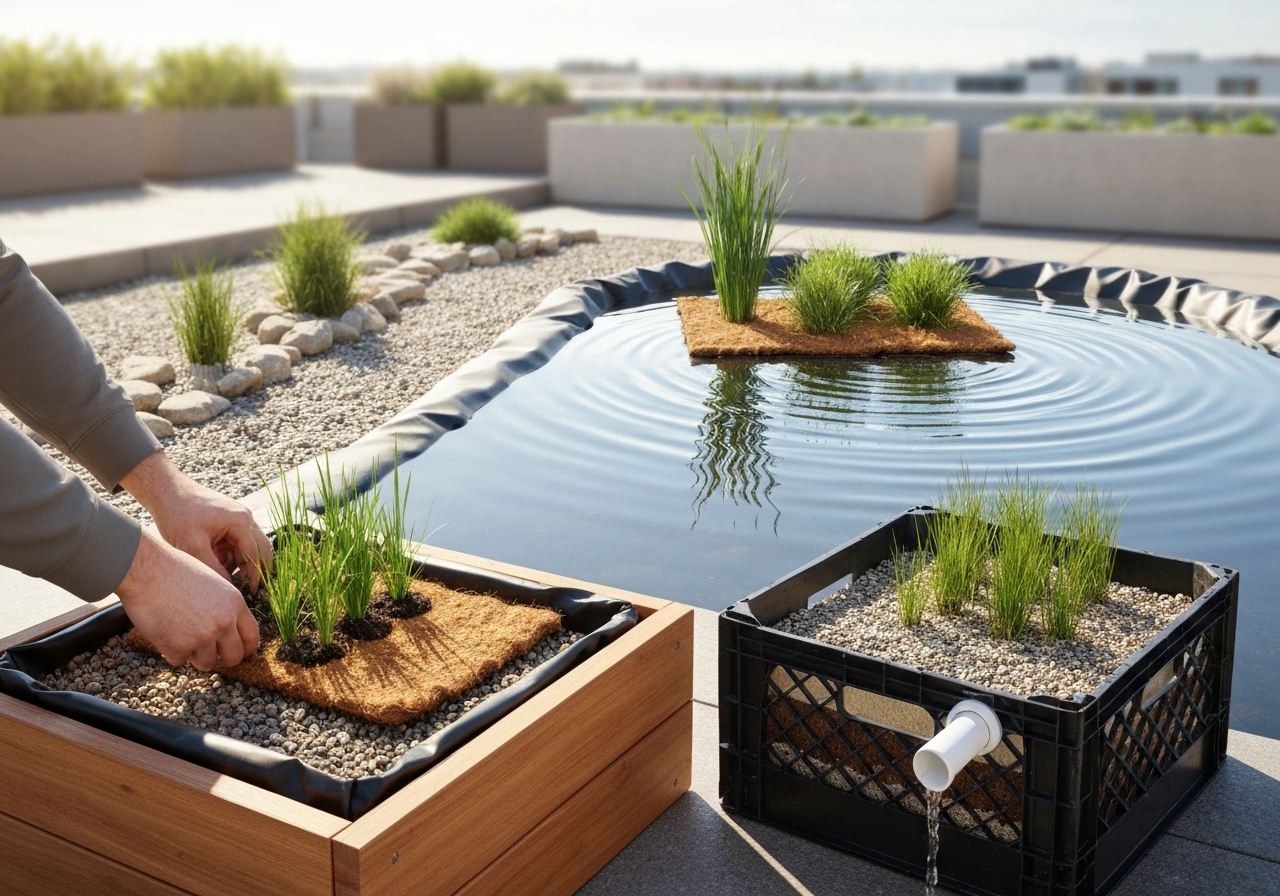
Quick-build options include shallow excavated basins with native plantings, retrofits of existing farm ponds with wetland fringe, and channelized wetlands in terraces or two-stage ditches. Simple trials can use small depressions fenced from grazing, or a planted fringe around an existing retention pond to add treatment capacity. Two-stage ditches and vegetated filter strips augment wetland function and are inexpensive to install.
How much maintenance do micro-wetlands need?
Maintenance includes periodic sediment removal from forebays, control of invasive plants, inspection of inlet/outlet structures, and occasional replanting. Inspect forebays annually and remove accumulated sediments when they occupy a large fraction of the forebay volume. Control woody encroachment in treatment cells if it reduces hydraulic function. Repair erosion at inlet and outlet points. Manage vegetation to retain emergent cover while allowing seasonal drawdown when needed to oxidize soils or facilitate removal of accumulated biomass.
How should micro-wetlands be integrated with other farm practices?
Integrate micro-wetlands with cover crops, buffer strips, adaptive crop rotations, and controlled fertilizer management for combined nutrient reduction. Use wetlands as one element in a treatment train. Maintain upstream cover crops to reduce sediment and nitrate mobilization. Plant perennial buffer strips to reduce edge runoff and provide wildlife habitat. Implement precision fertilizer application and soil testing to lower excess nutrient input at the source.
Coordinate wetland placement with crop rotation and field planning to maximize benefits across seasons. For guidance on rotation planning that reduces nutrient loss risk through timing and cropping choices, pair micro-wetland strategies with adaptive rotation frameworks such as those described in adaptive low-input crop rotation plans. Couple wetlands with efficient irrigation practices to reduce leaching; see applications in regenerative micro-irrigation that can inform irrigation optimization on small plots.
What monitoring and evaluation are needed to measure performance?
Monitor inflow and outflow water quality for nitrate, total nitrogen, orthophosphate or total phosphorus, turbidity, and flow to quantify removal rates. Establish baseline measurements before construction. Use automatic or manual flowgages to estimate loads. Sample inflow and outflow periodically across seasons. Calculate mass removal as the difference between incoming and outgoing loads. Consider simple indicators such as dissolved nitrate and turbidity for routine checks and add periodic laboratory analyses for total nitrogen and total phosphorus.
Use performance targets and adaptive management based on monitoring results. If nitrate removal is lower than expected, check for short-circuiting, insufficient residence time, or limited carbon availability. If phosphorus is being released, assess sediment disturbance and redox swings that mobilize bound phosphorus.
What are typical costs and funding sources?
Costs range widely: small, simple micro-wetlands can cost a few thousand dollars, while engineered systems with liners and controls can reach tens of thousands; cost-share and incentive programs often offset a large share. Cost drivers include excavation volume, liner choice, planting costs, and outlet structure complexity. Many programs such as USDA NRCS Environmental Quality Incentives Program (EQIP), state-level conservation cost-share, and watershed grants provide funding or technical assistance. Investigate regional conservation districts and nonprofit watershed partnerships for additional support.
What common design or management failures should be avoided?
Common failures include improper siting that misses concentrated flows, short-circuiting, under-sizing for peak events, invasive plant takeover, and lack of maintenance. Avoid placing wetlands on slopes where inflow energy will erode the basin. Prevent short-circuiting by distributing inlets and using baffles or plant patterns to force longer flow paths. Design spillways for extreme storms. Plan for ongoing maintenance in the farm budget and schedule.
How do micro-wetlands perform in different climates and seasons?
Micro-wetlands perform across climates but seasonal dynamics change processes: denitrification is higher in warm seasons, while freeze-thaw cycles can reduce plant uptake in winter. In cold climates, design considerations include extended residence times and subsurface carbon zones to maintain denitrification during shoulder seasons. In semi-arid climates, occasional dry periods require wetland design that can tolerate drying and rapid rewetting. Use vegetation mixes adapted to local hydrology to maintain year-round function where possible.
How can farmers pilot micro-wetlands with limited resources?
Start with a small pilot wetland at a single tile outlet or low-field corner, monitor performance, and scale based on results. Use low-cost excavation and native plant plugs. Document inflow and outflow quality to build a case for expansion. Partner with local extension services, university researchers, or conservation districts for design reviews and monitoring support. Small trials reduce risk and provide practical learning.
What are the co-benefits of micro-wetlands beyond nutrient control?
Micro-wetlands provide habitat for pollinators and birds, store floodwater, recharge shallow groundwater, and increase landscape resilience while enhancing farm biodiversity. Wetlands can sequester organic carbon in sediments over time and diversify on-farm habitats, supporting beneficial insects and wildlife. These co-benefits often strengthen grant and incentive applications for conservation funding.
Which regulatory or permitting issues should be considered?
Permitting depends on jurisdiction: consult local conservation districts, state environmental agencies, and U.S. Army Corps of Engineers or equivalent to determine wetland and watercourse permitting requirements. Many small agricultural treatment wetlands fall under agricultural exemptions in some regions, but regulated waters and jurisdictional wetlands may require permits. Work with technical service providers and conservation agencies early to identify permit needs.
How should micro-wetlands be scaled across a watershed?
Scale micro-wetlands by prioritizing critical source areas and aggregating small treatment sites into a distributed network to intercept runoff from many fields. Map contributing areas and identify high-export fields for targeted placement. Use a network of smaller wetlands to treat runoff at multiple levels in the landscape rather than a single large centralized structure. Distributed networks are resilient and easier to site on working lands.
What immediate steps can a farmer take this season?
Survey problem drainage points, fence a small low spot for planting, trial an excavated fringe around an existing pond, and contact local NRCS or extension for a design check. Test soil and water to quantify the issue. Plant a buffer strip and install a simple forebay behind a low berm. Document costs and results to inform future investments.
Where can farmers find technical resources and support?
Find technical resources through USDA NRCS practice standards, state conservation agencies, university extension services, and watershed groups; many offer templates, design tools, and cost-share programs. Consult NRCS practice standards for constructed wetlands and related edge-of-field practices. Contact local extension agents for native plant lists and monitoring protocols. Partner with watershed organizations for funding and monitoring collaboration.
How do micro-wetlands fit within regenerative farm systems?
Micro-wetlands complement regenerative practices by capturing losses from intensified areas while upstream regenerative practices reduce source loading. Combine wetlands with cover cropping, reduced tillage, diversified rotations, and improved manure management to reduce the need for downstream treatment. For integrated planning that balances rotations and soil health with edge-of-field measures, see approaches in crop mapping and diversified planning and consider microbial soil-building strategies that reduce nutrient mobilization.
Implement wetlands as part of a treatment train: prevention at source, interception mid-field, and polishing at field edges. This layered approach maximizes nutrient reduction while maintaining production goals.
How to quantify success and report outcomes?
Quantify success by tracking reductions in nutrient loads (kg N and kg P removed), changes in downstream water quality, and co-benefits such as acres of habitat created. Use load calculations from flow and concentration data to estimate mass removal. Report metrics to funders and certification programs. Translate environmental benefits into economic terms where possible to inform farm business planning.
Seek partnerships with local universities or citizen science groups for robust monitoring that supports adaptive management. Peer-reviewed and agency-standard protocols strengthen claims of performance and support applications for conservation payments or carbon/nutrient credit programs.
What are the long-term outlook and policy trends?
Policy trends increasingly favor nature-based solutions and payments for ecosystem services, making micro-wetlands an eligible practice under many emerging conservation programs. Programs that value water quality, biodiversity, and carbon storage are expanding. Anticipate increased technical and financial support as watershed-scale nutrient reduction targets gain prominence in regional planning.
Plan micro-wetland deployments to align with evolving incentive programs and watershed plans to capture funding and maximize landscape impact.
Integrating micro-wetlands into farm planning offers a practical pathway to reduce nutrient runoff, improve resilience, and generate co-benefits for biodiversity and water resources. Pilot small, monitor results, and scale with complementary practices for the greatest environmental and farm viability outcomes.


