
Native bloom strips that supercharge farm pollinators
Native bloom strips that supercharge farm pollinators
Native bloom strips around farms provide continuous nectar and pollen sources, increase pollinator diversity, and raise crop pollination services when designed and managed correctly. This guide explains which native flowers to plant, how to design and seed effective strips, seasonal management, monitoring methods, and examples for different farm types. Citations and practical seed-mix recipes follow to help farmers implement high-impact pollinator habitat.
What are native bloom strips and why do they supercharge farm pollinators?
What are native bloom strips and why do they supercharge farm pollinators? Native bloom strips are intentionally planted linear habitats composed of local native wildflowers, grasses, and shrubs placed near or within agricultural fields to provide season-long nectar and pollen for native bees, butterflies, hoverflies, and other pollinators. Native bloom strips supercharge farm pollinators by supplying diverse floral resources, nesting materials, and shelter that increase pollinator abundance and visitation rates to adjacent crops, as demonstrated by multiple studies and conservation organizations such as the Xerces Society and Pollinator Partnership.
Which native flowers are best for bloom strips on farms?
Which native flowers are best for bloom strips on farms? Choose a mix of native early-, mid-, and late-season bloomers including perennials, biennials, annuals, shrubs, and a few native grasses to create a continuous bloom sequence and varied structure that supports the widest range of pollinators.
Which early-season natives attract emerging pollinators?
Which early-season natives attract emerging pollinators? Plant early-flowering shrubs and herbs to feed overwintered bumblebee queens, mason bees, and syrphid flies from March to May:
- Willow (Salix spp.) – supplies nectar and pollen in very early spring; critical for bumblebee queens (USDA and multiple ecological surveys).
- Willowherb/Fireweed (Chamerion angustifolium) – early nectar source in disturbed sites.
- Willowleaf or early-season willowy shrubs like Salal in Pacific regions.
- Oregon grape (Mahonia spp.) or native currants (Ribes spp.) where regionally appropriate.
Which mid-season natives provide peak nectar and pollen?
Which mid-season natives provide peak nectar and pollen? Include prolific mid-season bloomers from late spring to mid-summer to sustain social bees and solitary species:
- Penstemon spp. – tubular flowers for long-tongued bees and some hummingbirds.
- Monarda (bee balm) – attracts bumblebees, honey bees, and butterflies.
- Asclepias (milkweeds) – essential for monarchs and important nectar for many bees.
- Phacelia tanacetifolia (in regions where native alternative is limited) or native equivalents – great nectar producer for many bee species.
Which late-season natives extend forage into autumn?
Which late-season natives extend forage into autumn? Plant fall-blooming species to maintain pollinator energy reserves before winter:
- Solidago (goldenrod) – high nectar and pollen late in the season; supports diverse insects.
- Aster spp. – diverse genera offering late-season nectar to bees and butterflies.
- Helianthus (native sunflowers) – provides nectar and seeds for birds and insects.
Which native grasses and structural plants are useful?
Which native grasses and structural plants are useful? Add native bunchgrasses and shrubs for nesting and overwintering habitat:
- Little bluestem (Schizachyrium scoparium) – stem structure for nesting and winter cover.
- Native bunchgrasses (e.g., Festuca spp., Poa spp.) – provide nesting microsites for ground-nesting bees.
- Native shrubs such as Ceanothus, Cephalanthus, and Vaccinium where climate allows.
How should a farm choose native species for local climate and soil?
How should a farm choose native species for local climate and soil? Match species to your ecoregion, soil texture, moisture regime, and elevation by selecting locally adapted ecotypes and consulting regional native-plant guides, university extension recommendations, and seed suppliers that indicate provenance.
How should a farm prioritize local ecotypes? Prioritize seed collected within the same EPA ecoregion or within 50 miles when possible; local ecotypes tend to establish faster, resist pests, and fit local phenology, according to state extension services and conservation organizations.
How to design effective native bloom strips on farms?
How to design effective native bloom strips on farms? Design bloom strips to maximize crop adjacency, season-long bloom, habitat heterogeneity, and connectivity while minimizing competition with crops and operations interference.
How wide and where should strips be placed? Place strips at field margins, between crops as headlands, or as cross-field corridors. Use widths of 3 to 6 m for narrow margins or 6 to 20 m for high-impact corridors; studies show that wider strips increase pollinator diversity and spillover into crops.
How to sequence plantings for continuous bloom? Sequence early shrubs, spring bulbs, spring herbs, mid-season perennials, and late-season asters and goldenrods. Use 40% perennial for long-term structure, 40% annual/biennial for early quick cover and mid-season boosts, and 20% grasses/shrubs for nesting and structure.
How to connect habitat across the farm? Link strips to hedgerows, remnant natural patches, and field-edge woody vegetation to form corridors that facilitate pollinator movement. Consider technology-based planning using AI or mapping tools; AI-guided pollinator corridor tools can optimize placement by microclimate and crop layout.
How should farms prepare soil and seedbeds for native bloom strips?
How should farms prepare soil and seedbeds for native bloom strips? Prepare a firm, weed-reduced seedbed through light tillage or herbicide fallow, firming, and timing seeding for species’ dormancy cues to maximize germination and reduce weed competition.
How to reduce weeds before seeding? Use a 6-12 month fallow with repeated shallow cultivation or a solarization/cover-crop sequence to exhaust annual weed seed banks. The USDA NRCS recommends reducing perennial weeds before establishing native seed mixes.
How and when to seed native mixes? Use drill seeding where possible at recommended seed depths (often surface-sown or shallow) in late fall to allow cold stratification for many native perennials. Use higher seed rates for annual nurse species to suppress weeds, followed by perennial establishment the following year.
How to use inoculants or soil amendments? Use minimal fertility amendments; native species often prefer low-fertility soils. Inoculate legumes with appropriate Rhizobium strains when including native nitrogen-fixing species, per extension guidance. For soil health strategies tied to microbial enhancement, consult on-farm microbial design principles such as in Designing On-Farm Microbial Consortia.
What are effective seed mixes and planting rates for bloom strips?
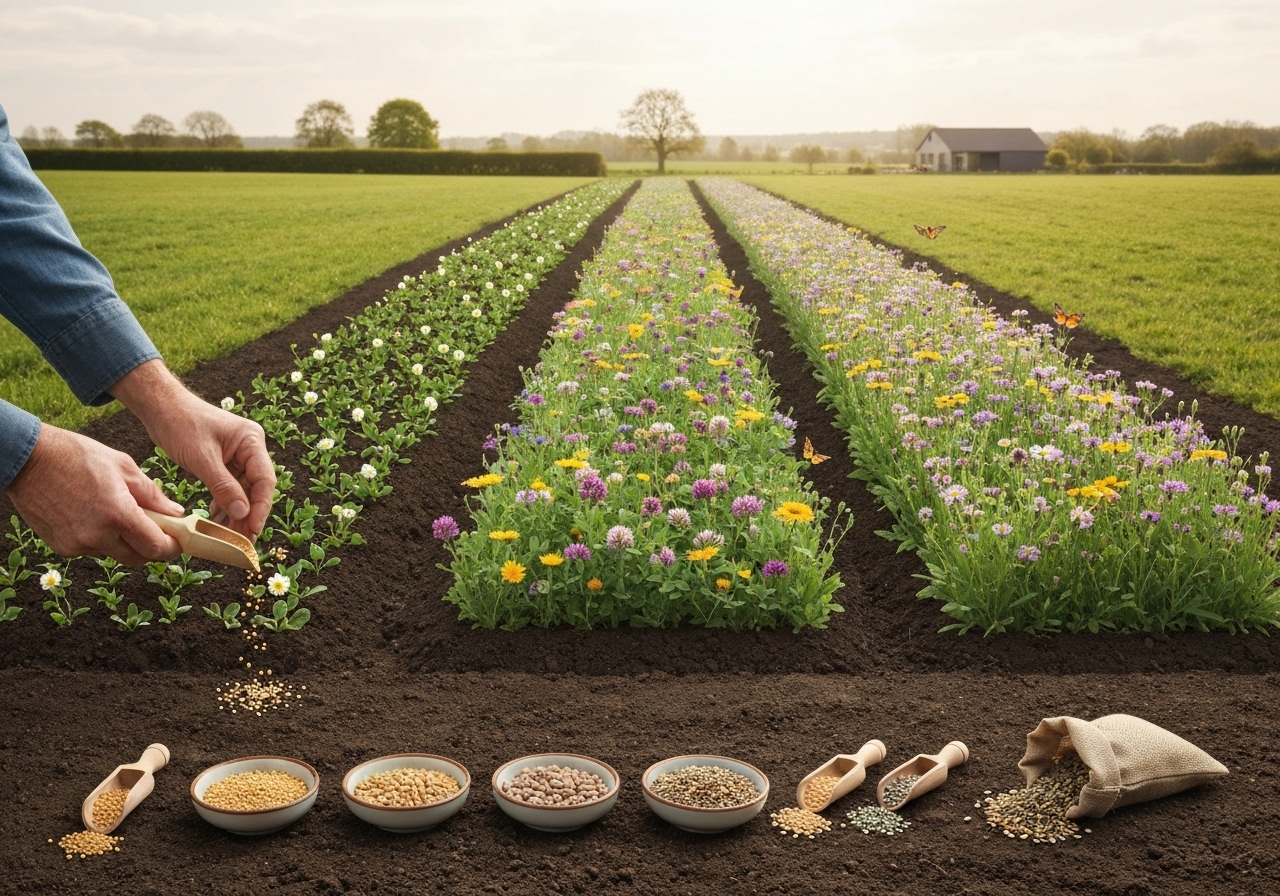
What are effective seed mixes and planting rates for bloom strips? Use seed mixes balanced by bloom season and functional group; follow region-specific rates and adjust for pure live seed (PLS).
What is a quick-start nurse mix for year one? Use a nurse mix with 30% annuals, 40% fast-establishing biennials, and 30% low-growing perennials by PLS. Example per acre (PLS-adjusted) for temperate regions:
- Phacelia or native annual buckwheat equivalent – .5-1 lb
- Biennial/buckthorn replacements (e.g., native poppies) – .5-1 lb
- Fast perennial wildflowers (e.g., Coreopsis, Monarda, Penstemon) – 2-3 lb
- Native bunchgrasses – 3-5 lb
What is a long-term perennial mix? Aim for 60-80% perennials by PLS including 20-30% grasses and 40-60% broadleaf forbs. Adjust total PLS rates to 8-15 lb/acre for low-density strips and 15-25 lb/acre for full meadow conversions depending on seed size and regional recommendations.
How to manage native bloom strips through the seasons?
How to manage native bloom strips through the seasons? Use a year-round management calendar: fall seeding, spring monitoring, conservative mowing, targeted spot weeding, and pesticide avoidance to maintain floral diversity and nesting habitats.
How should mowing be scheduled? Mow late (after seed set) once every 1-3 years in conservation strips to allow reseeding and structural habitat retention. For annual maintenance, use a single early-spring cut to control coarse grasses while retaining wildflower crowns; avoid mowing during peak nesting periods (April-August for many bees).
How to minimize pesticide impacts? Eliminate or reduce insecticide and systemic neonicotinoid use near bloom strips. Coordinate applications by time-of-day and floral phenology; apply pesticides when flowers are not in bloom and pollinators are less active.
What measurable benefits do native bloom strips provide to farms?
What measurable benefits do native bloom strips provide to farms? Native bloom strips deliver measurable increases in pollinator abundance, pollinator species richness, crop pollination rates, and some studies report yield increases and reduced pest pressure.
How much do pollinator visits increase? Studies summarized by the Xerces Society and academic meta-analyses indicate 20-40% increases in wild pollinator visitation to adjacent crops in well-designed habitat scenarios; a 2014 synthesis showed positive pollinator spillover up to 100 m into fields depending on strip size and landscape context.
How do strips affect yields and pest control? Research by Garibaldi et al. and others found that increased pollinator richness improves crop fruit set and value. Additional studies show enhanced biological control when strips host predators and parasitoids, reducing reliance on insecticides and delivering ecosystem services valued at hundreds to thousands of dollars per hectare in some cropping systems.
How to monitor pollinator response and habitat success?
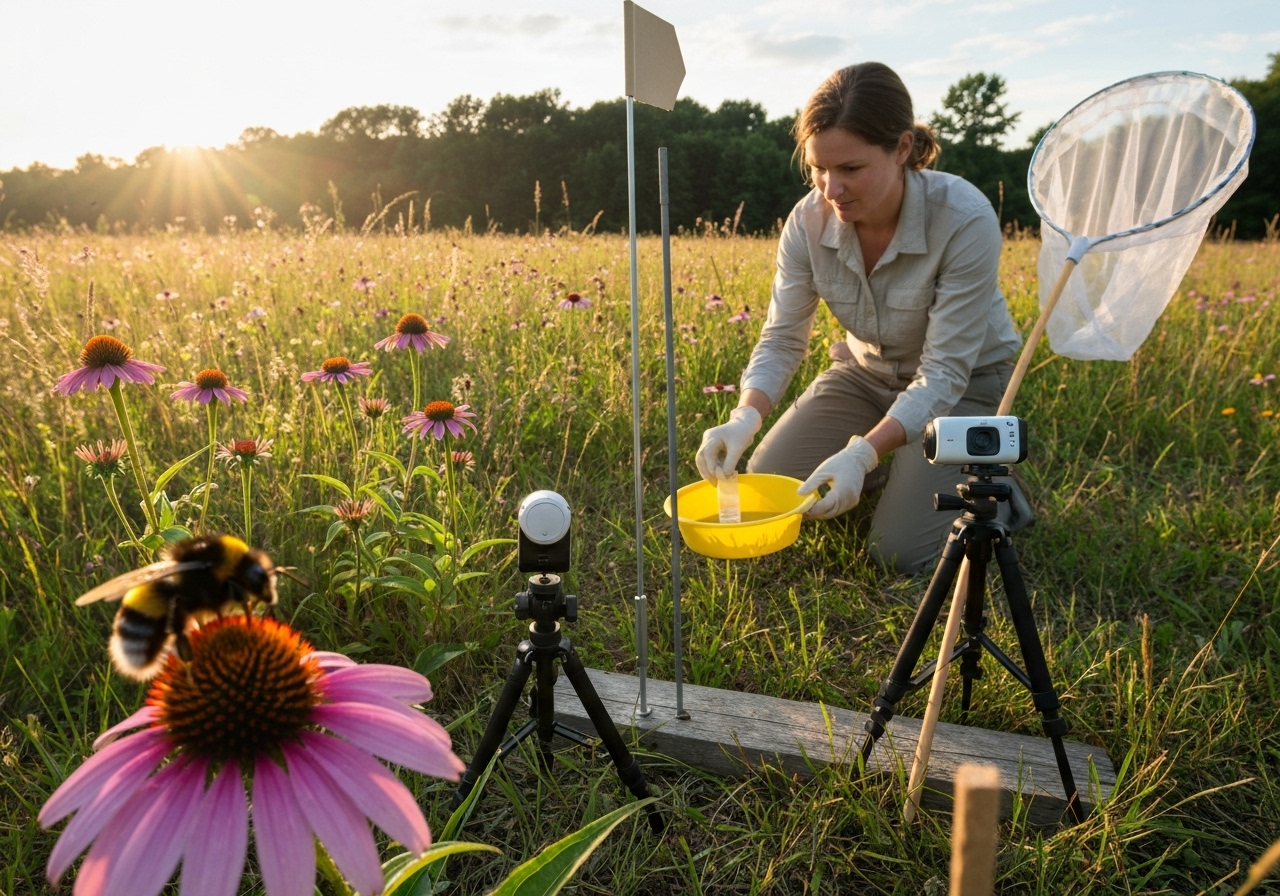
How to monitor pollinator response and habitat success? Implement periodic monitoring using transect counts, pan trapping, and floral resource surveys to quantify pollinator visits, species diversity, and bloom cover; track crop pollination outcomes to correlate with habitat metrics.
How to set up a simple monitoring program? Use 10-15 minute timed walk transects during peak bloom weekly or biweekly to count bee visits per flower species. Use colored pan traps for baseline species lists. Record bloom percentage by species and changes year-to-year to adapt mixes.
How can technology help monitoring? Use drone imagery and sensor mapping to quantify floral cover and microclimates; integrate mapping with planning tools such as microclimate crop maps to refine placement and timing for maximum pollinator benefit.
What common mistakes should farmers avoid when establishing bloom strips?
What common mistakes should farmers avoid when establishing bloom strips? Avoid planting non-native ornamental mixes, installing strips too narrow to support diverse communities, failing to address weeds before seeding, and applying insecticides to flowering habitat.
How to prevent establishment failures? Prevent failures by preparing seedbeds properly, choosing regionally adapted ecotypes, including nurse species for initial weed suppression, and committing to at least 3-5 years of adaptive management so perennials can establish.
How to integrate bloom strips into crop rotations and low-input systems?
How to integrate bloom strips into crop rotations and low-input systems? Integrate bloom strips by placing them in rotation plans where they provide cover in fallow years, act as refuge areas during intensive cropping, and synchronize with adaptive low-input rotations to conserve pollinators and soil health.
How to align strips with crop rotations? Reserve edges and set-aside strips in rotation maps; use strips as low-input cover in years when fields rest. Consult adaptive rotation frameworks for small farms to harmonize strip placement with irrigation and harvest logistics (see adaptive rotation case studies in adaptive low-input crop rotation plans).
Where should farms source native seed and what procurement practices matter?
Where should farms source native seed and what procurement practices matter? Source seed from reputable native-seed suppliers that provide provenance information and PLS percentages; prefer regionally collected seed and avoid cultivars selected only for appearance with reduced nectar production.
How to verify seed quality? Request analysis certificates, verify germination rates, and check for weed seed content. Purchase seed early and verify storage conditions; large orders may need stratification protocols and staggered seeding across blocks to maintain genetic diversity.
What monitoring metrics indicate long-term success?
What monitoring metrics indicate long-term success? Track increases in pollinator species richness, sustained floral cover of target species, reduced pesticide application near strips, increased crop visit rates, and improved crop yields per unit area adjacent to strips.
What time frame shows measurable change? Expect measurable pollinator response within 1-3 years and optimized community composition and stable domination by perennials by year 3-5. Document trends annually and adjust seed mixes when species fail to persist.
Which native bloom strip designs work best for specific farm types?
Which native bloom strip designs work best for specific farm types? Tailor design by farm type: orchards benefit from wide hedgerow strips and shrubs; vegetable farms gain from dense nectar mixes along beds and headlands; field crop farms benefit from wider corridors and restored hedgerows.
How to design for orchards? Plant multi-layered strips perpendicular to wind and adjacent to orchard blocks to enhance pollinator movement and shelter. Include early-flowering shrubs for early-season pollinators and mid-season perennials overlapping tree bloom.
How to design for vegetable farms? Use narrow but frequent strips along rows and between beds with high floral density mixes to ensure easy movement for short-distance foragers like sweat bees and small bumblebees.
How to design for field crops and dryland farms? Use wide corridors combined with native grasses and forbs tolerant of drought. Pair strips with regenerative micro-irrigation if establishing in marginally dry conditions; see guidance on micro-irrigation for smallholder farms for integration options.
How can farmers scale bloom-strip benefits across landscapes?
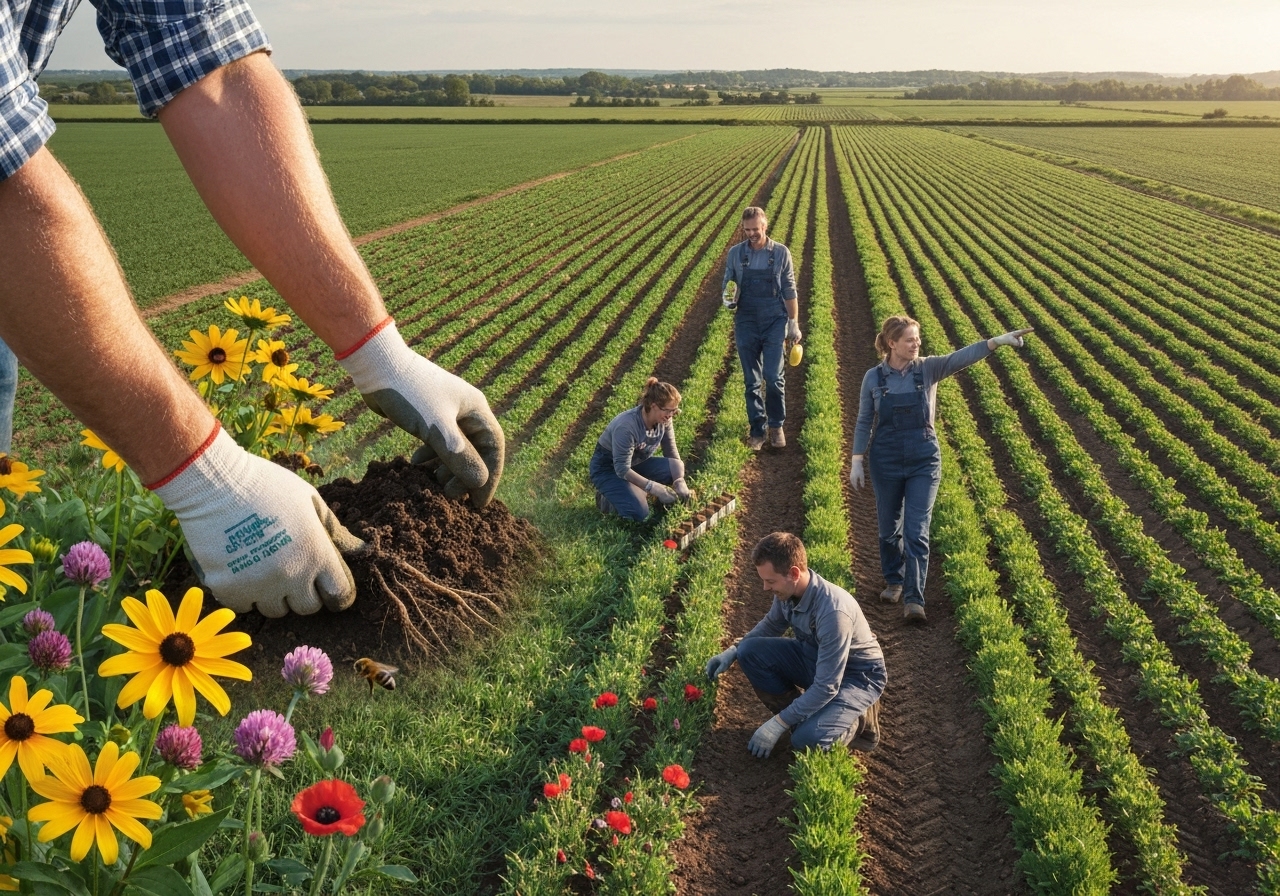
How can farmers scale bloom-strip benefits across landscapes? Scale by coordinating with neighboring farms to create networks of connected habitat, targeting corridors that reduce distances between floral patches and increase landscape-level resilience for pollinators.
How to coordinate at landscape scale? Form farmer cooperatives or conservation partnerships to plan corridors, share seed contracts, and align management calendars. Use regional programs and incentives such as conservation cost-share programs and explore carbon or ecosystem-service markets to fund establishment costs.
What role do bloom strips play alongside technology-driven pollination tools?
What role do bloom strips play alongside technology-driven pollination tools? Use bloom strips as the ecological foundation that supports biological pollinators while complementary technologies such as robotic pollinators, sensors, and drones can fill gaps during shortages and help monitor habitat performance.
How to integrate with robotic or sensor tools? Combine habitat creation with sensor-guided monitoring and targeted interventions; research and pilot projects highlight effective integration between habitat restoration and technologies like drones for mapping and robotic pollinators for supplemental coverage when natural pollinator abundance is low (see technology case studies on drones and robotic pollinators for farms).
What are quick action steps for farmers starting native bloom strips this season?
What are quick action steps for farmers starting native bloom strips this season? Follow these 6 steps: 1) Map margins and high-impact adjacency areas; 2) Select local native species lists; 3) Prepare seedbeds with weed control; 4) Order certified regional seed and calculate PLS rates; 5) Seed in late fall or early spring as species require; 6) Adopt monitoring and a 3-5 year adaptive plan.
How to fund and scale initial costs? Explore cost-share and conservation incentive programs, cooperative seed purchasing, and phased establishment across fields. Track ecosystem-service returns including potential yield increases and pest reduction to justify investment.
What resources and references support best practices?
What resources and references support best practices? Rely on regional extension services, Xerces Society guidance on pollinator habitat, USDA NRCS technical guides, and peer-reviewed studies in journals such as Journal of Applied Ecology and Agriculture, Ecosystems & Environment for evidence-based decisions.
What additional reading is useful? Read technical planting guides from Pollinator Partnership and regional native-plant societies. Combine ecological guidance with farm planning resources such as microclimate crop-mapping tools to place strips where they will have maximum impact; refer to calendar-based microclimate planning for placement and timing.
What internal farm resources can help? Integrate bloom strips with existing regenerative practices on the farm including soil microbial design and crop rotations. For example, combine strip placement with microbial enrichment efforts and adaptive rotations to enhance both soil and pollinator health.
What are final implementation reminders? Start with pilot strips, monitor impacts, and scale iteratively. Keep chemical use minimal, favor local ecotypes, and design for year-round structure and bloom continuity to sustain pollinators and realize measurable farm benefits.
Suggested seed mix examples (temperate region)
Suggested seed mix examples (temperate region) Use these as starting templates and adapt species to local ecoregion and PLS rates.
Quick-start one-year nurse mix (per acre PLS)
- Annual nectar plants (e.g., native buckwheat equivalent) – 1 lb
- Biennials/fast perennials (e.g., Coreopsis, poppy relatives) – 2 lb
- Perennial wildflowers (Penstemon, Monarda) – 3 lb
- Native bunchgrasses – 4 lb
Long-term perennial-rich mix (per acre PLS)
- Perennial forbs (Echinacea, Rudbeckia, Aster) – 6-8 lb
- Shrubs and woody species (where space allows) – 1-2 lb equivalents
- Bunchgrasses – 5 lb
Where can farmers find local technical support?
Where can farmers find local technical support? Contact your state or provincial extension service, local native-plant societies, conservation districts, and experienced regional seed suppliers for site-specific recommendations and installation assistance.
How to use on-farm trials and partnerships? Run small-scale trials and document outcomes to build local expertise. Partner with universities or conservation NGOs for monitoring assistance and to access funding streams for habitat restoration.
How do native bloom strips complement other regenerative practices?
How do native bloom strips complement other regenerative practices? Use bloom strips to enhance pollinator services, which supports higher yields and diversity in regenerative polycultures; pair habitat creation with soil health measures to multiply benefits across production and ecosystem outcomes.
How to integrate with microbial and soil strategies? Integrate habitat planting with microbial seed coating or soil-consortia practices to improve establishment and plant performance; consult research on microbial seed coatings and on-farm microbial consortia for guidance on combined strategies.
How to align with climate-resilient farm planning? Align strip placement with microclimate maps and rotational planning to reduce drought risk and boost resilience; use landscape-level planning to prioritize corridors based on microclimate and farm layout.
Start small, plan for continuity, monitor outcomes, and iterate. Native bloom strips are a cost-effective, high-return investment that increases pollinator populations, strengthens crop pollination, and contributes to farm biodiversity and resilience.


