
Step-by-Step Field-by-Field Water Conservation Roadmap
Step-by-Step Field-by-Field Water Conservation Roadmap
This guide provides a detailed, field-by-field water conservation roadmap for farms, laying out assessment, design, soil and plant strategies, technology choices, scheduling, financing and long-term maintenance.
What is a field-by-field water conservation roadmap?
What is a field-by-field water conservation roadmap? A field-by-field roadmap is an ordered plan that treats each field as a unique management unit, aligning water supply, soil capacity, crop needs and infrastructure to minimize applied water while protecting yields.
What is a field-by-field roadmap meant to do? The roadmap guides measurements, improvements and technologies to reduce irrigation volumes, increase water productivity and build soil water-holding capacity at the field scale.
Why should you implement water conservation on each field?
Why should you implement water conservation on each field? Implementing conservation field-by-field increases water use efficiency, lowers pumping and energy costs, reduces nutrient runoff and increases climate resilience according to FAO and USDA recommendations.
Why prioritize field-level action? Field-level targeting delivers 1) tailored irrigation amounts, 2) precise technology placement, and 3) measurable returns — typically 15-40 percent reductions in irrigation water with maintained or improved yields in trials (USDA, irrigation efficiency studies).
How do you assess baseline field water needs and assets?
How do you assess baseline field water needs and assets? Start by mapping each field and recording soil type, slope, current irrigation method, water source capacity and historic yields.
How do you map soils and topography? Use soil surveys, a simple auger profile or portable penetrometer, and a digital elevation model from a drone or GPS to mark low spots, ridges and runoff paths.
How do you measure infiltration and available water?
- Perform 3 to 5 infiltration or double-ring infiltrometer tests per field to gauge infiltration rates.
- Collect soil cores to 30 cm and laboratory-analyze texture and bulk density to calculate available water-holding capacity (AWHC).
- Install at least one soil moisture sensor (capacitance or TDR) per 2–5 hectares to correlate sensor readouts with field observations.
How do you audit irrigation infrastructure? Inspect pumps, meters and delivery pipes for leaks, assess emitter uniformity, and log system pressure and flow for a minimum of one irrigation event per field.
What irrigation technologies reduce water use field-by-field?
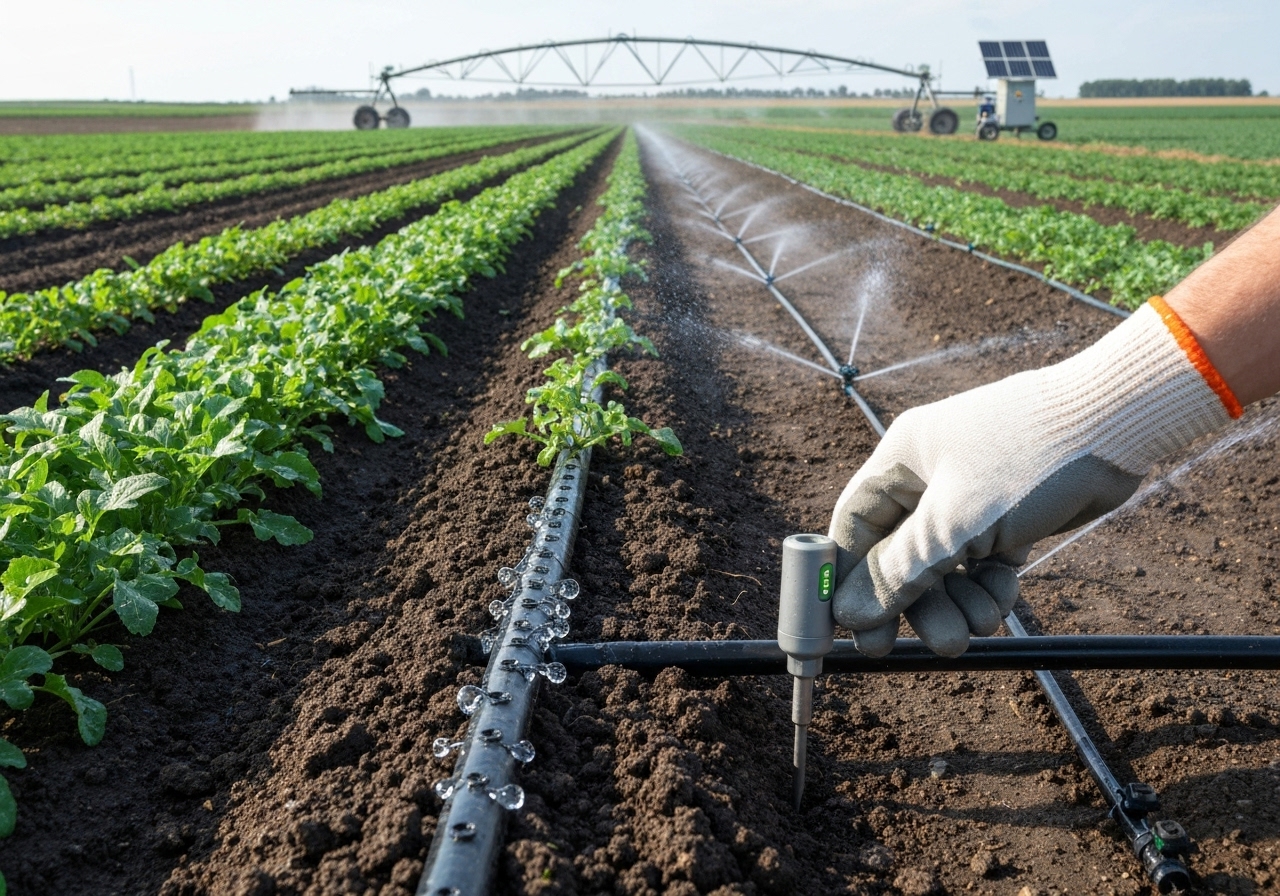
What irrigation technologies reduce water use field-by-field? Use micro-irrigation systems, soil moisture sensors, automated valves, and pressure-compensated delivery to target water exactly where and when needed.
Drip and subsurface drip irrigation
Drip systems place water at the root zone and cut evaporation losses; subsurface drip further reduces surface evaporation and improves uniformity for orchards and high-value row crops.
Micro-sprinklers and low-angle sprinklers
Micro-sprinklers suit tree crops and high-density plantings where emitter clogging risk is low and canopy microclimate control is valuable.
Sensor and automation integration

Sensor integration uses real-time soil moisture and weather data to start and stop irrigation events, reducing unnecessary applications and enabling regulated deficit irrigation strategies.
Implement regenerative micro-irrigation techniques for precise delivery that fit multiple farm scales by adapting emitters, filtration and pressure control to each field’s need. For design examples see regenerative micro-irrigation techniques.
How do you design field layout and microclimate zoning for water savings?
How do you design field layout and microclimate zoning for water savings? Divide the farm into water management zones based on topography, soil texture and crop microclimates to prioritize irrigation intensity and timing.
How do you use microclimate maps? Use microclimate mapping to place water-intensive crops in fields with higher AWHC and cooler exposures and move dryland or drought-tolerant crops to shallow soils or hot exposures.
How do you integrate crop maps with rotation and schedules? Align crop maps with rotation plans and planting windows so irrigation demand curves do not peak simultaneously across adjacent fields. See crop mapping and microclimate planning examples at crop mapping by microclimates.
How do you build soil to hold more water?
How do you build soil to hold more water? Increase soil organic matter, soil structure and biological activity through cover crops, compost additions, reduced tillage and targeted microbial amendments.
How do cover crops improve water retention? Cover crops increase porosity, reduce crusting and add organic residues that raise AWHC by 10 to 30 percent over several seasons in many trials (regional research reports).
How do compost and mulches help? Apply 5–30 tons per hectare of compost over time and use surface mulches to reduce evaporation and moderate soil temperature, raising effective plant-available water.
How do soil microbes affect water dynamics? Promote specific microbial communities that enhance aggregation and root-microbe interactions. For methods to design on-farm microbial solutions see microbial consortia to enrich soil.
What are the field-by-field steps to implement irrigation scheduling?
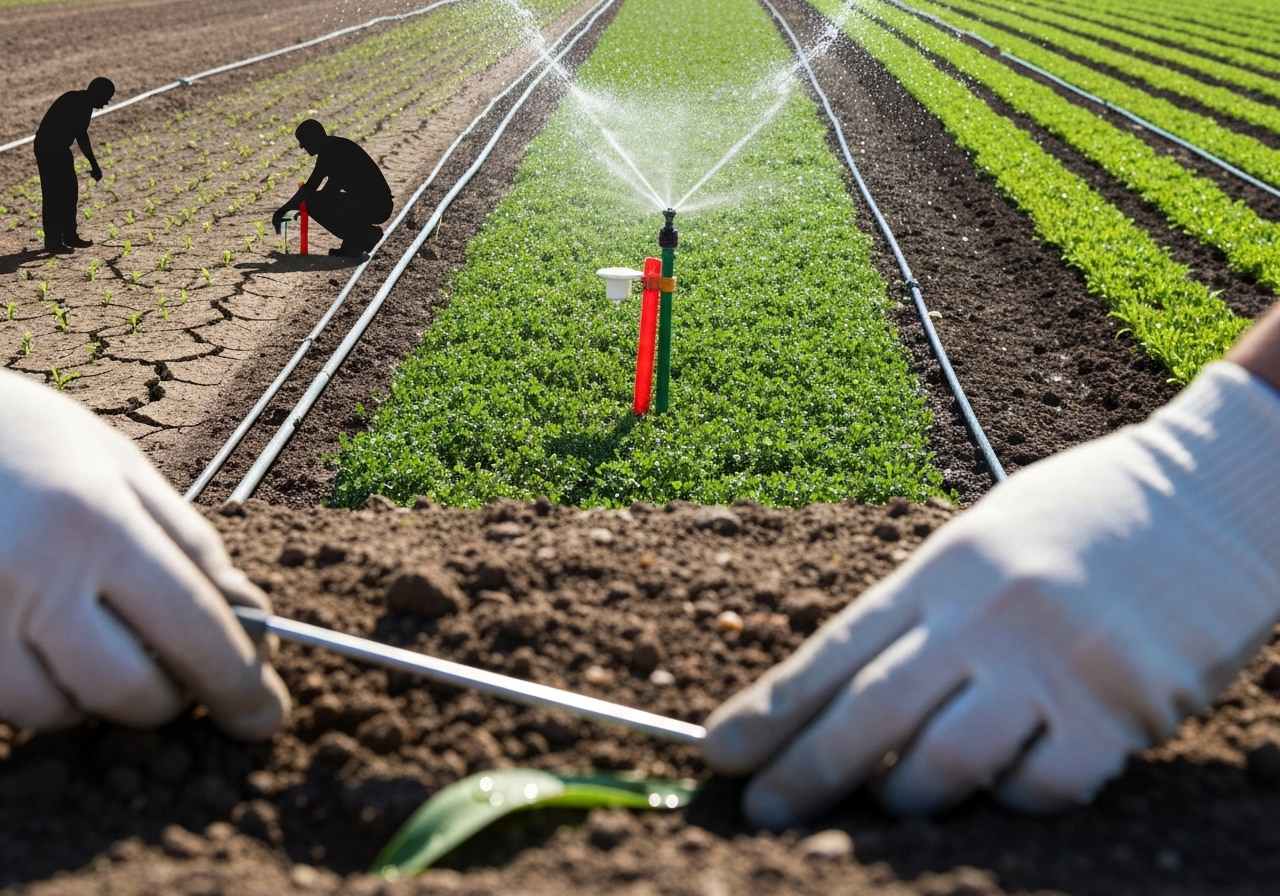
What are the field-by-field steps to implement irrigation scheduling? Step 1: Calculate crop water requirements using ET and crop coefficients for each field and crop stage.
What is Step 2? Install soil moisture sensors at representative locations and depths and develop a depletion threshold (for example 50–70 percent of available water) to trigger irrigation.
What is Step 3? Use weather-based ET models supplemented with local weather stations to adjust irrigation events in response to real-time conditions.
What is Step 4? Record each irrigation event, water volume applied and yield outcomes to refine coefficients and depletion thresholds every season.
How do you apply deficit and precision irrigation strategies?
How do you apply deficit and precision irrigation strategies? Use regulated deficit irrigation on tolerant growth stages to reduce water without sacrificing final yield or quality in many crops.
How do you zone for precision irrigation? Combine pressure-regulated manifolds and multiple zones per field to vary runtime by soil type and plant vigor, reducing average application depth across a field.
What field-level conservation practices combine with irrigation to save water?
What field-level conservation practices combine with irrigation to save water? Implement mulches, contour farming, cover crop strips, windbreaks, hedgerows and managed fallows to reduce evaporation, erosion and runoff.
- Apply 5–10 cm of organic mulch where feasible to cut surface evaporation by 30–60 percent.
- Use contour planting and terraces on slopes to slow runoff and increase infiltration.
- Establish vegetative buffer strips to capture runoff and recycle nutrients.
What about crop choice and rotation? Choose drought-tolerant varieties and stagger crop water demands across the farm through adaptive crop rotations to even out seasonal irrigation peaks. See adaptive rotation planning for low-input farms at adaptive crop rotation plans.
How should you harvest, store and reuse rainwater and runoff on each field?
How should you harvest, store and reuse rainwater and runoff on each field? Locate small on-farm storage ponds or tanks downslope of fields to capture runoff for later irrigation, and size systems based on seasonal rainfall and crop demand.
How do you calculate a storage size? Estimate seasonal demand per field, subtract expected rainfall, and design storage to hold the difference for dry weeks plus a safety margin of 10–20 percent.
How do you divert and filter runoff? Use silt traps and vegetative settling basins to reduce sediment and maintain water quality for reuse through drip filtration systems.
How do you finance field-level water conservation and measure ROI?
How do you finance field-level water conservation and measure ROI? Combine grants, low-interest loans, on-farm savings from reduced pumping and energy, and potential revenue streams such as ecosystem service payments to fund upgrades.
How do you calculate simple payback? Divide installation cost for a field system by annual savings in pumping, water purchases and labor. Typical paybacks for drip retrofits range from 3 to 8 years depending on energy costs and crop value (regional extension data).
How do you track performance? Use monthly metrics: liters applied per kilogram yield, energy used per cubic meter, and percent of fields meeting target moisture thresholds. Report these metrics to lenders or grant agencies to qualify for additional support.
How do you operate and maintain field systems long term?
How do you operate and maintain field systems long term? Implement a maintenance schedule for filtration cleaning, pressure checks, emitter flushing and sensor calibration, and keep a logbook per field with dates and results.
How often conduct maintenance? Inspect filters weekly during season, flush lines monthly, and calibrate sensors at the start and midpoint of each growing season.
How to train staff? Train at least two operators per farm on system basics, emergency shut-off procedures and simple diagnostics to avoid downtime during critical irrigation windows.
What common pitfalls should farmers avoid?
What common pitfalls should farmers avoid? Avoid mismatching emitter spacing with root zones, under-sizing pumps for future scaling, and skipping filtration which leads to frequent clogging.
What are data pitfalls? Avoid relying on a single sensor point to represent an entire field; place multiple sensors across soil and topographic variability to prevent under- or over-irrigation.
How do you scale successful field pilots across the farm?
How do you scale successful field pilots across the farm? Pilot the roadmap on 1–3 fields with different soils and crops, document water use and yield changes for a full season, then scale in phases based on cost-effectiveness.
How to standardize protocols? Create an irrigation protocol checklist and a field map that specifies emitter types, pressure settings and sensor depletion thresholds for each field category to ease replication.
Which metrics prove success for field-by-field water conservation?
Which metrics prove success for field-by-field water conservation? Use 1) cubic meters of water applied per hectare, 2) water productivity (kg yield per m3), 3) energy cost per m3, and 4) percent of fields within target moisture bands as primary KPIs.
Which target reductions are realistic? Aim for 15–30 percent water reduction in year one for retrofits and 25–40 percent over three years with soil and crop changes, per regional trials and extension research.
Where can farmers find technical resources and training?
Where can farmers find technical resources and training? Seek local extension services, NGO programs, irrigation associations and private consultants for system design, sensor calibration and grant applications.
Where to integrate new research? Integrate advances in AI-enabled sensors and remote sensing for field monitoring as they become affordable; examples of sensor-guided approaches are available from technology demonstrations and university extension bulletins.
How does this roadmap support climate resilience and farm profitability?
How does this roadmap support climate resilience and farm profitability? By reducing water use per unit yield and increasing soil water buffers, the roadmap increases drought resilience, stabilizes yields and lowers variable costs, improving profitability and risk management.
How does improved soil health contribute? Improved soil increases infiltration during storms and retains more plant-available water during dry spells, which reduces irrigation demand and crop stress in extreme years.
Which next steps should a farmer take this season?
Which next steps should a farmer take this season? Step 1: Map fields and install at least one soil moisture sensor per representative soil type. Step 2: Run an irrigation system audit and fix obvious leaks. Step 3: Pilot a drip or micro-sprinkler zone and record water and yield data.
Which documentation to keep? Keep a field workbook with baseline maps, infiltration test results, irrigation events, sensor logs and yield outcomes to refine the roadmap annually.
What related practices improve the roadmap outcomes?
What related practices improve the roadmap outcomes? Practices that complement water conservation include regenerative grazing adjacent to croplands, polyculture plantings to reduce peak water demands, and agroforestry that shades fields and reduces evaporative loss.
What additional resources are available on farm resilience and new technology integration? Explore posts on microbial seed coatings, AI-guided practices and microclimate farming in the farm innovation series to further improve water use and resilience across small farms.
What internal resources from this site are recommended? Review practical articles on micro-irrigation design, microclimate crop maps and microbial soil enrichment to customize the roadmap for your operation. Useful references: regenerative micro-irrigation techniques, crop mapping by microclimates, and microbial consortia to enrich soil.
How to get started now with minimal cost?
How to get started now with minimal cost? Start by fixing leaks, adjusting timers to avoid daytime evaporation, establishing mulches around young plants, and planting cover crops — low-cost steps with immediate water savings.
How to test low-cost improvements? Use a single trial bed to compare mulch versus no mulch and track irrigation volume and plant stress for four weeks to quantify savings before scaling.
Who should you contact for customized design and funding help?
Who should you contact for customized design and funding help? Contact local extension agents, irrigation equipment suppliers, and agricultural finance programs for on-site assessments and program eligibility checks.
Who writes reports for grants? Prepare concise technical and economic summaries from your pilot data to support grant applications and to demonstrate expected paybacks to lenders or partners.
Additional references and research
Additional references and research include FAO irrigation guidelines, USDA irrigation efficiency studies and peer-reviewed work on soil organic matter impacts on water holding capacity. Cite local extension findings for region-specific numbers when planning.


