
Top Green Manure Crops for Small Farms and Microplots
Top Green Manure Crops for Small Farms and Microplots
Green manure crops are short- to medium-term plantings grown primarily to build soil fertility, add organic matter, suppress weeds, and improve soil structure on small farms and microplots. This guide identifies the most effective green manure species and mixes for small-scale growers, gives seeding rates and timing tailored to microplots, explains establishment and termination methods, and links practical management to rotation and soil biology strategies for resilient, low‑input farms.
What are green manure crops and why should small farms use them?
Green manure crops are cover crops grown to be incorporated or terminated to enrich soil rather than harvested for food.
Green manure crops deliver six direct benefits useful to small farms and microplots:
- Fix atmospheric nitrogen (legumes) and increase nutrient availability.
- Build organic matter and improve soil structure and water infiltration.
- Suppress weeds and reduce erosion by rapid canopy closure.
- Break pest and disease cycles when used in rotation.
- Support soil biology and microbial diversity that increase nutrient cycling (see research from NRCS and university extensions for regional evidence).
- Provide floral resources for pollinators and beneficial insects when flowering species are used.
Which green manure crops are best for small farms and microplots?
Here are the top green manure crops and why each fits micro-scale systems.
Hairy vetch (Vicia villosa)
Hairy vetch is a winter-hardy legume that fixes notable nitrogen and produces dense biomass; it is a go-to winter cover for small farms.
- Seeding rate: 20-30 lb/acre (.5-.7 lb per 1,000 sq ft).
- Planting window: late summer to early fall for overwintering; can be interseeded with cereal rye.
- Benefits: fixes N, reduces erosion, smothers weeds in spring; pairs well with cereal rye to improve cover persistence.
- Notes: termination can be harder if allowed to set seed; crimping/mowing at flowering is effective.
Cereal rye (Secale cereale)
Cereal rye is a versatile winter cereal used for biomass, weed suppression, and erosion control on small plots.
- Seeding rate: 60-90 lb/acre (1.4-2. lb per 1,000 sq ft).
- Planting window: late summer to late fall for best winter growth.
- Benefits: extensive root system, effective weed suppression, scavenges nutrients, adds carbon to soil.
- Notes: mixes well with legumes to supply both carbon and nitrogen; roller-crimp works at anthesis.
Sunn hemp (Crotalaria juncea)
Sunn hemp is a fast-growing warm-season legume that produces large biomass and significant nitrogen in 8-12 weeks.
- Seeding rate: 30-60 lb/acre (.7-1.4 lb per 1,000 sq ft).
- Planting window: late spring to early summer for warm-season growth.
- Benefits: quick N contribution, deep rooting, nematode suppression in some soils, excellent for fallow replacement.
- Notes: does not tolerate frost; ideal for long warm seasons or summer windows.
Cowpea (Vigna unguiculata)
Cowpea is a drought-tolerant warm-season legume suitable for short rotations on microplots.
- Seeding rate: 30-40 lb/acre (.7-1. lb per 1,000 sq ft).
- Planting window: late spring through summer; tolerates heat and low moisture.
- Benefits: fixes nitrogen, suppresses weeds, useful where sunn hemp is not established.
- Notes: good under low-input irrigation regimes.
Buckwheat (Fagopyrum esculentum)
Buckwheat is a rapid, short‑duration broadleaf used for quick biomass, weed smothering, and phosphorus mobilization.
- Seeding rate: 40-60 lb/acre (1.-1.4 lb per 1,000 sq ft).
- Planting window: spring to late summer for 6–10 week covers.
- Benefits: fast canopy closure, great for smothering annual weeds and attracting pollinators.
- Notes: winter-kills in cool climates — useful for short-term fertility boosts without mechanical termination.
Sorghum-sudangrass (Sorghum bicolor x S. sudanense)
Sorghum-sudangrass is a warm-season grass that builds bulk organic matter and develops deep roots, helpful on degraded microplots.
- Seeding rate: 30-40 lb/acre (.7-1. lb per 1,000 sq ft).
- Planting window: late spring to early summer under warm conditions.
- Benefits: suppresses nematodes, produces high biomass, improves soil structure with deep roots.
- Notes: mow before seedhead to prevent reseeding; residue breaks down slower than legumes.
Crimson clover and red clover (Trifolium spp.)
Clovers are adaptable legumes for spring and fall plantings providing steady N and floral resources for beneficial insects.
- Seeding rate: crimson 8-10 lb/acre (.2 lb per 1,000 sq ft); red clover 8-12 lb/acre.
- Planting window: crimson for fall/winter in mild climates; red clover for spring or longer-term stands.
- Benefits: stable N contribution, good companion to small grain cereals, supports pollinators.
Phacelia and buckwheat mixes for pollinators
Phacelia and buckwheat flower quickly and provide nectar for bees while covering soil fast.
- Seeding rate: phacelia 4-8 lb/acre combined with buckwheat 40 lb/acre for quick flowering.
- Benefits: excellent pollinator support and short-term weed suppression.
Mustard and brassicas (biofumigant covers)
Mustard species can suppress soil-borne pests and act as biofumigants when incorporated at flowering.
- Seeding rate: 4-8 lb/acre for oilseed radish or mustards.
- Benefits: nematode suppression potential, quick growth, can be used ahead of brassica cash crops with attention to allelopathy timing.
How do seeding rates and row arrangements change for microplots?
Scale seeding rates down geometrically and adapt spacing for hand tools and small seeders.
For microplots use these conversions as starting points:
- Per 100 sq ft: multiply lb/acre rate by .0023 (for example 50 lb/acre => .115 lb ~ 1.8 oz per 100 sq ft).
- Broadcast thinly and rake for small plots, or use a hand-driven seeder for more uniform stands.
- Plant shallower for small seeded species (1/8″–1/4″) and deeper for larger seeds (1/2″–1″).
How should small farmers choose the right green manure for their goals?

Choose based on your primary goal: nitrogen, biomass, weed control, soil structure, or pollinator habitat.
Use this decision checklist:
- If nitrogen is priority, choose legumes (hairy vetch, sunn hemp, clovers).
- If quick weed suppression is needed, choose buckwheat or cereal rye for fast canopy closure.
- If soil rebuilding and deep-rooted structure is required, choose sorghum-sudangrass or sunn hemp.
- If nematode suppression is a problem, consider mustard or sunn hemp.
- If you need winter cover, choose winter-hardy species like cereal rye and hairy vetch.
- Consider microclimate and frost dates; use a local crop map or calendar to refine timing (diversified small-farm crop maps).
How to establish green manures on small plots?
Establish green manures by matching seedbed preparation, sowing depth, and inoculation to the crop.
- Prepare a firm, weed-free seedbed or broadcast into standing crop residues; light till or rake for small plots to ensure seed-soil contact.
- Inoculate legumes with the correct Rhizobium strain before seeding; follow label directions. For small farms, mix inoculant on-seed or use commercially coated seed. See guidance on microbial consortia when designing inoculant blends (on-farm microbial consortia).
- Sow at recommended depth and rate; firm the soil to ensure contact and consistent emergence.
- Manage moisture — irrigate newly sown microplots if in a dry window; many warm-season covers are drought tolerant after establishment.
When and how should small-scale growers terminate green manures?
Terminate at peak biomass or at the start of flowering to maximize benefits and ease incorporation.
Termination options for small farms:
- Rolling/crimping followed by direct seeding of no-till beds where feasible.
- Mowing or flail mowing then incorporating residues with shallow tillage or hand tools.
- Allow winter-kill in climates with reliable frost to avoid mechanical termination.
- Use undercutting or cut-and-leave techniques to retain mulch on the surface.
Wait times after incorporation depend on residue C:N ratio: low C:N legumes often allow planting within 2–3 weeks for transplants; high C grasses may need 4–6 weeks to mineralize enough nitrogen for sensitive seedlings. University extension guides and NRCS publications provide region-specific wait times.
Which green manure mixes work best in small-scale rotations?
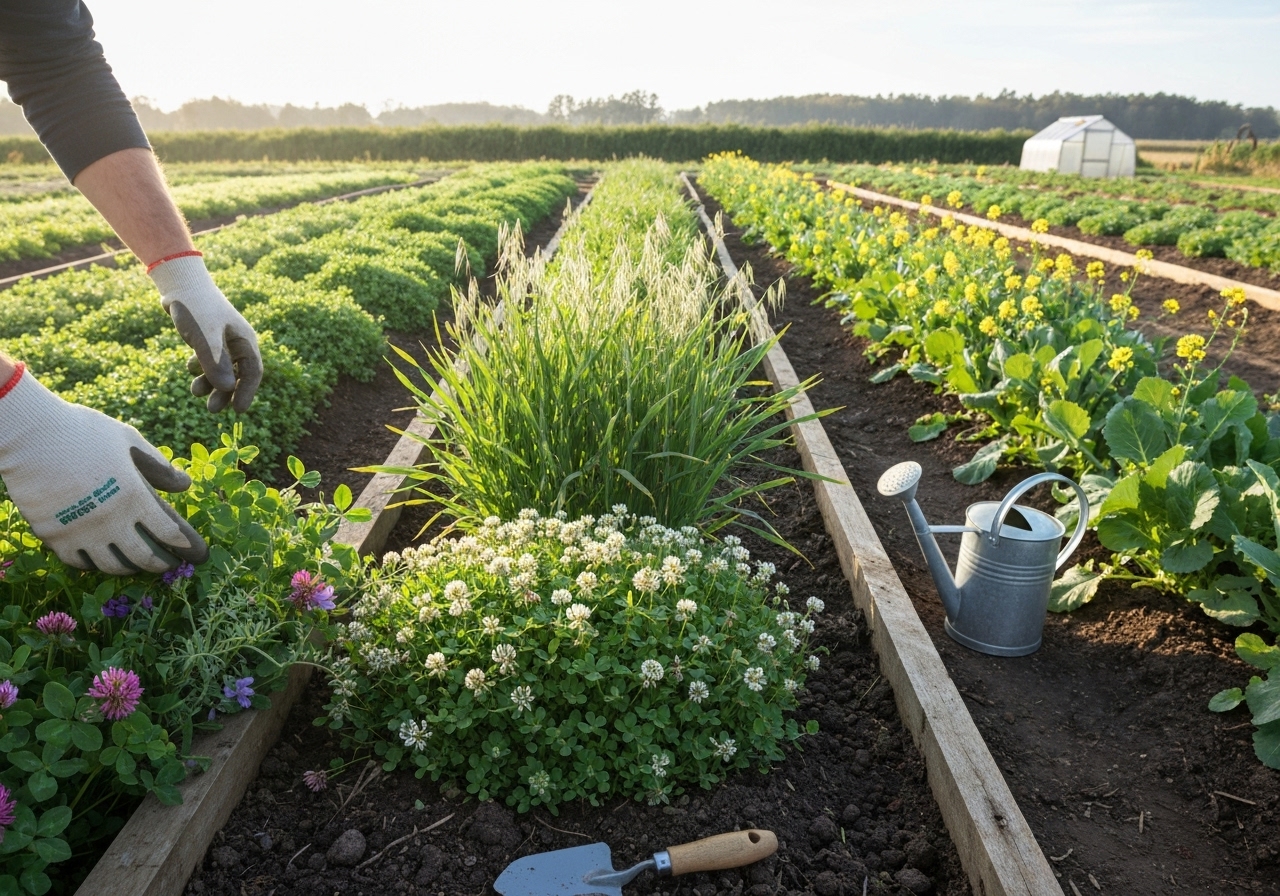
Use mixes tailored to season and rotation needs.
Recommended microplot mixes with seed rates per 1,000 sq ft:
- Winter N-builder: cereal rye 1. lb + hairy vetch .25 lb — long winter cover that supplies N in spring.
- Quick summer biomass: buckwheat 1.2 lb + cowpea .8 lb — 6–10 week summer cover that suppresses weeds and flowers for pollinators.
- Deep organic matter: sorghum-sudangrass .9 lb + sunn hemp .6 lb — heat-season bulk for rebuilding compacted plots.
- Biofumigant/preceding brassicas: oilseed radish .1 lb + mustard .05 lb + buckwheat 1. lb — rotation before sensitive vegetables, manage allelopathy timing.
- Pollinator corridor: phacelia .1 lb + crimson clover .05 lb — short-term flowering strips between beds.
How can small farms integrate green manures into adaptive low-input rotations?
Integrate green manures as fallow replacements, in-row intercrops, or between cash crop cycles to maintain continuous living roots and soil cover.
Plan rotations with these rules:
- Insert a green manure after heavy-feeding crops (e.g., brassicas, solanums) to rebuild nitrogen and organic matter.
- Use a short, fast cover (buckwheat) between quick vegetable crops to reduce weed pressure.
- Alternate legumes and deep-rooting grasses to balance N and carbon inputs and avoid species-specific pests.
- Follow adaptive rotation templates and tailor to seasonal conditions (adaptive low-input rotation plans).
What management tips maximize green manure benefits on microplots?
Manage timing, seed placement, inoculation, and termination to convert green manure into measurable soil improvements.
- Inoculate legumes and consider microbial seed coatings in saline or marginal soils to improve establishment.
- Match sowing date to growth window — late sowings reduce biomass and benefits.
- Use mowing or crimping to terminate while retaining mulch that conserves moisture and suppresses weeds.
- Rotate termination methods to reduce compaction and pathogen carryover from repeated tillage.
- Measure changes in soil organic matter and bulk density annually to document improvements and support regenerative outcomes.
Can green manures help small farms access soil carbon credits or other revenue streams?

Yes, incorporating green manures increases soil carbon and ecosystem services, which can support participation in carbon programs and conservation incentives when documented properly.
Documented practices, including continuous cover and legume-based rotations, are frequently recognized by conservation programs and credit systems; for program specifics consult local NRCS or soil carbon program providers. Articles on soil carbon markets for small farms provide pathways to quantify and monetize these benefits (small farm soil carbon credits).
What are common troubleshooting issues and how to avoid them?
Address establishment failures, weed competition, pest attraction, and allelopathy proactively.
- Poor establishment: improve seed-soil contact, check planting depth, and ensure moisture at sowing.
- Weeds: choose fast-closing species like buckwheat or rye in high-weed-pressure plots; manage seedbanks over multiple seasons.
- Pests and diseases: use diverse mixes and rotate families; avoid repeated brassica covers when brassica cash crops follow immediately.
- Residue allelopathy: allow 2–3 weeks after incorporation of brassicas or juglone-producing plants before planting sensitive crops; test on a small bed first.
What quick-reference green manure plan should a small farmer use this season?
Use a three-step microplot plan: plan, plant, and terminate.
- Plan: pick species based on season and rotation goal; consult microclimate maps and frost dates to set sowing dates.
- Plant: prepare seedbed, inoculate legumes, sow at microplot rates, and water if needed for establishment.
- Terminate: cut or crimp at flowering or peak biomass; incorporate or leave as mulch and time cash crop planting based on residue C:N.
For scheduling by microclimate and bed mapping, use diversified crop calendars tailored to small-farm maps and zones (diversified small-farm calendar).
Frequently asked questions (short answers)
Do legumes always add usable nitrogen?
Legumes fix nitrogen but the crop that follows receives N only after decomposition; timing of termination and C:N ratio determine release speed.
Can I use green manures in raised beds and containers?
Yes; use smaller seed rates, shallow-rooted species like clovers or buckwheat, and incorporate or cut as mulch to avoid root-bound residues.
Are green manures compatible with no-till or reduced-till systems?
Yes; roller-crimping and cut-and-leave methods allow no-till cash crop planting into terminated green manures where equipment and timing allow.
How long before I see measurable soil improvements?
Soil biology and infiltration can improve within one season; measurable organic matter increases typically require 3–5 years of consistent cover cropping and reduced disturbance (as documented by extension studies and NRCS guidance).
Where to learn more and next practical steps?
Read regional extension publications and NRCS cover crop guides for local seeding rates and termination windows. Integrate green manures with microbial management and seed coating strategies to improve establishment and resilience; see resources on designing microbial consortia for on-farm soil enrichment and consider linking green manure plans to low-input rotations for resilient yields.
Start small: test one species or mix on a single bed this season, track biomass and cover persistence, and adapt seed rates and timing the next season. Combining green manures with careful rotation planning and microbial management creates durable soil improvements on small farms and microplots.
References and resources
Guidance and data referenced throughout this article are based on NRCS and university extension cover crop guides, Rodale Institute studies on cover cropping, and multiple extension publications on green manures and small-scale rotations.


